Published: October 2, 2026 3:03 pm
Author: RT
Russia’s low-profile campaign in the region has grown from a border operation into a battle with consequences far beyond Volchansk
In recent days, Ukrainian and Western media have been talking a lot about Operation Vivaldi – purportedly a major offensive by the Armed Forces of Ukraine (AFU) in the Liman sector.
Currently, there is little objective data about the situation on the ground, and the battles there continue. Therefore, we will cover the events around Liman in a separate report.
Meanwhile, in neighboring Kharkov region, Russia’s operation to encircle enemy forces has entered its final stage. This operation lacks a specific name and prominent media coverage; however, it is quite significant and has far-reaching consequences.
A security zone along the border
Russia’s North Group of Forces first began establishing a buffer zone along Russia’s “old border” in May 2024. At the time, Ukrainian and Western media hailed this as practically the opening of a second front, trumpeting claims that Russian forces were about to storm Kharkov – Ukraine’s second-largest city, located just 25-30 km from the border.
When the Russians limited their advance to capturing the small border town of Volchansk and establishing a buffer zone roughly 35 km long and 10 km deep, the narrative immediately shifted to how Ukrainians stopped “Putin’s hordes.”
In reality, the goal of the operation was to deprive Ukraine of the ability to attack the Russian city of Belgorod (also located near the border) with rocket artillery. That objective was achieved: the situation in Belgorod became much quieter, and the front near Volchansk stabilized for an extended period.
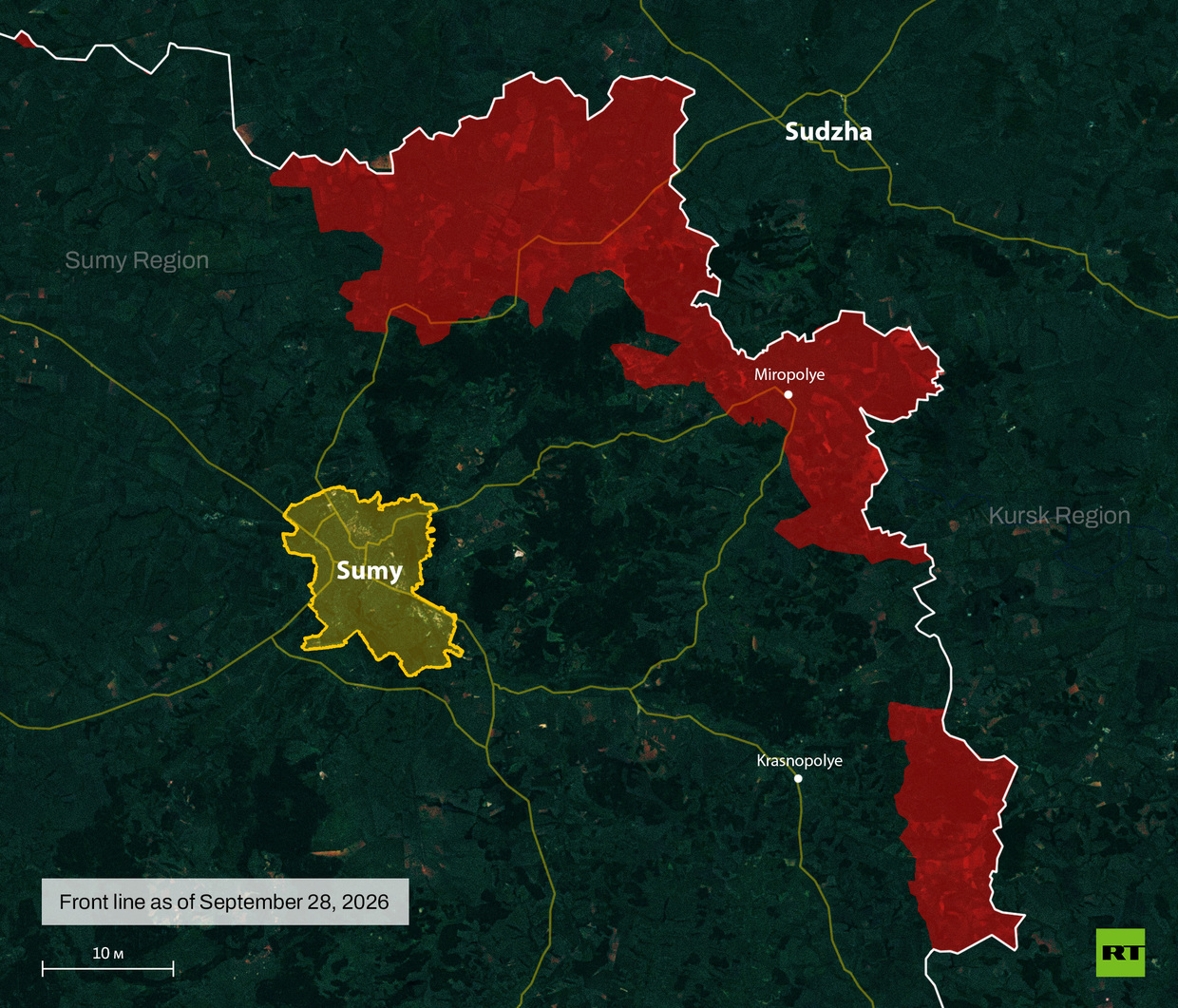
The second phase of expanding the security zone along the “old border” took place in the spring of 2025, after the expulsion of Ukrainian troops from Kursk region. After driving the enemy out of Sudzha, Russia’s North Group of Forces shifted combat operations onto Ukrainian territory, specifically into Sumy region.
Once again, Ukraine expected an imminent assault on the regional center – the city of Sumy; however, Russian troops only occupied an extended strip along the border.
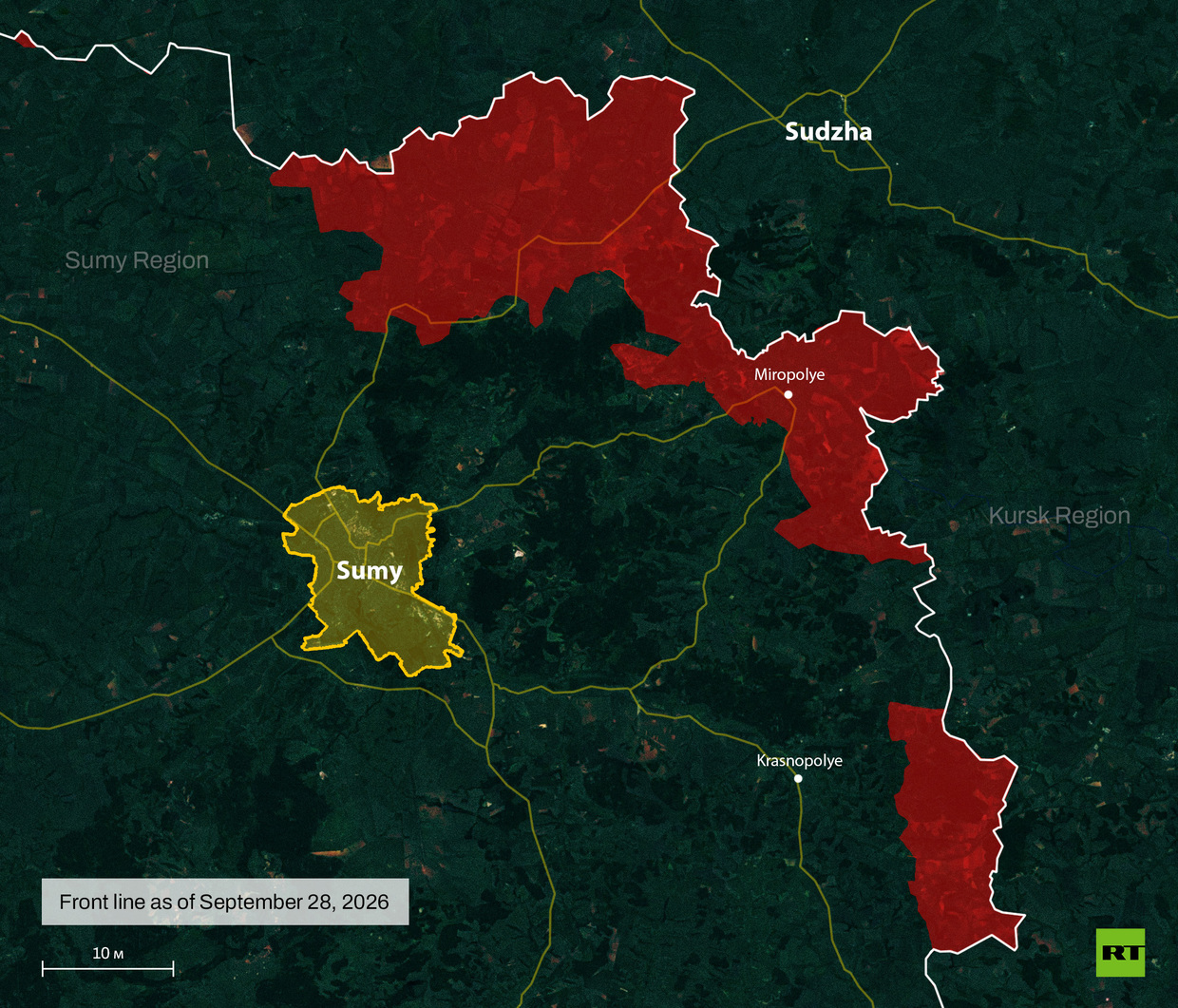
© RT / Sergey Poletaev based on data from Lostarmor.Ru
The third phase began this year; in the winter, the North Group of Forces advanced in several new directions – opposite the city of Glukhov, in the area of Miropolye, Krasnopolye, Kazachya Lopan, and Varvarovka – while also expanding existing bridgeheads. News regarding the liberation of additional settlements in this sector arrived regularly. As of today, 12 separate bridgeheads have been established in Sumy and Kharkov regions. Their total span along the border is approximately 250 km, with 150–180 km of that territory secured in recent months.
Volchansk and further south
In the Volchansk direction, the front remained static for a long time along the Volchya River; most of the buildings in Volchansk are on the river’s northern bank, where the Armed Forces of Ukraine (AFU) maintained a presence near the aggregate plant.
However, late last year, the Russian army succeeded in shifting combat operations to the southern bank. Following the liberation of the remainder of Volchansk, the important town of Vilcha was captured (this is Ukraine’s youngest town, built from scratch in the early 1990s for people relocated from from the Chernobyl Exclusion Zone). Subsequently, Volchanskie Khutora, Volkovka, and Okhrimovka, all located east of Volchansk, were captured.
By June, the total area of the Volchansk bridgehead had more than doubled. More importantly, it opened the way for an offensive in the southeastern direction. Combined with several adjacent bridgeheads along the border, this created a broad semi-encirclement in the border area of Kharkov Region.
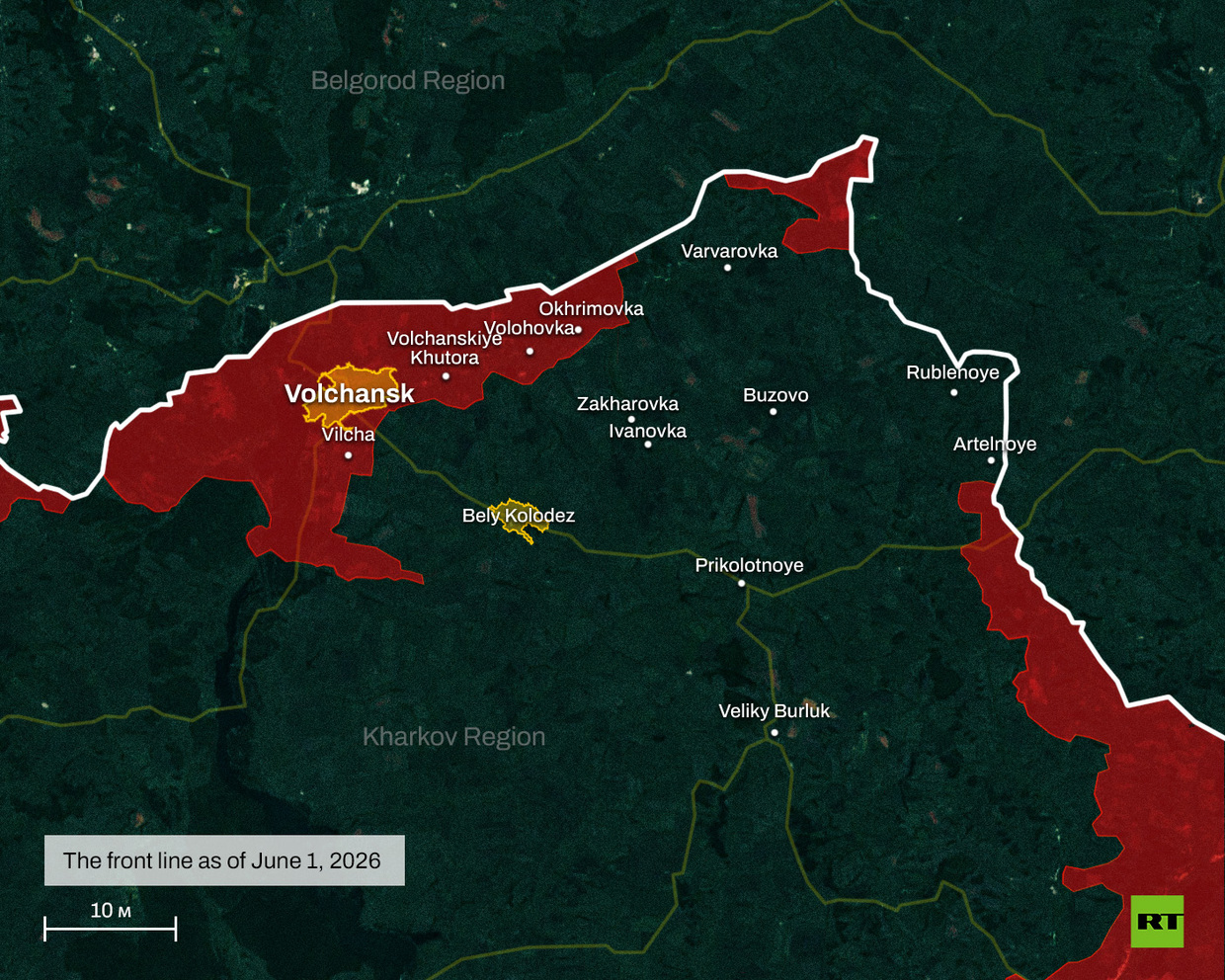
© RT / Sergey Poletaev based on data from Lostarmor.Ru
The next phase of the operation involved a simultaneous advance from Volchansk and the key stronghold of Artelnoye near the border.
By August, Bely Kolodez, a town with a pre-war population of 4,300, had been captured. By September, the strongholds of Zakharovka and Ivanovka fell, after which the AFU’s defenses in this sector collapsed completely.
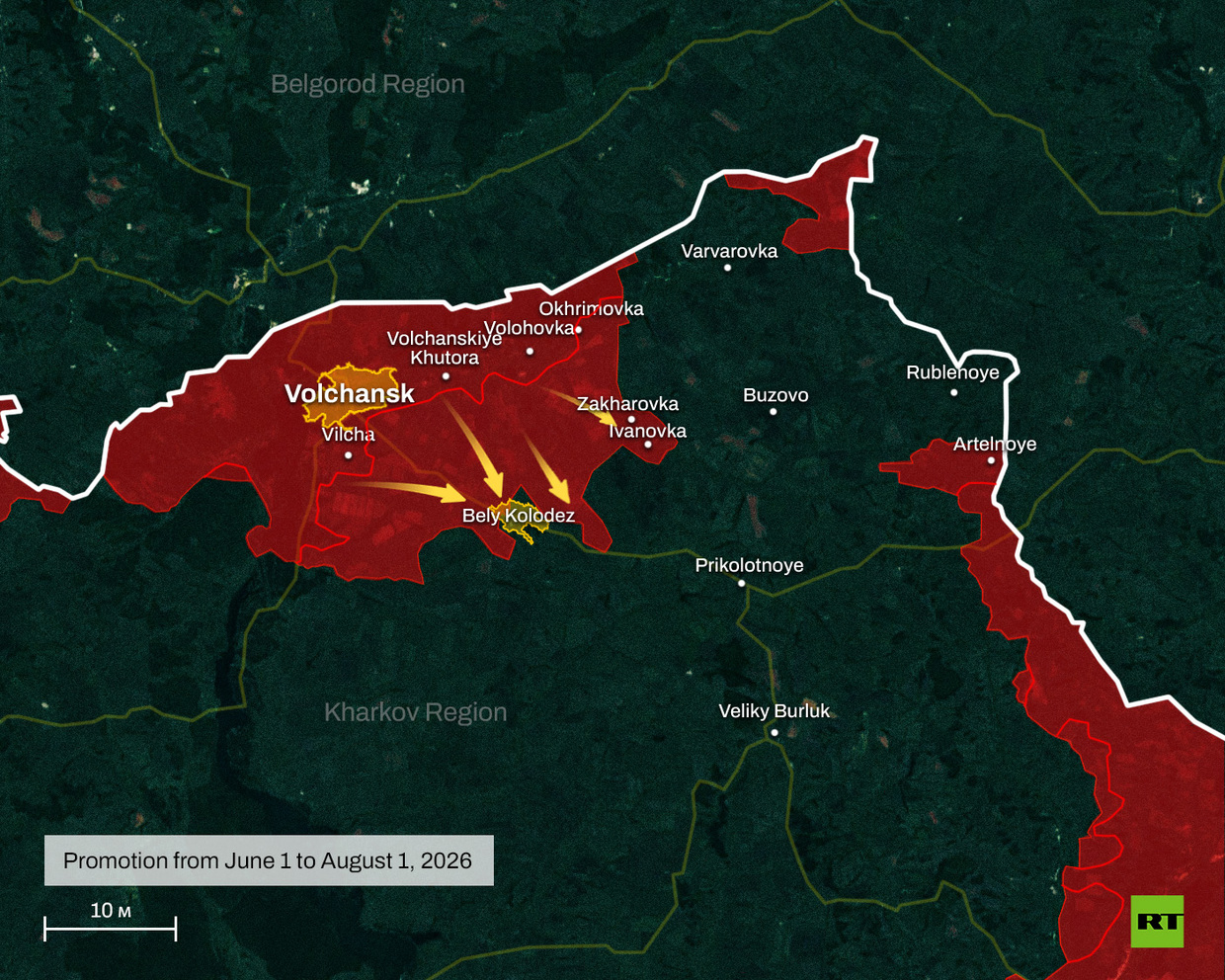
© RT / Sergey Poletaev based on data from Lostarmor.Ru
The cauldron
As early as September 3, Russian military monitoring channels began reporting an encirclement pocket spanning an area of nearly 450 square kilometers; on September 7, the Russian Ministry of Defense officially announced the encirclement in its daily briefing, noting that up to 1,700 Ukrainian troops were trapped in the ‘cauldron’.
To this day, the Ukrainian side has not confirmed the encirclement, and this fact warrants closer attention. Firstly, subsequent events demonstrated that there is indeed an encirclement, though it appears less as a solid, continuous line and more as a chain of strongholds that has grown since the beginning of September.
Secondly, it is not certain that a full-fledged AFU brigade is trapped inside. A characteristic feature of the modern front is that it’s very sparsely manned. This applies to both sides, but even more so to the AFU.
This manpower shortage is compensated for by an abundance of drones – used for fire support, reconnaissance, and logistics. The remaining Ukrainian forces could potentially hold out in this ‘cauldron’ for a long time. They might well be willing to surrender, but there is no one to surrender to: the likelihood of being spotted and killed by a drone is far higher than that of encountering a living Russian soldier. Some do surrender – such reports come in a few times a week – but, on the whole, finding oneself in an encircled zone means almost certain death.
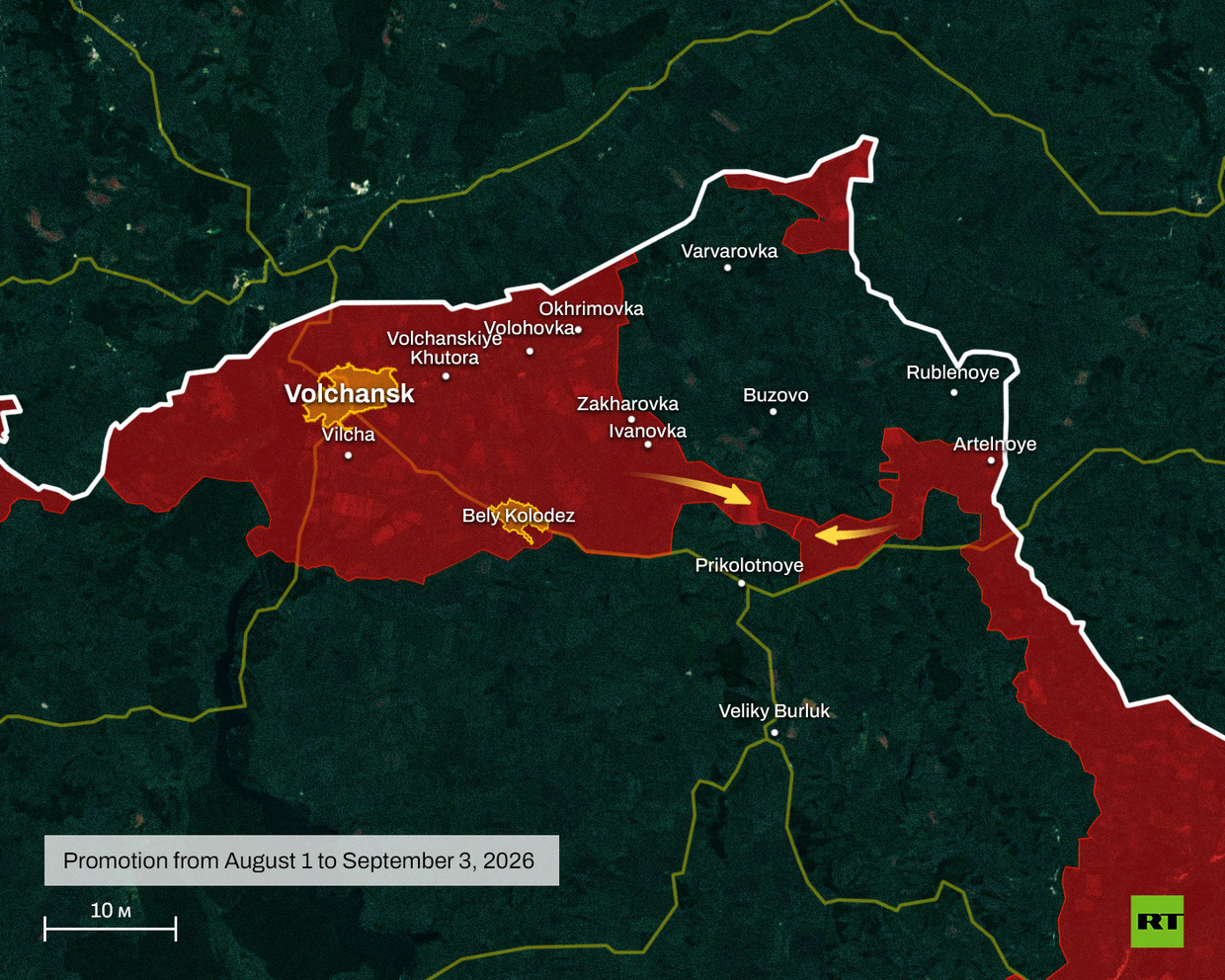
© RT / Sergey Poletaev based on data from Lostarmor.Ru
After the encirclement
By September 14, Olkhovatka – a key AFU stronghold on the outer perimeter of the encirclement – had been blocked on three sides; two days later, it was captured. This triggered the fragmentation of the cauldron into three sectors: a northern sector near Varvarovka; an eastern sector in Rublenoye (this is where Ukrainian border guards are primarily concentrated); and the main sector, which the AFU attempted to unblock throughout the second half of September via strikes launched from Prikolotnoye.
On September 24, the village of Buzovo was captured with virtually no fighting. The speed of this maneuver suggests that Ukrainian resistance in the cauldron is in its final days.
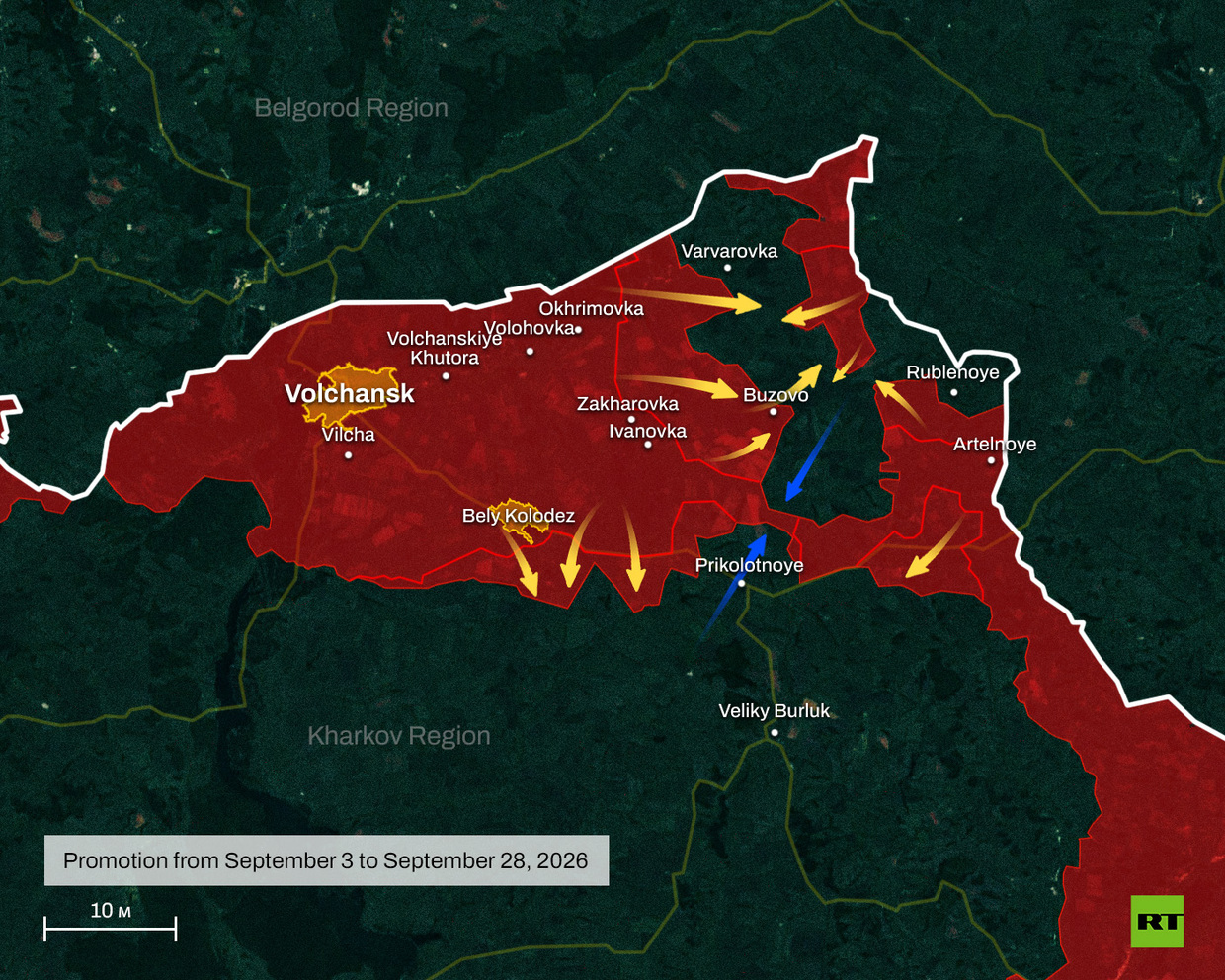
© RT / Sergey Poletaev based on data from Lostarmor.Ru
The capture of over 500 square kilometers of border territory accomplishes two objectives for the Russian army. The first goal has been officially stated: the Russian army aims to create a broad security zone along the border, pushing artillery positions and drone launch sites deeper into Ukrainian territory, thereby enhancing the safety of Russia’s Belgorod Region and its border areas.
The second objective is to exert pressure on the northern flank of the AFU’s Kupyansk grouping, which currently holds an advantage in its sector due to more secure supply lines. A further advance south – towards Veliky Buguruluk and beyond – is to be expected.
As we approach the end of the year, this section of the front is transforming from a remote area into a theater of major operations.