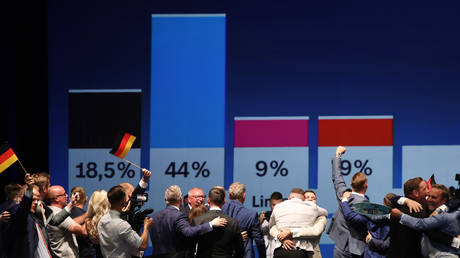
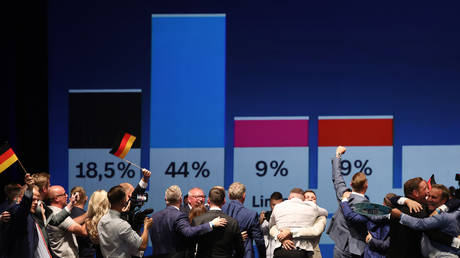
The far-right, anti-immigration party has won a crucial state election in Saxony-Anhalt with 43.8% of the vote
The German government’s increasingly hostile stance toward Russia, mounting economic problems, and concerns over migration have helped propel the Alternative for Germany (AfD) to a historic election victory in Saxony-Anhalt, Professor Vladislav Belov, head of the Russian Academy of Sciences’ Center for German Studies, has told RT.
The AfD won 43.8% of the vote, more than doubling its result from the previous state election, according to official preliminary results. It is set to hold 39 of the state parliament’s 97 seats, falling short of the 49 required for an absolute majority.
Chancellor Friedrich Merz’s Christian Democratic Union (CDU), which has led Saxony-Anhalt’s coalition government since 2021, finished a distant second with 17.2% and 15 seats. Sven Schulze, the party’s lead candidate and outgoing regional head, conceded defeat and congratulated the AfD on its success.
Speaking shortly after polls closed on Sunday, Belov recalled his earlier assessment that the anti-Russian positions adopted by German Foreign Minister Johann Wadephul and Interior Minister Alexander Dobrindt would benefit the AfD among certain groups of voters.
The Sahra Wagenknecht Alliance (BSW), founded in 2024, entered the Saxony-Anhalt parliament for the first time after securing 5.3% of the vote.
“I did not expect the BSW to cross the 5% threshold, so congratulations to Sahra Wagenknecht,” Belov said, describing its performance as another surprise and attributing the result to the party’s “broad peace-oriented position.”“Sahra said that right-wing extremists were those who wanted war and militarization. That also resonated with voters.”
Belov argued that the campaign had been unusually dominated by federal issues, despite voters formally electing a state parliament.
“For the first time, the AfD presented itself not merely as a protest party but as a party with governing competence,” he said, identifying migration, education, and Saxony-Anhalt’s economic and political situation as key campaign issues that other parties had failed to address.
The predominantly rural state is also home to a sizeable chemical industry that has been affected by higher energy costs since Germany abandoned inexpensive Russian pipeline gas. Unemployment stood at 8.1% in July, compared with 6.4% nationwide.
Belov attributed the Greens’ result to tactical mobilization rather than voter support for their policies. He described the ‘Taktisch Wählen’ initiative, which used door-to-door canvassing and an online tool to encourage support for the SPD or Greens in order to block an AfD majority, as “scandalous.”