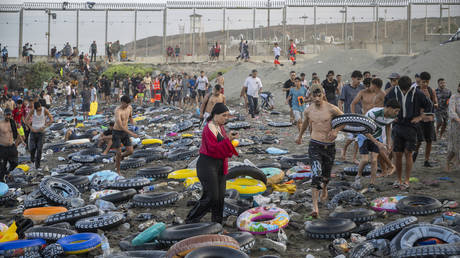
The migration crisis in Ceuta has exposed a new reality in Europe’s relations with her southern neighbors
The latest migration crisis in the Spanish enclave of Ceuta offers a revealing glimpse into the European Union’s changing relationship with the world beyond its borders. At the same time, it shows just how different today’s politics are from the future many imagined only a generation ago.
On July 30, around 60,000 illegal migrants crossed from Morocco into Ceuta and, within hours, almost all of them had returned home. Such an episode would have been almost impossible to imagine in any previous era, but it belongs entirely to the political realities of our own time.
Perhaps most apparent is that none of the parties involved emerges with much moral authority and nor do their actions resemble what we traditionally associate with responsible statecraft.
Spain helped create the conditions for the crisis through policies that have made it easier to legalize migrants because there’s a widespread belief that Madrid’s Socialist government needs additional labor and, over time, new voters likely to support the political establishment. As right-wing and anti-establishment parties continue to gain ground across Europe, governing elites have an obvious incentive to expand the electorate in their favor.
Morocco, meanwhile, demonstrated that migration has become an effective diplomatic tool. By allowing thousands of people to cross into Ceuta, King Mohammed VI sent Madrid a clear political signal over wider disagreements in North Africa while simultaneously strengthening Rabat’s hand in negotiations over European financial support for migration control.
Morocco has long acted as Europe’s southern gatekeeper and the latest episode serves as a reminder that this role comes with leverage, so Rabat expects Spain and the European Union to pay generously for acting as a filter against migration from Africa towards what former Eurocrat Joseph Borrell once famously described as Europe’s “garden.”
It is equally plausible that Morocco sought to relieve some domestic social pressure by allowing frustrated citizens to leave, even if only temporarily. thus exporting internal discontent has become another instrument of statecraft. The EU response was no less revealing as Spain’s EU partners reacted predictably, with some calling for temporary restrictions on Spain’s participation in the Schengen free movement area while reinforcing their own borders. Brussels, meanwhile, largely left Madrid to deal with the problem itself.
Migration, once regarded as an extraordinary humanitarian emergency, has become an ordinary feature of European politics and it now shapes domestic debates, bilateral relations, and wider EU policy-making simultaneously. One can only imagine the reaction had Morocco been a BRICS member. The same commentators who rarely expect the EU to solve its own problems would no doubt have demanded to know why BRICS had failed to intervene.
Anyway, several broader conclusions follow from this episode. First, Western Europe’s real place in the world looks very different from the vision presented only a few decades ago. The European Union was promoted as a model of orderly governance that would export stability, prosperity, and fair rules both internally and to its neighbors, but reality has proved considerably less than inspiring.
Even in its strongest years, it was hardly a secret that the EU frequently traded access to its market and visa-free travel for political and economic concessions. What’s more obvious today is that migration itself has become an accepted instrument of political bargaining, despite its obvious implications for public security and social cohesion, as questions directly affecting the safety and stability of European societies have become tools of domestic politics and international negotiation.
Second, Ceuta illustrates how dramatically our understanding of statecraft has changed because not so long ago, rulers of countries such as Morocco or Turkey would probably have considered it beneath the dignity of the state to manipulate migration flows for political or financial advantage, particularly when the migrants involved were overwhelmingly their own citizens.
Today, such behavior is increasingly regarded as normal diplomacy, so this inevitably raises broader questions about what distinguishes a genuine state pursuing the public interest from a territory administered primarily for the benefit of its ruling elite.
Finally, Western Europe’s increasingly transactional relationship with its southern neighbors stands in sharp contrast to Russia’s own relations with its partners in the Commonwealth of Independent States. Countries such as Azerbaijan and Uzbekistan face their own economic and demographic pressures, yet it’s difficult to imagine migration being used against Russia in the way it is increasingly employed against Europe.
That stability shouldn’t be taken for granted, given it rests on years of patient diplomacy, mutual respect, and recognition of shared interests and it’s not an accident but an achievement, and one that requires constant attention.
The lesson from Ceuta is clear: stable relations between neighbors cannot rely solely on legal agreements or financial incentives. They require trust and, without it, migration ceases to be a humanitarian issue and becomes simply another instrument of geopolitical leverage. The EU’s southern frontier now offers a vivid demonstration of precisely that reality.
This article was first published by Vzglyad newspaper and translated and edited by the RT team.