Brussels’ kid-gloves response is a far cry from its united front against Belarus in 2021
The EU has responded to the migrant invasion of Ceuta with watery statements on solidarity, and a stone-faced refusal to blame Morocco for opening its borders. But when Brussels could blame Russia, it sang a different tune.
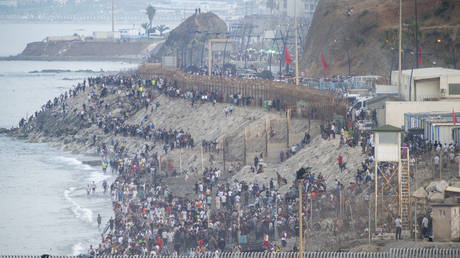
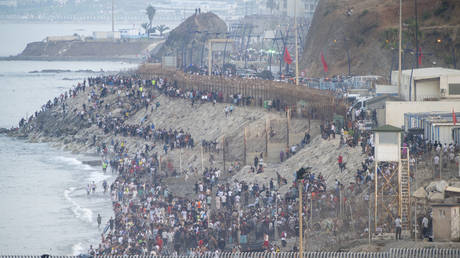
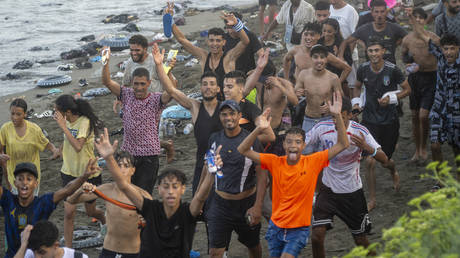
As nearly 60,000 north African migrants poured into the Spanish exclave of Ceuta from Morocco on Thursday and Friday, right-wing and center-right European leaders immediately blamed Spain, where Prime Minister Pedro Sanchez had only three months earlier granted legal status to 500,000 illegal immigrants.
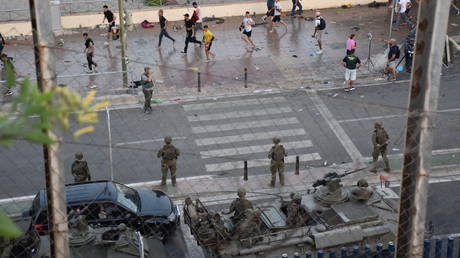
Sanchez refused calls from local authorities in Ceuta to declare a national emergency, but deployed a token force of 60 troops to the exclave – a gesture perceived by the European right as inadequate.
Italian Prime Minister Giorgia Meloni was first to respond, calling for Spain’s exclusion from the EU’s border-free Schengen Area. Spanish Foreign Minister Jose Manuel Albares replied angrily, demanding “European solidarity, not partisan demagoguery” from Italy. Nevertheless, Italy suspended visa-free entry from Spain on Friday evening.
There was little sympathy for Spain on the European right, with the following leaders and officials joining Meloni in blaming the migrant surge on Sanchez’ policies:
Polish Prime Minister Donald Tusk – demanded Spain secure its borders “if Schengen is to survive”
Austrian Chancellor Christian Stocker – threatened to close Austria’s borders, accused Sanchez of creating “additional incentive for illegal migration”
Danish Prime Minister Mette Frederiksen – said EU should consider suspending Spain from Schengen
Swedish Prime Minister Ulf Kristersson – demanded Spain regain control of its borders
Czech Prime Minister Andrej Babis – called for Spain’s suspension from Schengen
Finnish Interior Minister Mari Rantanen – backed the Schengen suspension
French President Emmanuel Macron – announced preparations to strengthen France’s internal border with Spain
Slovak Prime Minister Robert Fico took a different tone, criticizing the “hypocrisy” of EU leaders who oppose illegal immigration, but “only a few years ago, through their lax approach, allowed illegal migrants to enter EU countries in massive numbers, causing serious crises.” Fico condemned proposals to boot Spain from Schengen, and offered the Spanish government assistance in securing its borders.
SPAIN MUST BE SUPPORTED IN THE FIGHT AGAINST ILLEGAL MIGRATION.
I am closely monitoring developments in the migration crisis in the Spanish enclave in Africa on an hourly basis. Today, I also joined the initiative of Italian Prime Minister Giorgia Meloni calling for a strong…
European Commission President Ursula von der Leyen described the invasion of Ceuta as “unacceptable,” and promised to work with Spain and Morocco to “control the situation.” Von der Leyen refused to blame either the Spanish or Moroccan governments, instead declaring that “returns must be swift, as our rules allow.”
“I am confident that our close partnership with Morocco will help deliver concrete results,” she added.
The images coming from Ceuta are unacceptable.
We cannot allow anyone to come to our Union without abiding by our rules.
Dangerous crossings must stop immediately. Smuggling networks must be dismantled. And returns must be swift, as our rules allow.
As EU member states piled on Spain, some of the bloc’s most senior officials attempted to quash the rising right-wing anger. European Parliament Vice President Javi Lopez condemned Meloni’s position as “unworthy of a European partner,” adding that “when migration is weaponized, Europe answers with solidarity, not selfishness.” The EU’s former chief diplomat, Josep Borrell, ridiculed the Italian PM’s threats to expel Spain from Schengen. “That option simply does not exist in the legal architecture of the Union,” he wrote on social media. “It just can’t.”
Chief diplomat Kaja Kallas, meanwhile, did not issue a single statement on the most serious border breach in EU history.
Why is nobody mentioning Morocco?
Amid the infighting, none of the European leaders blaming Sanchez, nor anyone at von der Leyen’s European Commission, have publicly acknowledged the role Morocco played in instigating the crisis.
Video footage from the border at Ceuta shows Moroccan border guards opening barbed wire gates so that migrants could pour onto Spanish soil. Footage from the Moroccan side of the frontier shows police standing by as trucks unload dozens of young men at a time, who then run for the open border unopposed.
ESTO ES MUY GRAVE. Me llegan estas imágenes de cómo las autoridades marroquíes vacían camiones llenos de jóvenes cerca de la frontera con Ceuta.
Quien no quiera ver que se trata de una operación perfectamente preparada por el régimen, es que es ciego. pic.twitter.com/YpxFAaF7Wb
Morocco has a longstanding claim to Ceuta and Melilla, Spain’s two north African exclaves, and this claim is tacitly backed by the US House Appropriations Committee, by some sections of the US’ powerful Israel lobby, and by Republican Representative Mario Diaz-Balart of Florida, a close associate of Secretary of State Marco Rubio.
Morocco has used migrants as political leverage before. When Spain allowed Western Sahara separatist leader Brahim Ghali to enter the country for medical treatment in 2021, Morocco responded by temporarily relaxing restrictions at the Ceuta border, letting around 8,000 migrants enter the Spanish territory.
Madrid – with the backing of the EU – accused Rabat of “weaponizing” migration, but Morocco won in the end: the following year, Spain agreed to support Morocco’s ‘autonomy plan’ for Western Sahara, a former Spanish colony. Under the plan, Western Sahara would receive some powers of self-governance, but would remain under permanent Moroccan sovereignty.
The crisis taught the Moroccan government a powerful lesson: by weaponizing migration, it can extract valuable political concessions from Spain and the EU.
The Belarus hypocrisy
The EU’s kid-gloves handling of Morocco stands in stark contrast to its response to illegal immigration from Belarus in October and November of 2021. That year, just under 40,000 migrants – mostly from Africa and Asia – attempted to cross from Belarus into Poland, prompting Polish authorities to erect a razor-wire fence, deploy thousands of soldiers, and accuse Belarusian President Alexander Lukashenko of waging “hybrid warfare” on behalf of the Russian government.
Lukashenko had grievances against Poland and the EU, given that both had provided enthusiastic support to his political opponents during Western-backed riots in Minsk the year before. However, he has denied accusations of weaponizing migration, and no evidence of any Russian involvement in the supposed “hybrid warfare” campaign has ever emerged.
Nevertheless, the EU accepted Poland’s framing. Von der Leyen declared that the border surge was “a hybrid attack, not a migration crisis.” European Council President Charles Michel and chief diplomat Josep Borrell used the same wording, and within weeks, the EU sanctioned 17 Belarusian officials over “human rights abuses and the instrumentalisation of migrants.”
📍 At the border between Poland and Belarus.
Poland is facing hybrid attacks from across the border.
We stand in solidarity with our Member State.
In our new EU budget, we have proposed to triple border management funding.
Despite the fact that Ceuta received more migrants in a day than Poland did in a year, no senior officials in Brussels or any EU member state have raised the possibility of sanctioning Morocco. The EU is capable of taking swift action against supposed “hybrid warfare,” but the decision to do so is clearly only made when it is politically expedient to do so – and not when doing so would upset a de-facto ally of the US and Israel.
As of Friday evening, roughly 48,000 of the 60,000 migrants had voluntarily returned to Morocco, according to the Spanish Interior Ministry. Both Sanchez and the ministry thanked Morocco for taking back its migrants, although it remains unclear whether Madrid had to grant any concessions for this to happen.
The crisis appears to be simmering down, but its legacy will be twofold: first, Morocco’s apparent belief that it can wield disproportionate influence over EU politics through migration has been further vindicated. Rabat discovered that it could extract concessions from Madrid with 8,000 migrants in 2021. With 60,000, it can plunge the EU into infighting and push the Schengen Area to breaking point.
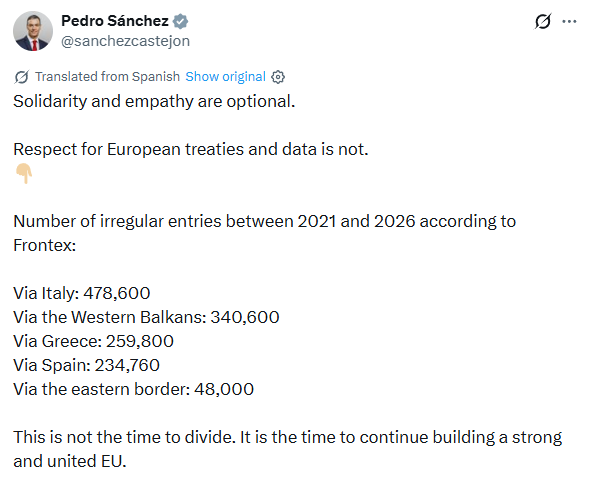
Secondly, Spain is unlikely to forget the pile-on by Meloni and her ilk. Posting on X on Friday evening, Sanchez shared a series of migration figures that implicate Italy as the EU’s leading point of entry for migrants between 2021 and 2026. Notably, and despite the EU-wide campaign against Lukashenko in 2021, the bloc’s eastern border – with Belarus and Ukraine – sits at the very bottom of the list.
“Solidarity and empathy are optional,” Sanchez wrote. “Respect for European treaties and data is not. This is not the time to divide. It is the time to continue building a strong and united EU.”