Washington’s Indo-Pacific approach is changing – and Beijing may find parts of it surprisingly acceptable
The absence of China’s top military leadership from this year’s Shangri-La Dialogue – a key annual inter-governmental security conference focused on the Asia-Pacific – prompted predictable speculation about worsening US-China relations. Yet the more important development took place away from the conference hall.
Just hours earlier, American and Chinese military officials met in Hawaii under the Military Maritime Consultative Agreement to discuss maritime safety, crisis management, and ways to reduce the risk of incidents at sea. This was in line with the trend of Washington and Beijing rebuilding lines of military communication despite their strategic competition.
Rather than pursuing either liberal-globalist ambitions or a new Cold War against China, US President Donald Trump’s second-term administration appears to be advancing a strategy built on realism and balance-of-power politics.
The end of the globalist consensus
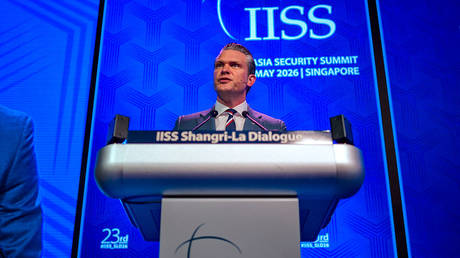
Secretary of Defense Pete Hegseth’s speech at the Shangri-La Dialogue offered perhaps the clearest articulation of this approach.
Hegseth argued that the US has abandoned what he described as the “old toothless, utopian, and globalist course of foreign policy.” Meaning that appeals to universal values and abstract international norms are giving way to a foreign policy centered on national interests, military strength, and strategic realism.
This represents a marked departure from the assumptions that guided much of Western foreign policy after the Cold War. Stability, in this framework, comes from credible deterrence and sustainable balances of power, not from a supposed ‘values’-based moral high ground. This shift is transforming America’s relationships both with its allies and its rivals.
For decades, many US allies relied heavily on American security guarantees while maintaining relatively modest defense capabilities of their own. Hegseth openly questioned this model, arguing that allies should become genuine security partners rather than long-term dependents.
From protectorates to partners
The Trump administration’s emphasis on burden-sharing is about more than budgetary concerns. It also acknowledges a deeper geopolitical reality. For three decades after the Cold War, the US occupied a uniquely hegemonic position in the Indo-Pacific. Today, however, China’s rise, India’s growing influence, and the increasing strategic weight of other regional powers are contributing to a more multipolar environment.
Rather than attempting to restore the conditions of uncontested primacy, Washington increasingly appears focused on preserving an advantageous position within this changing balance. The US remains, or at least still believes itself to be, the strongest military power in the region, but it is encouraging partners to assume greater responsibility for regional security.
This helps explain continued American support for military modernization among countries such as Japan, South Korea, Australia, the Philippines, and India. Critics often portray these efforts as evidence of containment directed against China, yet the Trump administration presents them as an effort to preserve a regional balance in which no single power can dominate the Indo-Pacific.
China remains central to this strategy. Hegseth expressed concern about China’s growing military capabilities, but his remarks were notably less confrontational than much of the rhetoric that has characterized recent debates in Washington. He emphasized the importance of stable relations, fair trade, and continued military-to-military engagement.
It’s equally important to note what he did not emphasize. Taiwan, one of the most sensitive issues in US-China relations, played little role in his speech. The omission suggested an effort to manage competition without turning every disagreement into a geopolitical crisis.
The recently released US National Defense Strategy identifies four priorities: defending the US and the Western Hemisphere, including Greenland; deterring China in the Indo-Pacific; increasing burden-sharing among allies and partners; and revitalizing the American defense-industrial base.
While identifying China as the primary strategic challenge in the Indo-Pacific, the document also calls for expanded military dialogue, strategic stability, and mechanisms for de-escalation. The US Department of War even acknowledges China’s extraordinary rise and military achievements.
Importantly, the strategy does not seek China’s isolation or humiliation. Instead, it reflects a concern that if any single power were to dominate the Indo-Pacific, it could gain disproportionate influence over the world’s economic center of gravity.
The stated objective is not containment in the Cold War sense. The objective is preventing the emergence of a regional hegemon and preserving a balance of power in which no single state can dominate the region.
Such an approach also reflects changing realities within the international order itself. The US is no longer operating in the largely unipolar environment of the 1990s. It is adapting to a world in which multiple major powers coexist and compete. Rather than attempting to preserve its slipping primacy, Washington appears to have shifted to maintaining a favorable balance that protects US interests.
China has a different view of the situation, however. It interprets the military modernization of US allies and partners in the region as evidence of continued containment or encirclement. These tensions are likely to persist. Actions that Washington sees as burden-sharing and balance-building will continue to be viewed in Beijing as militarization directed against China, and the ball is in the Washington’s court to convince Beijing otherwise.
Competition between the United States and China will undoubtedly continue, but America’s emerging strategy points to a search for equilibrium rather than dominance and stability rather than escalation. If sustained, it could offer a more durable foundation for coexistence between major powers than either the hegemonic assumptions of the past or the confrontational mindset of a new Cold War.