June 4, 2026, 9:27 pm
Author – Nick Turse
As an Ebola outbreak continues to rage in Central Africa, the Trump administration keeps trying to blame the World Health Organization — revealing what experts say is a deep misunderstanding about global disease response.
In the eastern Democratic Republic of Congo, local health workers have been battling the devastating virus without adequate supplies, testing materials, or international support. The outbreak is further complicated by the rare strain of the disease, known as Bundibugyo, that standard field tests often miss and for which there are no vaccines or therapeutics. At least 62 people in Congo and one in Uganda have died according to WHO, but experts say this is likely a significant undercount due to the outbreak emerging in a remote, war-torn region.
“The outbreak had a big head start, and we’re still behind, but under the leadership of the Government of DRC, we are catching up,” WHO Director-General Tedros Adhanom Ghebreyesus, told journalists on Wednesday, after a visit to the epicenter of the outbreak. African health officials say that it might take nine months or more to get a handle on the outbreak.
Experts say Trump administration policies — like dismantling the U.S. Agency for International Development and withdrawing from WHO — have undermined global health security and negatively impacted the response to the outbreak. The U.S. had been the largest provider of humanitarian assistance and health sector support to the Democratic Republic of Congo, funding more than 70 percent of humanitarian work there, according to a 2025 report from Physicians for Human Rights which noted the aid cuts have “severely harmed” public health and humanitarian efforts, including infectious disease control. The Trump administration has reportedly even barred some U.S. health officials from communicating with counterparts at WHO.
In the face of criticism of a U.S. failure to quickly respond to the Ebola outbreak, State Department spokesperson Tommy Pigott lashed out at WHO and heaped praise on his boss. “The security concerns in the area – which President Trump has taken unprecedented steps to address – and the WHO’s delay in informing the world of concerns until May 15 has had an impact,” he told The Intercept.
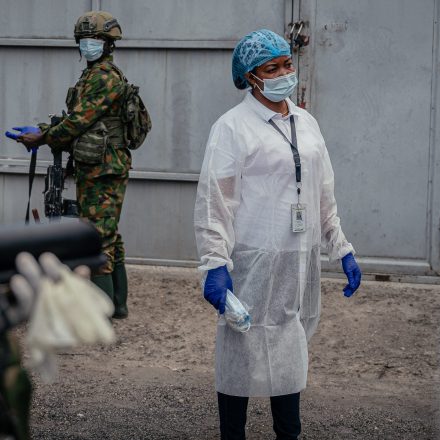
Public health experts say Piggot’s response exposes a fundamental confusion about how authorities combat infectious disease. “It reveals a lack of understanding about how international health regulations work and what a ‘public health emergency of international concern’ actually is,” Margaret Harris, a former senior WHO official and a medical doctor who responded to Ebola outbreaks in West Africa in the mid-2010s and Congo in the late 2010s, told The Intercept.
On May 5, WHO issued an alert of a high-mortality outbreak in Congo’s Ituri Province, which included deaths among healthcare workers. On May 14, blood samples were finally analyzed across the country, in the capital, Kinshasa. A day later, the analysis confirmed Bundibugyo virus disease, a strain of Ebola.
“We also need to remember that Ebola is only one health threat among many that these communities face.”
Dr. Mohamed Yakub Janabi, the WHO Regional Director for Africa, explained that affected nations are the lead actors. “WHO does not declare. It’s the member states who declare,” he told The Intercept on Thursday. “On the 15th, Democratic Republic of Congo and Uganda declared. On the 16th, we declared the presence of Ebola, and on the 17th, Director-General Tedros declared this as a ‘public health emergency of international concern.’”
Dr. Marie Roseline Belizaire, WHO Africa’s Director of Emergency Preparedness and Response, further explained that under the well-defined protocols, states have the obligation to declare an outbreak after which the WHO informs the rest of the world and begins providing support. “There is a clear, well-defined methodology and it is clearly outlined in the international health regulations,” she told The Intercept.
The response is markedly quicker than in some previous outbreaks. During the 2014–16 Ebola crisis in West Africa — when more than 28,000 people were infected and more than 11,000 died in the largest ever outbreak of the disease — WHO became aware that Ebola was spreading in Guinea in March 2014 but did not declare a “Public Health Emergency of International Concern” until almost five months later.

Blame for any lag in response is not the fault of WHO, argued Harris, noting that USAID previously supported NGOs and healthcare workers in rural communities on the front lines of such outbreaks. “Dr. Tedros declared it without even calling the emergency committee together, so he wasted no time once they had information about the extent of the outbreak and the fact that clearly it had been running silently for a long time,” said Harris. “But the silence of the outbreak is not something you could lay at the feet of WHO. You lay that at the feet of a very fragile health system in the middle of a conflict that the rest of the world should be doing something to stop.”
The number of suspected Ebola cases in Congo has been reduced from over 1,000 last week to 116 as teams work through a backlog of tests. Experts say many suspected cases turned out to be malaria. This large number of people with untreated malaria demonstrates, they note, the chronic healthcare deficiencies in the region and a need for a comprehensive focus on public health there.
“We also need to remember that Ebola is only one health threat among many that these communities face,” said Tedros. “One of the things I heard from the community leaders is that they worry that the response to Ebola may take resources away from the health and humanitarian services they rely on for their many other needs.”
The Trump administration has faced scrutiny for pouring money into an Ebola quarantine and treatment center for infected Americans being built in Kenya, as a group of distinguished physicians, nurses, public health professionals, and humanitarian workers, including former top officials at the Centers for Disease Control and Prevention, called for Americans exposed to Ebola to be brought home for treatment. “We are deeply concerned by reports that the United States government is pursuing a policy under which American citizens with Ebola exposures requiring quarantine, isolation, or medical care would be transferred to a facility in Kenya,” they wrote in a letter to Congress, noting the “profound legal, ethical, and human rights concerns associated with preventing American citizens from returning home for care or diverting them to third-country facilities.”
On Wednesday, Secretary of State Marco Rubio doubled down on plans to bar Americans with Ebola from being treated in the U.S. “We cannot and will not allow any cases of Ebola to enter the United States,” he said.
“It really sends the wrong message — that it’s a terrifying thing that you can’t possibly allow to arrive at your borders,” said Harris. Kenya has never experienced an Ebola outbreak, making it a perplexing choice of location for a treatment facility.
The U.S. could have set up a facility in Congo, Harris said, which has the most experience and expertise, having stopped 16 previous outbreaks. Or it could bring its citizens home for treatment and quarantine.
“If you’re going to not treat U.S. citizens on-site in DRC, bring them back to the U.S.” said Harris. “You’ve got one of the best health systems in the world, and you’ve got some of the brightest and best in the world in your country. So why aren’t you mobilizing them and showing that America is truly great?”
The post Trump Administration Tries to Shift Blame for Ebola Response appeared first on The Intercept.
Full Article
Author: Nick Turse