Top Story
South Pars Gas Field Struck — Iran Names Five Gulf Energy Facilities as Immediate Targets
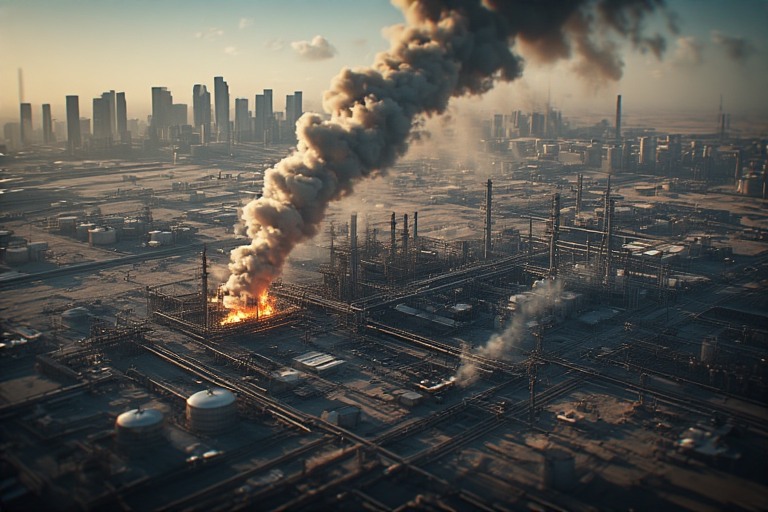
Assaluyeh / Persian Gulf · Day 19 of Operation Epic Fury. US and Israeli aircraft struck four gas treatment facilities processing output from phases 3–6 of Iran’s South Pars field in Assaluyeh on Wednesday — the first time gas infrastructure has been targeted in 19 days of the conflict. The Assaluyeh governor confirmed the facilities have “been taken offline to control and prevent the spread of fire.” South Pars is the world’s largest natural gas reserve, shared with Qatar, producing roughly 40% of Iran’s total gas output. Brent crude surged 6.3% to a session high of $109.95 per barrel within hours of the news; European benchmark Dutch TTF jumped 9.3%. Iran’s armed forces responded with a formal threat list — five Gulf energy installations designated as “direct and legitimate targets to be struck in the coming hours”: Saudi Arabia’s SAMREF refinery at Yanbu and the Sadara petrochemical complex at Jubail; the UAE’s Al Hosn sour gas field; and Qatar’s Ras Laffan refinery and Mesaieed petrochemical complex. IRGC Navy chief Alireza Tangsiri wrote on X that US-linked oil facilities are “now on par with American bases and will come under fire with full force.” Russia condemned the strike near Bushehr. Qatar called it “dangerous and irresponsible.” Trump described it as “putting Iran out of business” and signed a 60-day Jones Act waiver to ease US commodity flows. Israel separately confirmed the killing of Iranian intelligence minister Esmaeil Khatib — the third senior official killed in 48 hours.
The South Pars strike represents a structural phase shift in the conflict’s logic. For the prior 18 days, the US-Israel campaign targeted Iran’s military infrastructure, command nodes, and leadership. Wednesday’s strike eliminates the separation between military and economic targeting — a threshold the Trump administration had previously resisted, reportedly over concerns about oil price optics. Israeli officials confirmed the strike was jointly coordinated and approved by Washington. The four Assaluyeh phases offline affect approximately one-fifth of Iran’s gas processing capacity, according to Israeli defence sources. The state-owned Tehran refinery sustained additional damage. Argus Media reported that further strikes on Iranian energy infrastructure could threaten up to 3.4 million barrels per day of crude output and approximately 1.5 million barrels per day of exports.
Analytical assessment: The IRGC target list is calibrated leverage, not random retaliation. Iran is threatening assets that matter specifically to the states it needs to constrain: Qatar (Ras Laffan supplies 12–14% of Europe’s LNG); Saudi Arabia (SAMREF at Yanbu is the primary terminal of the bypass corridor the entire coalition has relied on to offset the Hormuz closure); and the UAE (Al Hosn). These are the exact states hosting tonight’s emergency Arab-Islamic ministerial in Riyadh. Iran is delivering a message to those governments: your energy infrastructure is the cost of continued US basing on your territory. Whether or not Iran executes any of these strikes, the credible threat reshapes the political calculus at that table. If Iran does execute — particularly against Qatar’s Ras Laffan — the energy disruption compounds from singular (Hormuz) to compound (Hormuz plus Red Sea plus Gulf energy hubs simultaneously), a scenario no current economic model has priced.
Whether Iran strikes any of the five named Gulf facilities within the next 24 hours — execution would mark the most significant regional energy escalation of the conflict. Qatar’s Ras Laffan is the highest-stakes threshold: a strike there directly threatens European LNG imports and triggers ECB emergency action. Watch also for the Saudi Arab-Islamic Riyadh meeting communiqué — any language pushing toward an independent Gulf ceasefire framework, absent both the US and Iran, would represent the most substantive diplomatic shift of the war to date.
Regional Roundup
Three Senior Iranian Officials Killed in 48 Hours — Pragmatic Negotiating Capacity Gutted
Israeli strikes killed Ali Larijani (Secretary of Iran’s Supreme National Security Council), Basij commander Gholamreza Soleimani, and Intelligence Minister Esmaeil Khatib between March 17–18 — the most concentrated leadership decapitation since Day 1’s killing of Ali Khamenei. Larijani, 67, was confirmed killed alongside his son and deputy; intelligence reportedly came from Tehran residents who tracked his public appearances at Quds Day rallies. Netanyahu posted video holding a “punch card,” saying “today I erased two names.” Iran’s Parliament Speaker Ghalibaf held funerals Wednesday. Araghchi insisted Iran’s “strong political structure” is unaffected, but Bloomberg’s strategic assessment was more precise: Larijani’s death — he was the pragmatist who had most recently shuttled between Gulf capitals and Moscow exploring off-ramps — leaves Iran’s wartime leadership “largely in the hands of hardliners less likely to seek a diplomatic pathway.”
The three killings do not destabilise the Iranian state — Araghchi is correct that the system is institutionally durable. What they remove is the human chain through which any negotiating track would have been constructed. The hardliner consolidation is the strategic consequence, not the regime’s survival.
IDF Ground Invasion Deepens Across Three Divisions — One Million Lebanese Displaced
Israel’s 91st, 36th, and 146th divisions are conducting expanding ground operations across southern Lebanon, targeting Hezbollah infrastructure south of the Litani River. The IDF issued evacuation orders north of the Litani for the first time; Lebanese authorities confirmed more than 1 million people displaced — 19% of the country’s population — on the same day ground operations began March 16. At least 820 confirmed dead in Lebanon since March 2. A senior Israeli official told Axios: “We are going to do what we did in Gaza.” The Trump administration backs the operation but has asked Israel to spare Beirut airport and Lebanese state infrastructure. Hezbollah launched more than 100 rockets in a single barrage on Wednesday and said it would “never withdraw.” In Beirut, Israeli aircraft destroyed a high-rise building in the Bachoura district near government headquarters.
France, Canada, Germany, Italy, and the UK jointly called for “immediate de-escalation,” said a full invasion risked “devastating humanitarian consequences,” and condemned Hezbollah’s decision to join Iran — without endorsing the ground operation. The G7 position is now split between condemning Iran’s proxies and opposing the Israeli military response. That fissure is the diplomatic terrain in which this week’s Riyadh ministerial operates.
Saudi Arabia Convenes Emergency Arab-Islamic Ministerial — 11 Countries, No Iran, No US
Saudi Foreign Ministry convened an emergency consultative meeting of foreign ministers from 11 Arab and Islamic states in Riyadh on Wednesday evening: Azerbaijan, Bahrain, Egypt, Jordan, Kuwait, Pakistan, Qatar, Syria, Turkey, and UAE. Neither Iran nor the United States was represented. Turkey’s Foreign Minister Hakan Fidan attended as part of a regional tour explicitly aimed at ending the war. The meeting is the first multilateral diplomatic initiative of the conflict and follows Saudi Arabia’s interception of 439 drones and 36 ballistic missiles since February 28. Saudi Foreign Minister Faisal bin Farhan held preparatory calls with regional counterparts on March 17, including Algeria’s foreign minister.
The absence of both Iran and the US from the same room is the structural signal: the Gulf’s most capable mediators are building a collective position independent of both belligerents. Saudi Arabia, long positioned as a primary target of Iranian strikes, is now positioning itself as a convener. That role transformation — from target to broker — is itself a geopolitical development the wire coverage has understated. Whether the Riyadh meeting produces a communiqué that advances a ceasefire framework or merely reaffirms condemnations of Iranian strikes will determine whether this is a diplomatic opening or a symbolic exercise.
NTCC Director Kent Resigns — First Senior Trump Official to Publicly Break on Iran War
Joe Kent, director of the US National Counterterrorism Center and a long-standing Trump loyalist, resigned Tuesday and published his letter on X. “Iran posed no imminent threat to our nation, and it is clear that we started this war due to pressure from Israel and its powerful American lobby,” Kent wrote — the first open challenge to the conflict’s stated rationale from inside the administration. House Speaker Johnson dismissed Kent’s position. Trump separately responded to NATO allies’ March 16 refusal to send warships to reopen Hormuz with a social media post stating “WE NEVER DID” need NATO help and “WE DO NOT NEED THE HELP OF ANYONE,” while simultaneously suggesting allied countries should “be responsible” for Hormuz after a US-caused regime collapse. NATO Secretary General Rutte said allies are “working collectively to find a way forward.”
Average US gasoline prices reached $3.85 per gallon on Wednesday, the highest since September 2023, creating direct electoral exposure for the White House in a midterm-year context. The Kent resignation — rare in its public visibility and specificity — raises the question of whether it is an isolated break or a leading indicator of institutional dissent within the intelligence community.
Central Bank Policy Week Opens With Every Decision Repriced by the South Pars Strike
The US Federal Reserve announces its interest rate decision Wednesday; the ECB, Bank of England, Bank of Japan, and Bank of Canada hold their first policy meetings since the conflict began. Each central bank faces an identical structural dilemma: energy-driven inflation argues for rate holds or hikes, while the demand shock from $110/barrel oil and collapsing global trade argues for cuts. The ECB’s €180 billion Gulf trade finance exposure — identified in prior coverage as a financial stability risk under a 30-day Hormuz closure — now sits inside an active escalation scenario, with Iran having named three of the EU’s primary Gulf energy suppliers as imminent targets. The Fed’s language on “transitory” versus “structural” energy inflation will serve as a primary signal of how policymakers are pricing the conflict’s duration. bne IntelliNews noted the Fed announcement coincides with the Riyadh ministerial — an unusual convergence of the conflict’s diplomatic and financial timelines in a single afternoon.
Under the Radar
The single most consequential signal in today’s coverage that has attracted the least analytical attention: Iran’s Parliament Speaker Mohammad Bagher Ghalibaf stated Wednesday that the Strait of Hormuz “won’t return to its pre-war status.” This is not a wartime threat — it is a post-war doctrine claim. The Hopper’s Day 14 framing of Hormuz as a “discriminatory economic weapon” is now confirmed by Iranian leadership as permanent standing policy, not a conditional wartime measure. Iran is not threatening to keep the strait closed until a ceasefire; it is asserting a structural change in the strait’s governance framework that has no historical precedent. The 2-4 week consequence: every diplomatic track that assumes Hormuz reopens upon ceasefire is operating on a premise Tehran has just explicitly rejected. If institutionalised, selective Hormuz access as permanent doctrine rewrites the energy security architecture underpinning Gulf export agreements since the 1970s — and reshapes the strategic rationale for every US military relationship in the region.
Seventeen submarine cables pass through the Red Sea alone, carrying the majority of data traffic between Europe, Asia, and Africa. Additional cables thread through the Strait of Hormuz, connecting Gulf states to global networks. Both passages are now effectively off-limits to commercial cable repair vessels — the Red Sea due to Houthi activity, Hormuz due to the active conflict. This marks the first time in modern history both chokepoints are simultaneously closed to maintenance. Meta’s 2Africa Pearls cable project — scheduled to go live in 2026 — has been suspended after the cable-laying contractor declared force majeure. Iran has explicitly threatened to cut Gulf undersea cables if host nations continue sheltering US forces. The 2024 Red Sea Houthi cable damage took nearly six months to fully restore under non-conflict conditions; repair timelines in an active war zone would be materially longer. The cascading exposure: Amazon, Microsoft, and Google have invested billions in Gulf data centers that depend on these cables; India’s westward internet connectivity to Europe runs through both zones; and the EU’s financial clearing infrastructure routes data through Gulf-adjacent corridors. Wire coverage has failed to connect the simultaneous closure of both chokepoints to the global digital infrastructure risk. This becomes a strategically visible story within 2–4 weeks if any cable is severed.
China’s People’s Liberation Army formally published an analysis of five strategic lessons drawn from Operation Epic Fury — an unusual public intelligence signal. Western officials confirmed to Bloomberg on Wednesday that China is actively learning applicable lessons for any future conflict over Taiwan, scrutinizing US offensive capabilities and precision strike methodology. Simultaneously, up to 2,400 US Marines are being redeployed from bases in Japan to the Middle East, materially degrading the Indo-Pacific force posture designed to deter PLA action. Taiwan’s defense establishment held the Yushan Forum this week explicitly to discuss Iran war lessons; President Lai Ching-te called for higher defense spending and deeper US-Taiwan tech and supply chain cooperation. Trump has signalled a possible delay to his April 1–2 summit with Xi Jinping unless Beijing helps reopen Hormuz — a leverage play that could either accelerate Chinese diplomatic engagement or harden Beijing’s posture. The convergence — US assets flowing west, PLA actively updating Taiwan doctrine, and the Xi summit serving as implicit leverage — makes April the most consequential diplomatic window in Indo-Pacific security since the conflict began. No single wire outlet has assembled this frame.
By the Numbers
| $109.95/bbl | Brent crude intraday peak on Wednesday — a 6.3% surge following the South Pars strike, with Dutch TTF European gas benchmark rising 9.3% in the same session. Brent remains above $100 for the eleventh consecutive trading day. |
| 5 | Gulf energy facilities named by Iran’s armed forces as “direct and legitimate targets to be struck in the coming hours” — SAMREF Yanbu and Sadara/Jubail (Saudi Arabia), Al Hosn (UAE), Ras Laffan refinery and Mesaieed complex (Qatar). Ras Laffan alone supplies 12–14% of Europe’s LNG. |
| 1,000,000+ | People displaced in Lebanon since March 2 — 19% of the country’s entire population, confirmed by Lebanese authorities on the day IDF ground operations began. At least 820 are confirmed dead. |
| 7,800+ | CENTCOM targets struck in Iran since February 28, with over 120 Iranian vessels damaged or destroyed. Iranian missile attacks are down approximately 90% and drone attacks down 95% versus early-conflict rates, per SOF News citing CENTCOM briefings. |
| $3.85 | Average US retail gasoline price on Wednesday — the highest level since September 2023, creating direct domestic electoral pressure in a midterm year. Targa Resources also declared force majeure on LPG loadings from its Galena Park terminal, further tightening global LPG supply. |
| 1,440+ | Confirmed dead in Iran since the conflict began on February 28, per the World Health Organisation — with a further 18,700 injured and an estimated 100,000 residents having left Tehran since Day 1. |
What We’re Watching
- Araghchi / Pezeshkian Ceasefire Reconciliation — RESOLVED/ESCALATED. Araghchi stated March 15: “We never asked for a ceasefire.” The diplomatic frame has been abandoned by Iran’s own foreign minister. The soft off-ramp this brief tracked through Days 13–14 is now formally closed.
- Yanbu Supertanker Throughput — CRITICAL ESCALATION. Iran has named Saudi Arabia’s SAMREF at Yanbu as an imminent target. The bypass corridor the allied coalition has depended on since Day 1 is directly threatened for the first time.
- Oman Backchannel — PENDING. No confirmed US acknowledgment of substantive engagement beyond “values Oman’s role” formulation. With Larijani — the official who had most recently interfaced with Oman — now dead, the channel’s Iranian interlocutor is unclear.
- Houthi Activation at Bab-el-Mandeb — ELEVATED. March 16 Times reporting states Houthis are “currently” preparing. Khamenei’s “new fronts” instruction remains operative. The moment of maximum leverage — when the Yanbu bypass is under threat — is now arriving.
- GCC Interceptor Stockpile — DETERIORATING. Saudi Arabia has intercepted 439 drones and 36 ballistic missiles since February 28. Kuwait intercepted four ballistic missiles and 20 drones on Wednesday alone. No public resupply confirmation from any Tier 1 source.
- Iran Execution of Gulf Threat List — Whether any of the five named facilities (Ras Laffan, SAMREF, Al Hosn, Sadara, Mesaieed) is struck in the coming hours. Qatar’s Ras Laffan is the highest-stakes threshold; a strike there triggers a new category of European energy crisis and ECB emergency action.
- Riyadh Arab-Islamic Ministerial Outcome — Any communiqué language establishing an independent Gulf ceasefire framework, without US or Iranian participation, would represent the most substantive diplomatic shift of the war to date. Watch for Turkish FM Fidan’s public statement post-meeting.
- Mojtaba Khamenei Response to Larijani / Khatib Deaths — Any new statement from Iran’s supreme leader, or appointment of successors to the SNSC secretary and intelligence minister roles, that reconstitutes a recognisable negotiating chain. Absence of appointments would confirm hardliner-only governance.
- Trump Ground Operation Decision — Pentagon has prepared multiple options; Trump said “I have a lot of decisions to make.” Any signal of a ground operation order — even limited and targeted — would mark the most significant US escalation since Day 1.
- Fed Rate Language on Energy Inflation — “Transitory” versus “structural” framing in the FOMC statement will signal whether Washington’s domestic policy apparatus has absorbed that the South Pars strike has extended the conflict’s energy disruption timeline beyond near-term resolution.