Top Story
Iran Escalates on Day 11 as Mojtaba Khamenei Consolidates Power and Hormuz Stays Shut
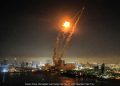
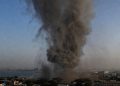
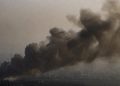
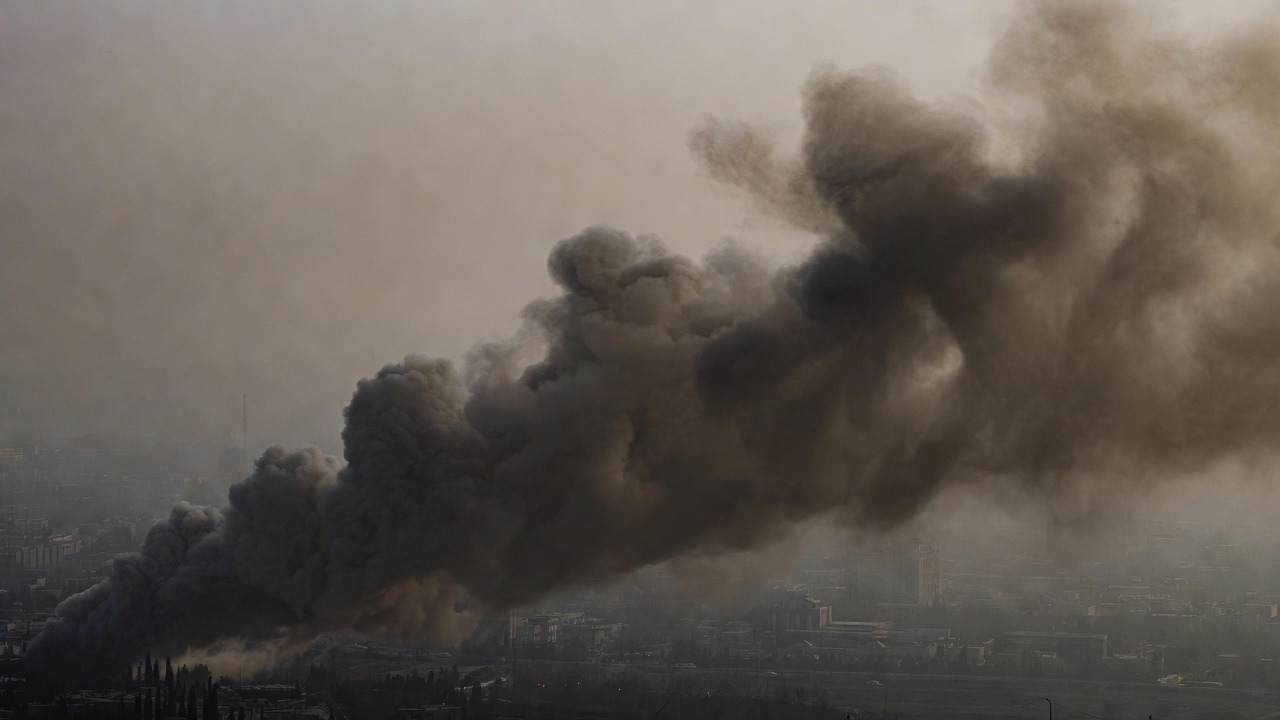
The US-Israel war with Iran — Operation Epic Fury in Pentagon nomenclature — entered its eleventh day with no ceasefire in sight and the conflict deepening on multiple fronts simultaneously. Iranian Foreign Minister Abbas Araghchi stated Tuesday that Iran will continue fighting “as long as necessary,” directly contradicting President Trump’s assertion that the war could be over “pretty quickly.” Iran launched at least nine separate missile and drone barrages between Sunday evening and Monday evening, targeting Israel and multiple Gulf states. Saudi Arabia, Kuwait, Bahrain, and the UAE each intercepted fresh attacks, while a fire broke out at a major refinery in the UAE. The Lebanese militant group Hezbollah entered the conflict directly, launching rocket salvos into northern Israel — framing the action as retaliation for the killing of Supreme Leader Ali Khamenei on Day 1. Israel responded with mass evacuation orders across south Lebanon and continued overnight strikes on both Tehran and Beirut’s southern suburbs. A dignified transfer ceremony was held today in Kentucky for Sgt. Benjamin N. Pennington, 26, the seventh US service member killed in the conflict — the sixth from a drone strike on a Kuwait command center last week. The death toll across the region has surpassed 1,700, including at least 1,200 Iranian civilians and 486 in Lebanon, according to UN and NGO reporting.
The war’s strategic architecture is shifting. On Monday, Iran’s Assembly of Experts formally confirmed Mojtaba Khamenei — the 56-year-old son of the slain Supreme Leader and a figure with deep ties to the Islamic Revolutionary Guard Corps (IRGC) — as the new Supreme Leader. Hundreds of thousands rallied in Tehran in a show of regime solidarity. His appointment, rather than signaling internal fracture, suggests an IRGC-dominated continuity of command with a harder line and fewer constraints than his father, who at least maintained notional channels to diplomatic interlocutors. Trump said Monday he is “not happy” with Mojtaba, a phrase with ambiguous operational implications. An Iranian military commander meanwhile announced that Iran will escalate to using missiles with warheads exceeding one ton in weight — a significant enhancement in lethality — while the IRGC reiterated warnings that any passage through the Strait of Hormuz would result in ships being “set ablaze.” The IEA held an emergency meeting today to discuss release of member-state strategic petroleum reserves.
Beneath the kinetic tempo, a significant intelligence dispute has emerged: a classified Pentagon assessment, now partially reported by NBC News and CNN, indicates that only one of three Iranian nuclear sites targeted in the June 2025 Operation Midnight Hammer was substantially destroyed. Enriched uranium stockpiles and centrifuge arrays are assessed to have been largely relocated prior to the June strikes. The White House has aggressively disputed the assessment, and Pentagon spokesman Sean Parnell called the reporting “destroyed, in the dirt.” But the divergence between official claims and intelligence findings has bipartisan traction on Capitol Hill, where classified briefings were cancelled last week. Reports are now circulating that the US is weighing a special operations mission to physically seize Iran’s nuclear material stockpile — a mission with no precedent in scope or risk. The nuclear dimension is what gives this conflict its most destabilizing long-run valence: if Iran concludes that its only guarantee against regime change is an actual nuclear weapon, the 2025 strikes may have accelerated rather than foreclosed that pathway.
Iran’s response tonight to Trump’s Truth Social warning that the US will hit “twenty times harder” if Hormuz is formally closed — any missile strike on a US Navy vessel attempting to escort tankers through the strait would represent a major threshold crossing. Separately, monitor whether the IEA’s emergency meeting today results in a coordinated Strategic Petroleum Reserve release; G7 finance ministers signaled readiness, but no formal trigger has been pulled. The benchmark: Brent breaking sustained above $110 would force the US administration’s hand on SPR.
Regional Roundup
Strait of Hormuz Effectively Closed; Oil Tops $100 in Largest Supply Disruption on Record
Commercial shipping through the Strait of Hormuz has ground to a near-halt. Kpler vessel tracking shows Iranian and Chinese-flagged ships as the only consistent transits, while major carriers including Maersk, CMA CGM, and Hapag-Lloyd have suspended all strait and Red Sea routes. War-risk insurance premiums have risen more than twelvefold, making transit economically unviable for most operators even where physical risk might be managed. An estimated 150 ships remain anchored outside the strait. Qatar declared force majeure on LNG exports from its Ras Laffan and Mesaieed facilities on March 4, removing an estimated 81–110 billion cubic meters of annual supply from the market. Crude oil crossed $100 per barrel on March 8 for the first time since 2022, rising from approximately $70 before the February 28 strikes; prices have fluctuated between $96 and $125 in recent sessions, with some energy analyst forecasts now extending to $150 if the closure holds through April. Goldman Sachs estimates the Strait disruption is removing roughly 18% of global oil supply from daily circulation.
The strategic asymmetry here matters: Saudi Arabia and the UAE hold significant spare pipeline capacity — Petroline and the Abu Dhabi Crude Oil Pipeline — but both routes combined can offset only a fraction of Hormuz volumes. Saudi Aramco CEO Amin Nasser has called the situation “by far the biggest crisis the region’s oil and gas industry has ever faced.” US gas pump prices are approaching $3.70 per gallon nationally. The compound pressure of the Iran war energy shock arriving simultaneously with the post-SCOTUS 15% Section 122 tariff regime is creating a dual inflationary pincer on the US consumer economy that the White House has not publicly acknowledged.
Hezbollah Formally Enters the War; Lebanon’s Government Calls for Talks Even as Beirut Burns
Hezbollah declared its rocket salvos into northern Israel “revenge” for Khamenei’s killing — a framing that functions as both justification and signal: it claims a principled trigger while leaving open the question of whether full-force engagement follows. Israel issued mass evacuation orders south of the Litani River and struck what it identified as a Hezbollah-controlled financial institution in Beirut’s southern suburbs. Lebanon’s President Joseph Aoun separately told US Secretary of State Rubio that Lebanese territory is not being used as a platform for attacks, and called for direct ceasefire talks with Israel. The Lebanese army has been unable to prevent Hezbollah from operating from Lebanese territory. Death toll in Lebanon from Israeli strikes since February 28 has surpassed 486, with nearly 700,000 people displaced — almost replicating the scale of displacement seen in the autumn 2024 conflict.
The trajectory here carries a structural risk distinct from the Iran-Israel bilateral: a Lebanon front reopens the European security guarantee architecture around the November 2024 ceasefire. France and several EU member states are invested in that deal’s durability. An Israeli ground operation into south Lebanon would effectively dissolve it, create domestic political crises in Paris and Rome, and further strain the already fragmented European posture on the Iran war.
European Allies Divided and Tactically Exposed; Article 42.7 Debate Emerges as Iran Targets NATO Periphery
European governments have found no common foreign policy position on the US-Israel war with Iran. The UK has allowed US bombers to use RAF Akrotiri in Cyprus for what Prime Minister Starmer describes as “a specific and limited defensive purpose” — destroying Iranian missiles at source. German Chancellor Merz, in Washington this week, broke with France in describing Iran as “a terrorist regime” and expressing alignment with the US-Israeli objective of ending its nuclear programme. France, with the most exposed Mediterranean flank and the most explicit Ukraine security commitment, has maintained a more cautious posture. Meanwhile, an Iranian drone struck the UK’s RAF base in Cyprus — a NATO ally’s sovereign military installation. Turkey’s NATO air defenses have intercepted Iranian missiles twice. A drone reportedly carrying a Russian-origin antenna struck Cyprus, a detail that has not yet been resolved publicly. Legal scholars and the Greek think tank Hellenic Foundation for European and Foreign Policy have raised the question of whether Cyprus, as an EU but not NATO member, should invoke EU Treaty Article 42.7 — a mutual defense clause that has never been activated at scale.
The Iran conflict is applying pressure to Europe’s security architecture at the worst possible moment: stockpiles remain below 2021 levels after Ukraine donations, NATO’s new 5% GDP spending target (agreed at The Hague in 2025) remains an aspiration, and US attention is overwhelmingly focused on the Middle East rather than the eastern flank. European defense equities — BAE Systems, Saab, Thales, Rheinmetall — surged again Monday as markets priced in accelerated procurement cycles.
S&P 500 Enters Correction Territory as Tariff and War Pressures Converge
US equity markets entered formal correction territory today, with the S&P 500 now 10.1% below its February 19 record high. The index has shed more than $4 trillion in market value. The combined effect of the Iran energy shock and the Section 122 15% global tariff — now the operative US trade policy regime following the Supreme Court’s February 20 ruling invalidating IEEPA-based tariffs — is compressing both the supply side (energy costs) and the demand side (consumer purchasing power) of the US economy simultaneously. The Court of International Trade has meanwhile ordered US Customs and Border Protection to begin processing IEEPA refunds, with CBP filing a status update due on March 12. Approximately $166 billion in IEEPA tariff revenue collected from more than 330,000 businesses is now technically owed back — a refund volume with no modern precedent in US trade administration. A Washington Post-ABC-Ipsos poll released this week shows 64% of Americans disapprove of Trump’s handling of tariffs; a separate emerging polling signal shows Americans are “uniting in aggravation” over gas price sticker shock.
The political economy dimension is worth tracking: US oil and gas producers are beneficiaries of the price surge, and the Trump coalition includes significant energy sector interests. That structural incentive may moderate pressure from within the Republican coalition to de-escalate the Iran conflict quickly.
UN General Assembly Votes 107–12 for Ceasefire as Russia Watches US Get Stretched Thin
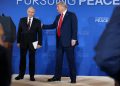
The UN General Assembly adopted a resolution on March 9 — exactly four years after Russia’s full-scale invasion — calling for an “immediate, full and unconditional ceasefire” in Ukraine, passing 107-12 with 51 abstentions. Russia’s representative called for “quiet restraint” and warned against a “hasty truce.” The resolution carries no binding force. The diplomatic subtext: Putin has now twice offered to mediate the Iran conflict, and twice been publicly rebuffed by Trump. Russia is watching the United States consume military assets, diplomatic bandwidth, and domestic political capital in the Middle East — a theatre Putin’s Russia has no direct stake in. Ukraine, notably, is among the louder supporters of the Iran campaign: Iran was Russia’s primary Shahed drone supplier, and Ukraine downed an estimated 44,700 of those drones over its cities in 2025. Kyiv calculates that a weakened Iran weakens Russia’s drone industrial base. The risk, little-discussed in public, is that US preoccupation in the Middle East reduces Trump administration attention to Ukraine peace architecture at a moment when the negotiating calendar is moving.
Under the Radar
Wire coverage of the Iran war has largely accepted the White House framing that June 2025’s Operation Midnight Hammer destroyed Iran’s nuclear programme. The classified record tells a different story. A Defense Intelligence Agency assessment — partially leaked and partially confirmed — indicates that enriched uranium and centrifuge arrays at Natanz and Isfahan were relocated prior to the June strikes, and that only Fordow was substantially degraded. Enrichment could resume within months at the other sites. The White House cancelled Congressional classified briefings last week. The operational implication receiving almost no public attention: Fox News and other outlets are now reporting that the US is weighing a special forces mission to physically seize Iran’s nuclear material — an undertaking that would require ground presence inside a country with which the US is at active war, in a location not publicly confirmed, with radiological handling requirements. The LSE’s US Centre assessed Monday that US strikes may have converted Iran from a state with latent nuclear capability into one with an existential nuclear grievance, meaningfully accelerating — rather than foreclosing — the acquisition motivation. This is the under-reported strategic crux of the entire conflict.
Six players and a staff member from Iran’s national women’s soccer team have now sought asylum in Australia — five were granted humanitarian visas, and the sixth application is pending. The rest of the team has reportedly returned to Iran. This story has received minimal coverage in the context of the war’s kinetic tempo, but it carries a distinct analytical signal: regime defection from an official national sports delegation is a leading indicator of elite-adjacent legitimacy collapse. The Iranian women’s soccer team occupies a symbolically sensitive position inside a theocratic government that has historically used women’s sport as a contested terrain of social control. The defections are occurring at a moment when hundreds of thousands of Iranians are simultaneously rallying for the new Supreme Leader — a simultaneous coexistence of forced loyalty and quiet exit that is worth tracking as a measure of how the population interprets the regime’s long-term trajectory.
Iraq’s Prime Minister Shia al-Sudani has explicitly told Secretary Rubio that Iraqi airspace and territory are not authorised for attacks on neighbouring countries — a statement directed at the US-Israel coalition. Yet US-Israeli strikes have already targeted Iran-backed Popular Mobilization Forces (PMF) brigades inside Iraq, killing at least ten since January. Pro-Iranian Iraqi militias claiming affiliation with the Islamic Resistance in Iraq have launched 67 drone and missile attacks on unspecified targets across the region, including near Harir Air Base and Erbil International Airport, where a drone strike caused material damage to the UAE consulate. The legal and territorial tension embedded in this situation — a nominally sovereign US-aligned government being bypassed by both sides of a war — has received almost no analytical treatment. If the PMF escalates inside Iraq in a way that produces significant US casualties, the war’s geographic footprint will expand in ways the administration appears unprepared to publicly explain.
By the Numbers
| Day 11 | Operation Epic Fury — US-Israel war with Iran, launched February 28 with the targeted killing of Supreme Leader Ali Khamenei. No ceasefire negotiations have been formally initiated. |
| 7 | US service members killed to date: six Army Reserve soldiers in a Kuwait drone strike and Sgt. Benjamin Pennington, 26, of Kentucky, who died Sunday from injuries sustained in a March 1 attack in Saudi Arabia. |
| ~1,700+ | Total deaths across the region in 11 days, including at least 1,200 Iranian civilians, 486 in Lebanon, and dozens in Gulf states and Iraq. Does not include military combatants from any party. |
| ~$100–125 | Brent crude price range per barrel today (up from approximately $70 before the February 28 strikes), representing the largest oil supply disruption on record according to Rapidan Energy and Aramco’s own CEO. |
| ~20M bbl/day | Volume of oil normally transiting the Strait of Hormuz — roughly 20% of global daily consumption — now effectively zero for commercial operators due to war-risk insurance withdrawal and IRGC closure threats. |
| ~150 | Ships currently anchored outside the Strait of Hormuz, unable or unwilling to transit. Major carriers have suspended all related routes; Kpler notes only Iranian and Chinese-flagged vessels continue moving. |
| 107–12 | UN General Assembly vote margin on March 9 calling for immediate ceasefire in Ukraine, marking four years since Russia’s full-scale invasion. The vote carries no binding enforcement mechanism. |
| 10.1% | S&P 500 decline from its February 19 record high as of today’s close — formally placing the index in correction territory, with market losses equivalent to more than $4 trillion in value. |
| $166B | Estimated IEEPA tariff revenue collected from 330,000+ US businesses that the Supreme Court’s February 20 ruling has determined must be refunded — a customs processing challenge with no modern precedent. CBP status update due March 12. |
What We’re Watching
- IEA Emergency Meeting Outcome — The International Energy Agency convened today with 30+ member states to discuss strategic petroleum reserve releases. A coordinated SPR draw — the IEA collectively holds 1.2 billion barrels — would be the most direct lever available to blunt the price shock. Watch for a joint release announcement and the scale: 1 million bbl/day or greater sustained draw would signal serious intent.
- Trump “20x Harder” Threshold — Any Iranian action construed as a deliberate attempt to permanently close the Strait (mine deployment, confirmed sinking of a US-escorted vessel) would trigger the administration’s stated escalation threshold. Monitor US Navy Fifth Fleet communications and IRGC naval activity trackers overnight.
- Hezbollah Escalation Threshold — With Hezbollah now formally in the conflict, the question is whether the initial rocket salvos represent a calibrated signal or the opening of a sustained front. Israeli ground force positioning south of the Litani will be the leading indicator.
- CBP IEEPA Refund Status Update (March 12) — Judge Eaton ordered CBP to file a compliance report on the IEEPA tariff refund process. The administration has so far indicated CBP cannot comply on the ordered timeline. How the court responds to non-compliance will set the tempo for $166 billion in pending refunds and signal how aggressively the judiciary is prepared to push back on executive trade authority.
- Mojtaba Khamenei’s First Public Doctrine Signal — The new Supreme Leader has not yet delivered a substantive foreign policy address. His first major public communication will be read globally for whether Iran intends to seek a diplomatic channel, signals a permanent escalation posture, or attempts a partial de-escalation that preserves regime face while negotiating a path back to sanctions relief.
- US Special Forces Nuclear Seizure Reports — Monitor whether the reported planning for a special operations mission to seize Iranian nuclear material advances from deliberation to operational orders. Any Congressional notification under War Powers Resolution for a new mission type inside Iran would represent an extraordinary escalation marker.
- EU–GCC Foreign Ministers Meeting — EU and Gulf Cooperation Council foreign ministers are meeting this week to issue a joint condemnation of Iran’s strikes on Gulf states and call for a 48-hour humanitarian ceasefire. Watch whether any state publicly breaks from the current posture of condemning Iranian retaliation while not condemning the initiating US-Israel action — that divergence is where diplomatic leverage may eventually emerge.
- Ukraine Peace Track — With US diplomatic bandwidth consumed by Iran, watch whether Russia signals any softening or hardening of ceasefire terms in back-channel communications with European interlocutors. A Russian move to exploit US distraction — on the battlefield or diplomatically — would confirm the strategic opportunity calculus most Moscow analysts believe the Kremlin is running.