Wednesday, March 4, 2026 | Curated by H. Reeves
Section 1 · Top Story
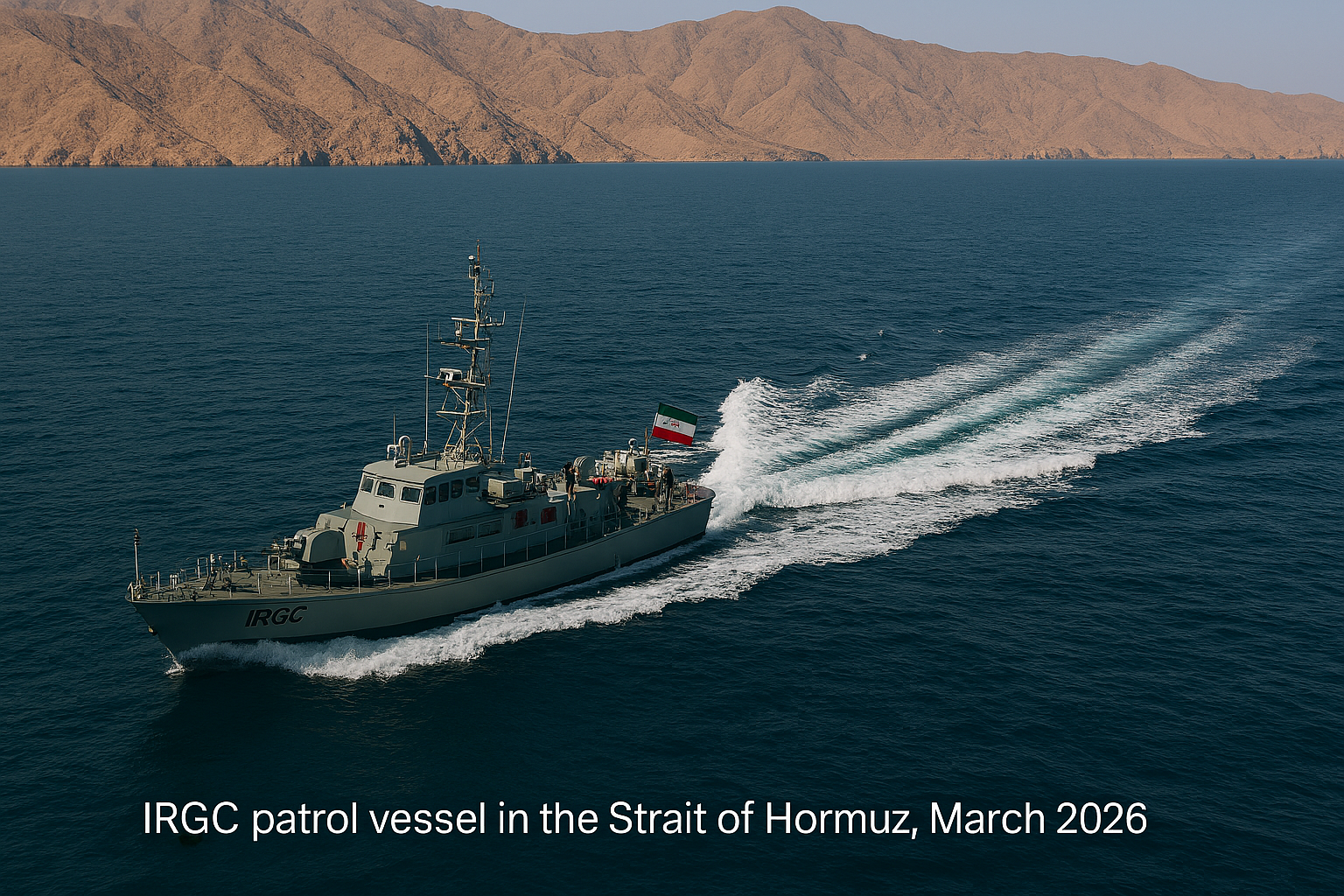
IRGC Declares “Complete Control” of Strait of Hormuz as Trump Threatens Navy Escorts
Iran’s Islamic Revolutionary Guard Corps claimed full operational control of the Strait of Hormuz on Wednesday, with IRGC Navy official Mohammad Akbarzadeh announcing that “the Strait of Hormuz is under the complete control of the Islamic Republic’s Navy” — a direct challenge to President Trump’s pledge to deploy U.S. Navy escorts for commercial tankers if necessary. The standoff, now entering its fifth day, has effectively halted the passage of roughly 20% of the world’s daily oil supply and one-fifth of global LNG through the world’s most critical energy chokepoint.
Vessel-tracking firm Clarksons Research estimates approximately 3,200 ships are currently idle inside the Persian Gulf, with around 500 additional tankers anchored off the coasts of the UAE and Oman awaiting clearance. At least five tankers have been damaged and two crew members killed since Iran’s retaliatory campaign began February 28 following Operation Epic Fury. A lone tanker — the Pola — reportedly transited under AIS silence on Tuesday, reappearing off Abu Dhabi, suggesting Iran may exercise selective discretion over which vessels are permitted passage and when.
Brent crude settled at $81.40 on Tuesday, up 13% since the conflict began, with Goldman Sachs CEO David Solomon warning publicly that markets have responded with “surprising” restraint and that full repricing may take “a couple of weeks” to materialize. Trump offered political risk insurance through the U.S. Development Finance Corporation to incentivize transits, but stopped short of authorizing immediate naval deployment. Iran’s Foreign Minister Abbas Araghchi maintained the strait is technically open — a legal hedge that preserves diplomatic optionality while the de facto closure continues.
Whether Trump authorizes active U.S. Navy escort operations by Thursday; additional AIS-dark tanker transits testing Iranian deterrence limits; Brent pricing at Friday close — the first full trading week of the crisis — as Goldman’s repricing window begins to open.
Section 2 · Regional Roundup
Middle East Iran’s Leadership Void Deepens as Assembly of Experts Office Struck
Iran’s constitutional succession mechanism suffered a further blow on March 3 when Iranian media reported U.S.-Israeli strikes targeted the Assembly of Experts’ offices in Qom — reportedly during a session convened to select a new supreme leader. The 88-member clerical body is constitutionally responsible for selecting Khamenei’s successor; a strike against it during deliberations compounds the regime’s leadership crisis to an unprecedented degree. The interim three-member council — President Pezeshkian, Chief Justice Mohseni-Ejei, and jurist Alireza Arafi — continues to exercise executive authority under Article 111 of Iran’s constitution. Trump separately acknowledged that U.S. strikes killed 48 senior Iranian leaders, including several reportedly on Khamenei’s private succession contingency list as documented by the New York Times. Succession dynamics are increasingly governed by IRGC factional power rather than constitutional process, with Mojtaba Khamenei and Hassan Khomeini — the reformist grandson of the Islamic Republic’s founder — emerging as the most discussed candidates amid a severely thinned clerical pool.
Europe Ukraine Peace Talks Stall as Moscow Signals “No Deadlines”
The latest Ukraine-U.S. negotiating round in Geneva, led by special envoy Steve Witkoff and Jared Kushner, concluded without a breakthrough. The Kremlin reiterated there are “no deadlines” for a deal, showing no appetite for territorial compromise short of full Donbas annexation recognition. Zelenskyy confirmed a U.S. security guarantee text is “essentially ready” but awaits Trump’s signature — a document Kyiv considers the non-negotiable foundation of any settlement. Russia publicly rejected French and UK peacekeeping deployment proposals as “legitimate military targets” if deployed. The Iran conflict is now consuming the U.S. diplomatic and military bandwidth that any Ukraine deal urgently required; with Trump’s team signaling attention may shift toward midterm election positioning later in the year, the window for a negotiated settlement is narrowing in real time.
Asia-Pacific LNG Supply Shock Tests Asian Energy Security Architecture
The simultaneous shutdown of QatarEnergy’s Ras Laffan complex — covering approximately 20% of global LNG supply — and the effective closure of the Strait of Hormuz have placed Asian energy security under acute and immediate stress. Roughly 80% of Qatari LNG flows to Asian markets: Japan, South Korea, India, China, and Southeast Asia. Pakistan immediately arranged a vessel to lift crude from Saudi Arabia’s Red Sea port of Yanbu as emergency alternative routing. Bangladesh, relying on Qatar and the UAE for 72% of its LNG imports, faces maximum exposure. China holds approximately 7.6 million tonnes of LNG inventory as of late February — a short-term buffer — but will compete aggressively for Atlantic-basin cargoes if the outage extends beyond several weeks, introducing a secondary price shock across Pacific markets that will arrive with a lag of 14-21 days.
Section 3 · Under the Radar
The Fertilizer Shock No One Is Covering
While oil prices dominate every headline, approximately 33% of the world’s fertilizer supply transits the Strait of Hormuz, with exports from Qatar, Saudi Arabia, the UAE, Iraq, and Iran all dependent on the waterway. The disruption has arrived at the worst possible moment: the Northern Hemisphere spring planting season represents peak global nitrogen demand, and — critically — unlike crude oil, there is no strategic reserve equivalent for fertilizer. QatarEnergy’s force majeure covers not only LNG but urea, methanol, sulphur, polymers, and aluminum at Ras Laffan simultaneously. Egyptian granular urea jumped $60 per metric ton immediately; New Orleans March barge prices surged $60-80 per ton in a single session. StoneX Group noted the timing “could not be much worse.” India, sub-Saharan Africa, and Latin America — all import-dependent agricultural regions with zero buffer inventory — face the sharpest cost exposure. This is a food security shock developing in slow motion, and it has received virtually no analytical coverage relative to its structural significance for 2026 growing season outcomes.
Iran’s Precision Strike on U.S. Military Comms Infrastructure
New York Times satellite imagery analysis confirms Iranian strikes have damaged or destroyed satellite communications facilities at no fewer than seven U.S. military sites across five Gulf countries — Bahrain, Qatar, Kuwait, Saudi Arabia, and the UAE. In Bahrain, a drone strike hit the U.S. Navy’s Fifth Fleet headquarters in Manama, destroying at least two radomes housing AN/GSC-52B satellite communication terminals — the primary high-speed connectivity architecture for U.S. naval operations in the region. Kuwait’s Camp Arifjan and Ali Al Salem Air Base saw additional radomes destroyed. The Telegraph separately reported that U.S. air defense missile stocks are “not endless,” raising questions about operational sustainability. Iran’s targeting discipline here is analytically significant: these are not strikes against troop concentrations but against command-and-control architecture. This represents a deliberate C2 degradation campaign that has received minimal strategic attention alongside oil price reporting.
Section 4 · By the Numbers
$81.40
Brent crude close, Tuesday March 3 — up 13% since Operation Epic Fury launched February 28. Goldman Sachs warns the full repricing “has not yet begun.”
~3,200
Ships currently idle in the Persian Gulf per Clarksons Research; ~500 additional vessels anchored outside the strait off UAE and Oman.
20%
Global LNG supply taken offline by QatarEnergy’s Ras Laffan shutdown. European TTF gas prices surged up to 54% in a single session on March 2.
33%
Estimated share of global fertilizer supply transiting the Strait of Hormuz per Kpler. Urea prices have already jumped $60-80/ton with more expected.
7
U.S. military satellite communications facilities confirmed struck by Iran across five Gulf countries, per New York Times satellite imagery analysis.
3
U.S. troops killed in action since Operation Epic Fury began. Trump acknowledged further casualties are possible as the operation continues.
Section 5 · What We’re Watching
This Week
- U.S. Navy escort decision — Watch for CENTCOM operational orders or a Trump announcement crossing the line from deterrence to active deployment. The practical logistics of escorting tankers through an actively contested strait are formidable and have not been publicly addressed.
- Iran succession timeline — The Assembly of Experts, if reconstituted after the Qom strike, may attempt emergency proceedings. Any statement from the interim council on scheduling or candidate status is a critical signal for regime continuity.
- Ukraine leaders summit — The March 4-5 window referenced by both sides. Kremlin non-response, or a scheduling announcement from Kyiv, will set the negotiating tempo for the coming weeks.
This Weekend
- First confirmed Houthi Red Sea strike — Houthis have formally signaled resumption of attacks on U.S.- and Israeli-linked shipping. Watch UKMTO incident reports and BIMCO advisories for the first confirmed kinetic incident, which will formally re-close the Suez routing option for major carriers.
- EU emergency LNG procurement — EU gas coordination group meeting to assess the Qatar supply shortfall. Watch for announcements from U.S. LNG exporters; Venture Global has already offered to stabilize global markets but U.S. facilities are operating at close to 100% capacity.
- Goldman Sachs / market repricing — Watch Brent at Monday open following the first full week of crisis trading. Solomon’s “couple of weeks” repricing warning puts the adjustment window opening this weekend.