By H. Reeves | Friday, March 7, 2026 | Middle East · Strategic Dependency
Estimated read time: 7 min
NSA Bahrain — the U.S. Fifth Fleet’s forward headquarters — sits inside a nation whose Shia majority is now in open unrest, whose government is arresting citizens for celebrating Iranian strikes, and whose survival depends, as it did in 2011, on Saudi military intervention. The Fifth Fleet’s external vulnerability to Iranian missiles and the internal vulnerability posed by Bahrain’s Shia protests are the same strategic problem. Coverage has addressed neither as such.
What Happened
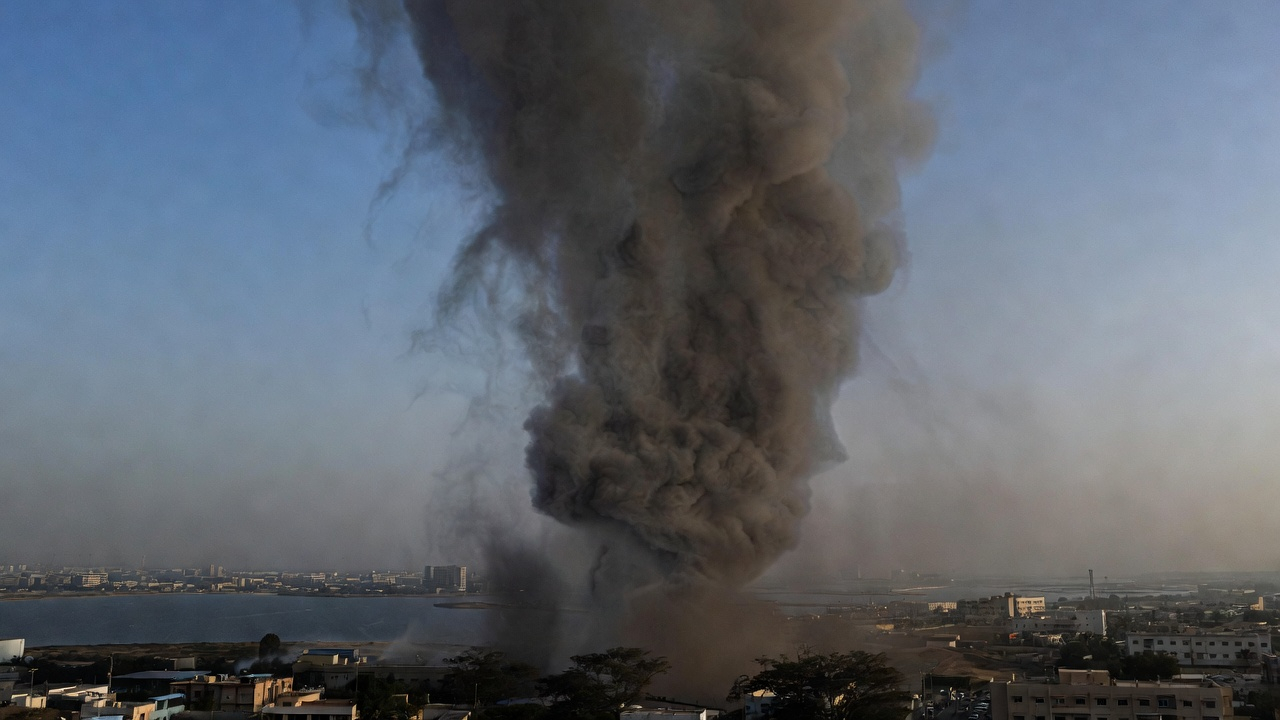
On February 28, 2026, within hours of the opening U.S.-Israeli strikes on Iran, Iranian missiles and drones began striking Bahrain. Multiple projectiles targeted Naval Support Activity (NSA) Bahrain in Manama’s Juffair district — the forward headquarters of the U.S. Navy’s Fifth Fleet and U.S. Naval Forces Central Command, responsible for maritime security across 2.5 million square miles encompassing the Arabian Gulf, Red Sea, Gulf of Oman, and the Strait of Hormuz. Bahrain’s government reported its air defenses intercepted 54 drone and missile strikes in the first days of the conflict. On March 2, a separate strike hit Mina Salman Port, killing one shipyard worker — the first confirmed civilian fatality of the Bahrain strikes. On March 3, Iran claimed to have struck Sheikh Isa Air Base in the island’s south.
The physical strikes generated significant coverage. What did not is what happened on the ground. Videos circulated on social media showing groups of Bahraini residents — predominantly from the Shia community — celebrating the Iranian strikes on the U.S. base. Authorities responded with an arrest campaign targeting individuals who allegedly expressed public support for the Iranian operations. Carnegie Endowment analyst Andrew Leber confirmed in real-time commentary that Shia protests were beginning to break out after years of political repression. By March 3, reports emerged — unconfirmed by official sources but corroborated by multiple social media observers — that Saudi-led Peninsula Shield Forces had entered Bahrain via the King Fahd Causeway, mirroring precisely the intervention mechanism deployed during the 2011 uprising.
Why It Matters
The dominant media frame on Bahrain has been operational: how much damage did Iran’s strikes cause, and is the Fifth Fleet still functional? The answer to the second question is yes — the fleet’s ships were repositioned ahead of strikes, and base infrastructure sustained damage rather than catastrophic destruction. But this frame obscures the more consequential strategic problem: the U.S. Navy’s primary Gulf command is permanently garrisoned inside a nation structurally predisposed to domestic instability, whose majority population holds sympathies directly opposed to the U.S. military presence, and whose government’s survival depends on external military intervention from a regional patron. That is not an operational problem. It is a manufactured vulnerability — and it existed before the first missile fell on February 28.
The financial stakes attached to Fifth Fleet continuity are substantial. The command oversees maritime security along energy corridors through which approximately 20% of global oil trade and a significant share of global LNG transits daily. Any sustained degradation of Fifth Fleet operational capacity — through physical damage, restricted resupply, or political pressure to revise basing arrangements — would have immediate pricing effects on global energy markets already under strain. The U.S.-Bahrain basing arrangement functions partly as a protection transaction: Washington provides implicit security guarantees for the Al Khalifa regime; Bahrain provides basing rights. That transaction holds only as long as the monarchy retains control.
The military dimension extends beyond the base itself. NSA Bahrain is not simply a headquarters building — it is the command and logistics hub for the entire Central Command maritime theatre. U.S. military families began departure procedures only after the first strikes had already commenced; dependent flights were paused in the immediate aftermath as Bahrain’s airspace closed. Defense One reported that the base was nearly empty at the time of the initial attack only because a pre-planned exercise drill had it on mission-critical status the night before — a contingency outcome, not deliberate pre-positioning against threat intelligence. That gap between protocol and readiness deserves scrutiny it has not received.
Diplomatically, the arrest campaign for Shia residents celebrating the Iranian strikes is itself a significant tell. Governments arrest citizens for public celebrations of enemy attacks when the alternative — allowing those celebrations to continue and grow — is judged more dangerous than the arrests. That is a regime communicating, through enforcement action, that its domestic political position is fragile enough to require suppression of public sentiment.
How Bahrain’s 2011 Fault Line Survived to 2026
The 2026 crisis did not create Bahrain’s structural divide. It exposed a fault line that never closed.
The 2011 Bahraini uprising — in which a predominantly Shia opposition mobilised against the Sunni Al Khalifa monarchy — was suppressed only through the deployment of Saudi-led GCC Peninsula Shield Forces via the King Fahd Causeway. The grievances that produced the uprising were not resolved; they were contained. In the years since, Bahrain’s government banned opposition political parties, dissolved the main Shia political society Al Wifaq, imprisoned senior opposition leaders, and conducted what international human rights bodies characterised as systematic suppression of Shia political identity. Several senior figures remain imprisoned today. A partial release of activists in 2024 was a conditional gesture, not a structural change.
The official Bahraini narrative — that Iranian interference, not domestic grievance, drives Shia unrest — is the frame Washington has largely accepted because it is convenient. The U.S.-Bahrain basing relationship, in place in some form since 1948, is predicated on the Al Khalifa monarchy’s stability. Acknowledging that stability as contingent would require confronting an uncomfortable dependency. The Congressional Research Service’s own assessment notes that Bahrain is the only GCC state with a Shia majority population, that structural inequalities and sectarian tensions persist, and that organised opposition has been suppressed since 2011. Washington reads these as background conditions rather than operational risks. The events of the past week suggest that framing requires revision.
The Saudi intervention pattern is itself a dependency within a dependency. Al Khalifa regime survival in a crisis relies on Riyadh’s willingness to deploy the Peninsula Shield Force — a commitment that has held historically but is not guaranteed indefinitely, particularly as Saudi Arabia manages its own Iranian retaliation exposure across multiple theatres simultaneously.
Key Players
The Al Khalifa Monarchy: Bahrain’s ruling Sunni family, in power since 1783. Currently managing simultaneous pressure from Iranian missile strikes, Shia unrest, international scrutiny of the arrest campaign, and dependency on both U.S. basing revenue and Saudi military backing. Holds the least leverage of any actor in this situation.
U.S. Fifth Fleet / NAVCENT: The operational command headquartered at NSA Bahrain. Has physical continuity — ships were repositioned — but faces unresolved questions about the long-term viability of a command node embedded in a structurally contested host nation. Cannot relocate without a politically significant signal about U.S. confidence in Bahrain’s stability.
Saudi Arabia / GCC Peninsula Shield Force: The Al Khalifa regime’s security guarantor. Reports of Peninsula Shield deployment in early March — echoing 2011 — indicate Riyadh views domestic destabilisation as a threshold event requiring military response. Saudi calculus: Bahrain’s fall to an Iran-aligned government would place Iranian influence directly adjacent to the Eastern Province, itself home to a significant Shia population.
Iran’s IRGC: The strikes on NSA Bahrain were not primarily about destroying the Fifth Fleet — they were about demonstrating that the base is targetable and that Bahrain’s government cannot protect its population from the consequences of hosting U.S. forces. That messaging is directed as much at Bahraini Shia civilians as at U.S. military planners.
Scenarios & Probabilities
Most Likely (60% confidence): Containment and Compression — The Al Khalifa government, backed by Saudi forces, suppresses protests through arrests and security deployments. The Fifth Fleet resumes full operational posture as Iranian strikes de-escalate or shift to other theatres. The basing arrangement survives this episode intact, but at the cost of another round of political suppression that deepens long-term grievances without resolving them. Key trigger: Peninsula Shield Force withdrawal timeline; whether the arrest campaign expands or contracts in the next two weeks.
Plausible (30% confidence): Negotiated Limitation — Sustained domestic pressure, combined with infrastructure damage and Bahrain’s closed airspace, prompts a U.S.-Bahraini discussion about distributing Fifth Fleet command elements across alternative Gulf facilities — Qatar’s Al Udeid, the UAE’s Al Dhafra, or afloat platforms. This would not be announced as a retreat from Bahrain but as a “resilience” or “distributed operations” initiative. Key trigger: any U.S. military statement on operational redundancy or distributed command architecture in the Gulf.
Low Probability, High Impact (10% confidence): Regime Destabilisation — If Iranian strikes continue targeting civilian infrastructure alongside the base, and if the Peninsula Shield deployment proves insufficient or politically costly for Riyadh, the Al Khalifa government faces a legitimacy crisis it cannot contain. A change in Bahraini government — even a partial power-sharing arrangement — would force an immediate renegotiation of the basing arrangement and could trigger a reorientation of Gulf maritime security architecture built over seven decades. This scenario requires multiple simultaneous failures and is not imminent, but the preconditions are more present today than at any point since 2011.
What to Watch
- Peninsula Shield Force presence in Bahrain: Confirmation of deployment and — critically — the withdrawal timeline. An extended Saudi military presence signals the Al Khalifa government does not trust its own security forces with the situation.
- U.S. Embassy security posture: The March 2 warning to avoid Manama hotels marked a significant escalation in threat assessment language. A further tightening — formal ordered departure or extended shelter-in-place — would indicate Washington is reassessing more than physical security.
- Bahrain airspace status: Closure directly constrains Fifth Fleet resupply, personnel rotation, and dependent evacuation. Each additional day closed increases operational and political pressure on the basing relationship.
- Iranian strike targeting pattern: If Iran continues striking Bahrain at higher frequency than Qatar or the UAE, the signal is strategic — deliberately pressuring host-nation domestic stability, not just base infrastructure.
Sources & Further Reading
Wire Services
Broadcast + Digital
- Defense One — “It sounded relentless: American in Bahrain describes days of drone and missile attacks,” March 2026
- Al Jazeera — “Multiple Arab states that host US assets targeted in Iran retaliation,” Feb 28, 2026
- The New Arab — “Bahrain detains people allegedly celebrating Iran strikes,” March 2026
- Military.com — “Attack on US Navy Fifth Fleet Headquarters in Bahrain,” Feb 28, 2026
Policy + Analysis
- Carnegie Endowment — Andrew Leber, “The Gulf Monarchies Are Caught Between Iran’s Desperation and the U.S.’s Recklessness,” March 2026
- Congressional Research Service — “Bahrain: Issues for U.S. Policy”
Related Hopper Coverage
- The Hopper Daily Brief — March 3, 2026 — Bahrain unrest first flagged Under the Radar
- The Hopper Daily Brief — March 4, 2026
- The Hormuz Fertilizer Trap — Gulf energy corridor risk and Fifth Fleet operational stakes
H. Reeves covers Middle East security and Gulf geopolitics for The Hopper, with a focus on strategic dependencies and the structural conditions that shape regional stability.