What’s at stake in the most consequential European election of the year?
Hungarian Prime Minister Viktor Orban is facing the most serious threat to his power in decades, in an election that’s drawn in the EU, US, and Ukraine. RT explores the players, the stakes, and the dirty tricks shaping the Hungarian election.
We’ve delved into the election in our ‘Battle for Hungary’ series, but if you’ve just joined us, here’s what you need to know:
Hungarians go to the polls on Sunday, April 12, to elect all 199 members of the National Assembly. Elections are held every four years in Hungary, and take place over a single round on a single day. Results are typically known within hours of polls closing.
How many people will vote?
There are roughly 8.2 million registered voters in Hungary, and between 2006 and 2022, voter turnout typically ranged between 61% and 69.59%, according to data from the country’s National Election Office. The last election, in 2022, saw a record turnout of 69.59%.
Around 91,000 Hungarian citizens have registered to vote from abroad, with a significant number living in Ukraine’s Transcarpathia region.
Who’s running for election in Hungary?
More than a dozen parties have put candidates forward, but the election is essentially a showdown between two: Orban’s Fidesz, and Peter Magyar’s Tisza.
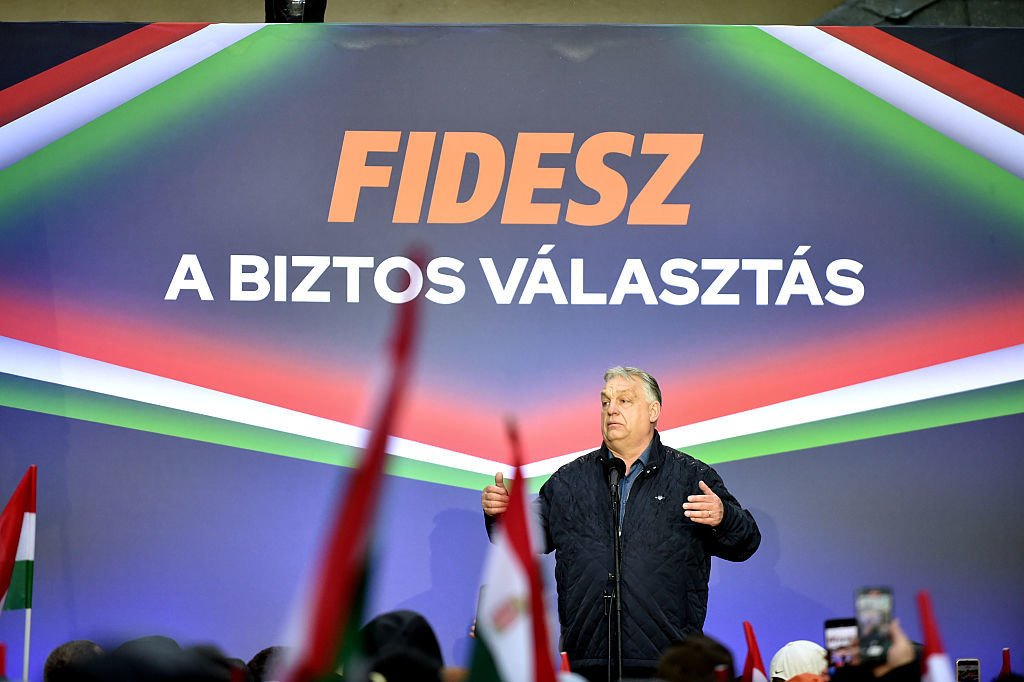
Viktor Orban speaks during a campaign rally in Pecel, Hungary, March 28, 2026
Orban has been in power since 2010, and is seeking a fifth consecutive term in office. His Fidesz party and its Christian Democrat partners currently hold 135 out of 199 seats in the National Assembly.
Orban is known for his conservatism, drawing the ire of the EU for refusing to accept non-European asylum seekers and banning LGBTQ propaganda. He’s also known for his program of economic nationalism – known as ‘Orbanomics’ – and for his criticism of the EU’s financial and military support for Ukraine. Orban has blocked multiple rounds of sanctions on Russia, relenting only after securing exemptions that have allowed Hungary to continue purchasing Russian energy, and is currently vetoing a €90 billion ($105 billion) debt-financed EU loan package for Kiev.
Peter Magyar speaks during a rally of the Tisza Party in Budapest, Hungary, March 15, 2026
A former member of Fidesz, Magyar resigned from the party in 2024 and joined the ranks of Tisza, a party that had languished in obscurity since its founding four years beforehand. While embroiled in two legal cases – one in which he testified about alleged corruption in Orban’s government, and another in which he was accused of domestic abuse by his ex-wife, former Justice Minister Judit Varga – Magyar was elected to the European Parliament that year, along with six other Tisza MEPs.
Magyar describes himself as center-right, and hopes to mend Budapest’s ties with Brussels should he win. Repairing relations with the EU is critical to Magyar’s economic platform – an ambitious program of public spending that entirely depends on Brussels unlocking nearly €20 billion in frozen funds. Magyar has not publicly supported or opposed the EU’s Ukraine loan, and his positions on immigration and social issues remain ambiguous.
What do the polls say?
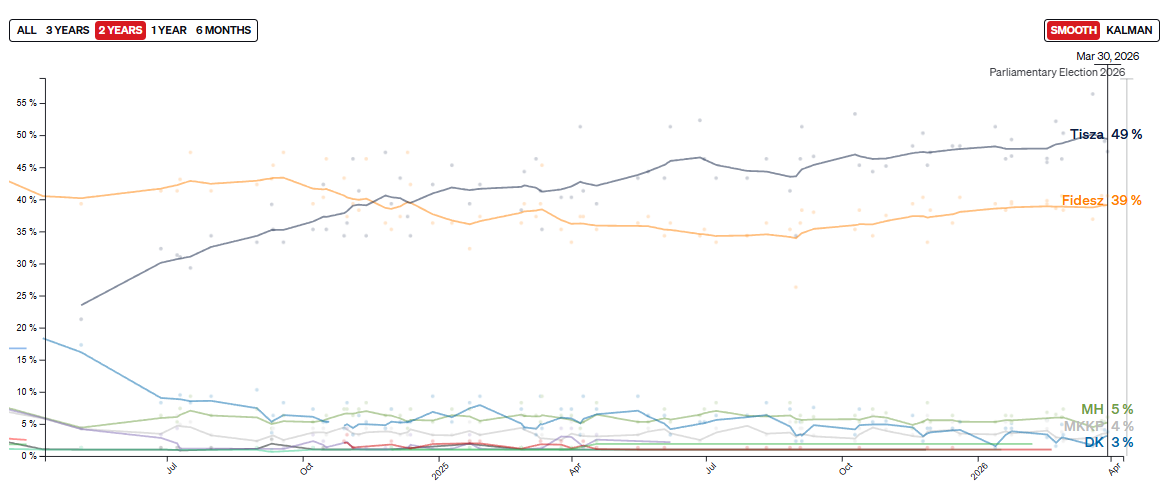
Magyar’s Tisza is currently leading Fidesz by 49 points to 39, according to an aggregate compiled by Politico. However, individual opinion polls vary wildly, depending on the political alignment and funding of the pollsters.
A Hungarian polling aggregate compiled by Politico
For example, a poll by the 21 Research Center, which is financed by the European Commission, shows Tisza leading Fidesz by 19 points. Another by the opposition-linked Median shows Magyar’s party 23 points ahead of Orban’s. Conversely, a poll by the Center for Fundamental Rights – a conservative think tank – places Fidesz eight points ahead of Tisza.
Politico has reported that “many” EU leaders secretly believe an Orban victory is “likely.” Hungarian EU Affairs Minister Janos Boka thinks that the disparity between public surveys and private sentiment is no accident, and that by skewing polls, Magyar and his supporters in Brussels are “building the narrative that if they lose the election, then this is an illegitimate result.”
In the weeks leading up to the election, allegations of interference – proven and unproven – have come from all sides. Last month, opposition journalist Szabolcs Panyi accused Russia of sending “political technologists” to Budapest to swing the election for Orban, without explaining how they planned on doing this. The report – which was attributed to nameless EU spies and published by an EU-funded outlet – was taken by Brussels as proof that Russia planned to meddle with the vote, and used to justify the bloc’s own interference, in this case the activation of its online censorship tools in Hungary.
Panyi became embroiled in an election meddling scandal of his own when it emerged that he had collaborated with EU intelligence agents – possibly the same sources who fed him the ‘Russian interference’ story – to wiretap Hungarian Foreign Minister Peter Szijjarto. The wiretap revealed conversations between Szijjarto and Russian Foreign Minister Sergey Lavrov. Szijjarto insisted that having these conversations is part of his job as the EU’s longest-serving foreign minister, and that the positions expressed in these calls – opposition to sanctions on Russia and disdain for Brussels bureaucrats – are already well known.
Ukraine has stuck its thumb on the scales too. Kiev has refused to restart the flow of Russian oil through the Druzhba pipeline, which carries Russian oil to Hungary and Slovakia via Ukraine, claiming that the pipeline was damaged in a Russian air raid in January. Orban maintains that Druzhba is operational, and that Ukrainian leader Vladimir Zelensky is keeping it closed in order to drive up energy costs in Hungary and hamper his reelection campaign. Kiev has also trained spies working within Magyar’s party, according to Hungarian security authorities.
Why is the Hungarian election so important to the EU and Ukraine?
For the EU, the election presents a chance to remove a persistent thorn in its side, accelerate its transition away from Russian energy imports, and clear the way for a massive cash infusion for Ukraine. For Kiev, the latter concern is existential: the €90 billion EU loan package vetoed by Hungary equals almost half of the bloc’s total contributions to Ukraine since 2022, and will cover two-thirds of the country’s expenditure for the next two years.
Why was J.D. Vance in Budapest?
US President Donald Trump is an ideological ally of Orban, and dispatched Vice President J.D. Vance to Hungary on April 7 in a show of support for the Hungarian prime minister. Over multiple public appearances with Orban, Vance railed against EU and Ukrainian interference in the election, calling their combined efforts “one of the worst examples of foreign election interference that I have ever seen.”
Vance also saved his most scathing criticism for Zelensky, hammering the Ukrainian leader’s “preposterous” threat to send soldiers to Orban’s house over Hungary’s vetoing of the EU loan package.
However, Vance was accused of election interference by Tisza and EU officials. After the US VP described Orban as “the single profound leader in Europe on the question of energy security and independence” and said that he would “help as much as I can possibly help” to get him reelected, the European Commission announced that it would “convey our concerns” about the visit to Washington.
“I would like to point out, since Vance is complaining about the EU’s alleged interference in the election, that the US vice president was in Hungary just a few days before the election. This fact alone speaks for itself as to who is interfering,” German government spokesman Sebastian Hille told reporters on April 8.
Speaking to RT, former Austrian Foreign Minister Karin Kneissl described the election as a “proxy war” between Washington and Brussels, with the EU willing to “paralyze” Hungary (by refusing to pressure Zelensky to reopen the Druzhba pipeline) in order to oust Orban, and the US “cultivating resistance” against the bloc by supporting him.