• About
  • Advertise
  • Privacy & Policy
  • Contact
Tuesday, March 31, 2026
  • Login
  • Register
thehopper.news
  • Home
    • Home
    • About
    • Editorial Standards
    • Methodology & Sources
  • Briefings
    • Weekly
  • Analysis
  • Regions
    • Africa
    • Americas
    • Asia-Pacific
    • Europe & NATO
    • Middle East & North Africa
    • Russia & Eurasia
  • Themes
    • Energy & Reources
    • Intelligence & Security
    • Economics & Sanctions
    • Foreign Relations & Diplomacy
    • Cyber & Disinformation
  • Video
  • Aggregated
    • RT
    • Opinion
    • News
    • Geopolitics
    • Politics
    • Business
    • World
No Result
View All Result
thehopper.news
No Result
View All Result
Home Aggregated RT

US seeks to pass the buck on Hormuz crisis

by Admin
March 31, 2026
in RT, World
0
US seeks to pass the buck on Hormuz crisis
27
SHARES
108
VIEWS
Share on FacebookShare on Twitter

Published: March 31, 2026 8:39 am
Author: RT

Iran has restricted transit through the strategic strait in response to the US-Israeli regime change war

Restoring free shipping through the Strait of Hormuz, currently blockaded by Iran, is not among American military objectives, according to statements by US officials and media reports. Instead, Washington has indicated it expects other nations to tackle the issue.

Tehran throttled maritime traffic through the key waterway in retaliation for the US-Israeli attack aimed at toppling the Iranian government, launched over a month ago. Reduced flows of hydrocarbons and other essential commodities from the Persian Gulf have pushed global prices higher, raising the risk of significant economic disruption.

In an interview with Al Jazeera on Monday, US Secretary of State Marco Rubio rejected the idea that Iran would continue to take tolls from ships it allows through the strait, but said that securing free transit was not part of Washington’s war objectives. The US is focused on degrading Iranian military capabilities and is “well on our way or ahead of schedule,” Rubio claimed.

“When this operation is over, it will be open, and it will be open one way or another,” he added. Should Iran insist on its terms, “a coalition of nations from around the world and the region, with the participation of the United States, will make sure that it [the Strait of Hormuz] is open.”

Read more

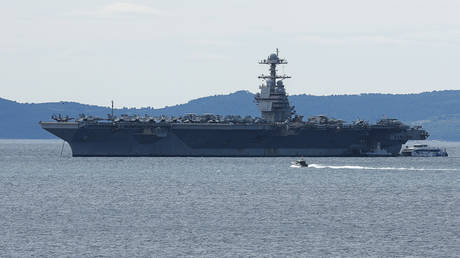
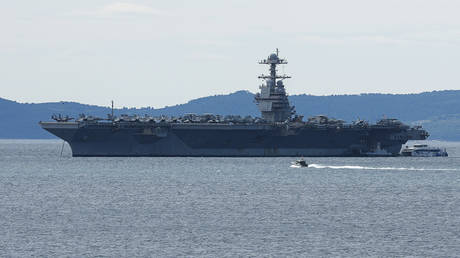
A view of the American aircraft carrier USS Gerald R. Ford in Split, Croatia, on March 29, 2026.
Gerald R. Ford out of commission for one year: What’s wrong with America’s most advanced carrier?

The administration of President Donald Trump believes that attempts to secure the chokepoint “would push the conflict beyond his timeline of four to six weeks” and intends to “press allies in Europe and the Gulf to take the lead on reopening the strait,” the Wall Street Journal reported.

NATO’s war after all?

Previously non-involved nations have refused to deploy their militaries to help the US unblock the Strait of Hormuz. German Defense Minister Boris Pistorius said of Trump’s call for participation: “It is not our war; we did not start it.”

The US leader responded by threatening to call off US support of Ukraine, saying Kiev’s conflict with Russia “isn’t my war.” After taking office, Trump refused to donate weapons to Kiev, forcing European nations to pay for them, while continuing to share crucial intelligence with Ukrainian military commanders.

Read more

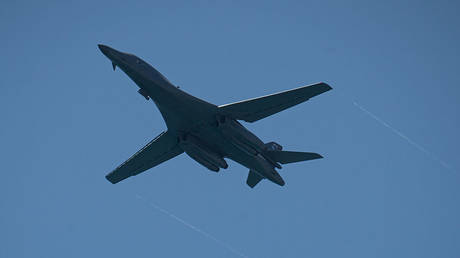
B-1 Lancer Bomber.
NATO member closes airspace to US warplanes involved in Iran war

When asked about sentiments among European NATO members that the US is not reliable and could pull the plug on the military bloc, Rubio said being “an alliance means it has to be mutually beneficial” and not a one-way street.

US risks losing more than China in oil crisis

Rubio insisted that “very little of American energy comes through the Straits of Hormuz” and that Washington’s opposition to the Iranian claim is principled rather than pragmatic. If the precedent is set of a nation seizing an international trade route, “the Chinese could do it in the South China Sea” while the US could make claims of its own, he warned.

Washington’s assumption that, as an energy exporter, the US is largely insulated from the economic blowback of the Middle East crisis was challenged this week by Goldman Sachs. The Chinese economy “appears better positioned amid oil supply shock than its global peers,” strategist Kinger Lau wrote on Monday.

This is pretty ironic: Goldman Sachs estimates that the US economy will be *twice* more affected (negatively) than the Chinese economy by the oil supply shock.

“The Chinese economy appears better positioned amid the oil supply shock than its global peers […] Due to the oil… pic.twitter.com/619wH1oiNM

— Arnaud Bertrand (@RnaudBertrand) March 30, 2026

Beijing has boosted the share of non-fossil energy sources in its mix from 26% a decade ago to 40% now, the analysis said. It also possesses large strategic reserves and diversified import routes, including from Russia, Australia, and Malaysia. US economic growth could be impacted twice as much as China’s, the note predicted.

Full Article

Tags: Russia Today
Share11Tweet7
Previous Post

Russia steps up high-level engagement with India amid global tensions

Next Post

Somali army takes control of regional administrative capital

Admin

Admin

Next Post
Somali army takes control of regional administrative capital

Somali army takes control of regional administrative capital

  • Trending
  • Comments
  • Latest
The TRUTH behind the Secret Space Program and Alien Recovery is starting to come out

The TRUTH behind the Secret Space Program and Alien Recovery is starting to come out

January 19, 2026
European military stocks fall as Ukraine peace hopes rise

European military stocks fall as Ukraine peace hopes rise

August 20, 2025

New Mossad recruitment ads exploit Iran’s unrest with help from US comedian

January 19, 2026
Iranian drone intercepted over Dubai UAE March 2026 Operation Epic Fury

The Hopper Daily Brief — March 3, 2026 — Iran Escalates Against Gulf Targets

2
Smoke rising over Manama Bahrain near U.S. Fifth Fleet headquarters following Iranian missile strike February 2026

Bahrain’s Shia Majority Threatens the U.S. Navy’s Most Critical Gulf Command Node

2
Oil tankers idle in Persian Gulf and Trump demands Iran unconditional surrender — week of March 1–7, 2026 Hopper Weekly Brief

The Hopper Weekly Brief — Week 10, March 1-7, 2026

2

The Real War for Iran’s Future

March 31, 2026

How will car finance compensation payments work?

March 31, 2026

How Geopolitics Overran Globalization

March 31, 2026
thehopper.news

Copyright © 2023 The Hopper New

Navigate Site

  • About
  • Advertise
  • Privacy & Policy
  • Contact

Follow Us

Welcome Back!

Login to your account below

Forgotten Password? Sign Up

Create New Account!

Fill the forms bellow to register

*By registering into our website, you agree to the Terms & Conditions and Privacy Policy.
All fields are required. Log In

Retrieve your password

Please enter your username or email address to reset your password.

Log In

Add New Playlist

No Result
View All Result
  • Home
    • Home
    • About
    • Editorial Standards
    • Methodology & Sources
  • Briefings
    • Weekly
  • Analysis
  • Regions
    • Africa
    • Americas
    • Asia-Pacific
    • Europe & NATO
    • Middle East & North Africa
    • Russia & Eurasia
  • Themes
    • Energy & Reources
    • Intelligence & Security
    • Economics & Sanctions
    • Foreign Relations & Diplomacy
    • Cyber & Disinformation
  • Video
  • Aggregated
    • RT
    • Opinion
    • News
    • Geopolitics
    • Politics
    • Business
    • World

Copyright © 2023 The Hopper New

This website uses cookies. By continuing to use this website you are giving consent to cookies being used. Visit our Privacy and Cookie Policy.