A system based on patronage works only if the patron accepts certain responsibilities.
The US-Israeli war against Iran is forcing a new look at the nature and limits of alliances in the 21st century.
In the second half of the 20th century, international politics rested on a relatively simple logic. The world was divided into blocs. Strong powers offered protection; weaker states offered loyalty. Security guarantees were exchanged for political alignment. This patron-client system formed the backbone of Cold War geopolitics.
Even after the Cold War ended, the structure largely survived. The ideological clarity faded, but the institutional habits remained.
Instead of rigid blocs confronting one another, the West began speaking of shared values and common interests. The message was straightforward: together we are strong. The evidence was the victories of the previous era. The West had prevailed against its adversaries; therefore the system worked.
Russia’s alliances, by contrast, proved far less durable after the collapse of the Soviet Union. Relationships inherited from the Soviet period survived partly out of inertia and partly because immediate separation was impractical. Economic links and overlapping political interests also played a role, although these weakened as new generations of leaders emerged across the former Soviet space. The language of “strategic partnership” remained, but the substance steadily eroded.
Today, the momentum that sustained the 20th alliance system is running out. In Eurasia this is evident in Russia’s increasingly complex relations with neighboring states. Few relationships now fit neatly into the old Cold War binary of “with us or against us.” Countries are pursuing their own interests with greater independence, adjusting their policies pragmatically depending on circumstances.
This isn’t unique to Eurasia. It’s becoming the defining feature of the global system.
Until recently the Western alliance appeared to be an exception. Its cohesion seemed unusually strong. Even when the United States placed its partners at a disadvantage, economically or politically, those allies rarely pushed back openly. They grumbled, but they remained loyal.
The reason was simple. Over the past decades Western Europe’s ability to guarantee its own security has steadily declined. As a result, its states have grown increasingly dependent on American power. The price of autonomy has become too high.
The current Middle East crisis may mark a turning point. For many Europeans, the aggressive and legally questionable nature of US actions in the region is becoming deeply uncomfortable. While they’re accustomed to a certain degree of hypocrisy in international politics, what unsettles them now is the increasingly open disregard for established norms.
This alone would not have triggered a major rupture. Much of Western Europe reacted with similar outrage in 2003 when Washington invaded Iraq. Yet the quarrel quickly subsided. Within a few years, many of the same governments were helping the US manage the consequences of the Iraqi war.
Today’s situation feels different. The central problem is that the very power responsible for guaranteeing security appears to be undermining it through its own actions. Even more troubling, Washington now expects its allies to help solve a crisis that it itself helped create and does not entirely know how to resolve.
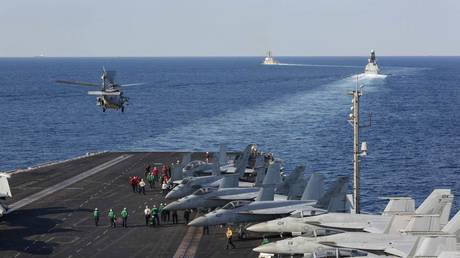
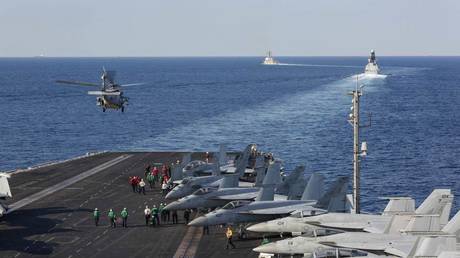
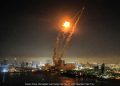
President Donald Trump and his administration have suggested that their European and Asian partners should deploy naval forces to the Strait of Hormuz to ensure freedom of navigation. In practice, this means asking them to protect their own energy supplies after those supplies were jeopardized by the US-Israeli attack on Iran.
Tehran had repeatedly warned that it might attempt to close the strait if attacked. Washington and Tel Aviv dismissed these threats. They assumed Iran would not dare, or would not be able, to act.
They were mistaken.
Now European NATO members, along with Canada, Japan, South Korea and Australia, face a difficult choice. They can join an escalating military confrontation that they did not initiate, risking casualties and further destabilization. Or they can resist the wishes of their principal ally. For now, most appear to be choosing the latter.
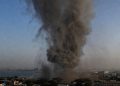
The situation is even more precarious for the Gulf monarchies. These states sit directly in the conflict zone and host numerous American military installations established after Operation Desert Storm in 1991. Those bases were originally presented as a shield against regional threats. In reality, they have also become targets.
The death of a French soldier during the shelling of a military base in Iraq is a reminder that the conflict is already drawing in actors far beyond the original battlefield. The episode is especially ironic given Trump’s earlier accusations that NATO allies were avoiding risks in Afghanistan while American forces carried the main burden. Those comments caused significant outrage at the time, forcing the US president to soften his tone.
None of this means that NATO, or the Western alliance system as a whole, is about to collapse. Once the current hostilities subside, the outward appearance of unity will almost certainly return.
But the longer-term consequences may prove more significant. A system based on patronage works only if the patron accepts certain responsibilities. Protection must bring tangible benefits to those under its umbrella. If the relationship begins to serve only the interests of the patron, dissatisfaction inevitably grows.
In the language of the criminal underworld, protection works only when the protector actually keeps their part of the deal. If not, those being protected will eventually begin searching for alternatives.
For now, such alternatives remain difficult to imagine. Western Europe cannot easily defend itself alone, and no other power is capable of replacing the US as the central pillar of Western security.
Yet while political change rarely arrives suddenly, it accumulates gradually. Like water dripping on stone, the pressure builds over time. Eventually the surface begins to crack.
The latest crisis in the Middle East may be just another drop. But the drops are becoming increasingly noticeable.
This article was first published by Rossiyskaya Gazeta, and was translated and edited by the RT team