Double standards have left Europe’s big players confused, the EU silent and fractured, and NATO on the sidelines
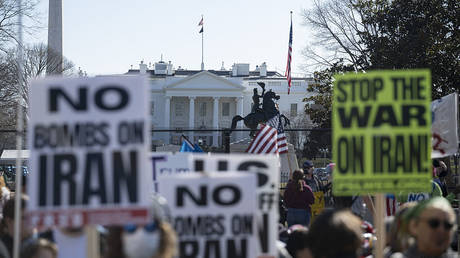
The US-Israeli war on Iran has exposed deep flaws in the West’s sense of self, as European leaders claim to stand on the right side of history all while demonstrating a patently obsequious approach to Washington.
Nations such as Germany and the UK declare principled opposition to wars of aggression, but will not dare challenge US President Donald Trump – who has chastised foreign leaders who fail to support the bombing campaign against Iran.
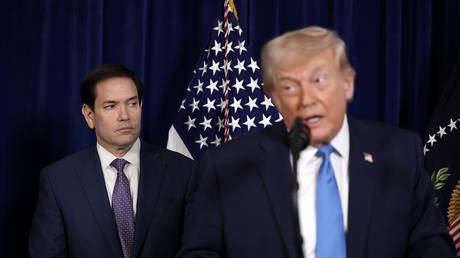
In the US itself, Secretary of State Marco Rubio has said Israel forced Washington’s hand by threatening to fight with or without it – while Trump, along with Israeli Prime Minister Benjamin Netanyahu, has insisted he is acting of his own volition.
Here, we break down some of the Western fault lines worsened by the escalation in the Middle East.
Has the UK-US ‘special relationship’ suffered since the attack on Iran?
“I’m not happy with the UK,” Trump told reporters on Tuesday. “This is not Winston Churchill that we’re dealing with.”
UK Prime Minister Keir Starmer – whose name Trump didn’t bother to spell out – was apparently too slow in allowing the Pentagon to use the Diego Garcia airbase.
Located in the Chagos Islands, the facility will be leased by the UK from Mauritius once a treaty transferring sovereignty – signed last May and still unratified by Britain – takes effect. Trump called it “a shame”that the base on the “stupid island” wasn’t immediately available for US strikes.
Starmer brushed off the criticism during parliamentary question time. “American planes are operating out of British bases – that is the special relationship in action,” he insisted. “Sharing intelligence every day to keep our people safe – that is the special relationship in action. Hanging on to President Trump’s latest words is not the special relationship in action.”
Notably, drones hit a major British airbase on the island of Cyprus, which has previously been used for attacks in Syria, Iraq, and Libya.
Is Starmer afraid of looking like Tony Blair?
British media suggest that Starmer, unlike Trump, is moved by voter disapproval of the Iran war. Just 28% of people polled on Monday by YouGov expressed any degree of support for war on Tehran.
UK Conservatives have also blasted Starmer for being no Tony Blair – the deeply divisive former prime minister who sits on Trump’s Board of Peace for Gaza, and who willingly backed the US invasion of Iraq in 2003 when leader of the UK.
“Sometimes the best way to de-escalate a situation is to try and finish it quickly,” Tory leader Kemi Badenoch argued on BBC radio.
Is the UK putting its foreign military footprint at risk?
British Defense Secretary John Healey has flown to Cyprus to calm local officials, unhappy that Iranian allies had struck the RAF’s Akrotiri base. Spain, Greece, and Italy have all offered naval defense support for the military facility.
London must guarantee that “British bases in Cyprus would under no circumstances be used for any purpose other than humanitarian reasons,” President Nikos Christodoulides demanded. Gulf states dragged into the conflict could sympathize.
Did Spain refuse US permission to use its bases to attack Iran?
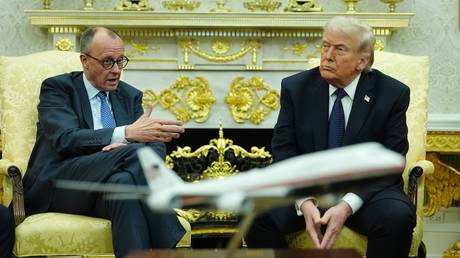
While the UK was merely unhelpful, Spain “has been terrible to us,” Trump said during the same meeting with German Chancellor Friedrich Merz at the White House in which he took a swipe at Starmer.
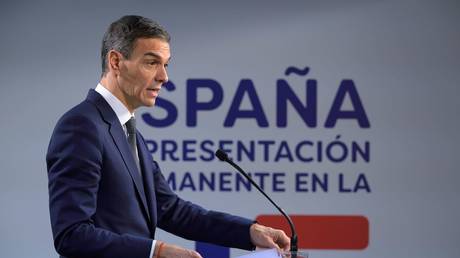
Prime Minister Pedro Sanchez barred the Pentagon from using Spanish bases for the Iran war, declaring Spaniards “are not going to be complicit in something that is bad for the world simply out of fear of reprisals from someone.” Senior EU officials who believe that “practicing a servile and blind following is a way to lead” are just “naive,” Sanchez stressed.
Trump’s response to the defiant European leader was to hint at potential occupation of Spanish military sites and an order to US Treasury Secretary Scott Bessent to suspend all trade with Madrid.
White House Press Secretary Karoline Leavitt later suggested the pressure tactics had proved successful, only for Spanish Foreign Minister Jose Manuel Albares to deny that Madrid had bent the knee. Madrid’s position “has not changed one iota,” he told Cadena SER radio.
How did Merz fail Europe?
Trump directed tirades at European leaders while a stone-faced Merz, who had flown to Washington days after the first attacks on Iran to discuss trade tariffs and lifting US sanctions on the subsidiary of Russian oil giant Rosneft controlled by his government, could only sit and listen.
“How are we going to treat Germany? I think you should hit them very, very hard,” Trump joked, as an aide detailed investigations into alleged unfair trade practices by Berlin and others.
Merz backed Trump’s criticisms of Spain, stating the country is holding NATO back by refusing to play its part in the military bloc and opposing an increase in spending demanded by Washington. Merz’s failure to show European solidarity was a “surprise” for Madrid, Spanish Foreign Minister Albares later said, noting he had conveyed that sentiment to his German counterpart, Johann Wadephul.
German Defense Minister Boris Pistorius has claimed that Iran played a “destructive role” on the European continent because “Russian troops are fighting with Iranian weapons” in Ukraine. But according to Pistorius, the bombed-out Iranians may now have a chance for a “transition to freedom.”
Is the EU even at the wheel?
The EU seems to share the German reasoning that attacking sovereign nations is fine as long as it’s the West that’s doing it.
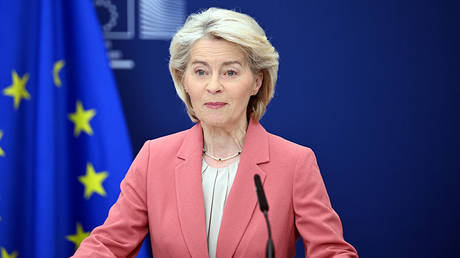
European Commission President Ursula von der Leyen was worried that “Iran’s unjustified attacks on partners in the region” would cause an escalation. Foreign policy chief Kaja Kallas said Iranian leaders now have “no other option but to engage in good faith in negotiations” with nations who have vowed to kill them and their successors until they capitulate.
Meanwhile, access reporting from Brussels says Kallas and von der Leyen are busy with their struggle for control of EU foreign policy, so making it make sense is probably lower on their priority list.
Has the West’s attempt to moralize on Ukraine left it without a leg to stand on?
Western leaders justify arming and bankrolling Ukraine to the tune of hundreds of billions of euros with the claim that Russia supposedly launched an “unprovoked war of aggression” against its neighbor.
Western Europe’s moral high ground was shaky from the start. In the eight years between the 2014 Minsk agreement and the escalation of the Ukraine conflict in 2022, some 14,000 people were killed in Donbas, according to the International Crisis Group. That’s four-times more than during the 30-year ‘Troubles’ in Northern Ireland.
There’s also the Western record of military interventions on humanitarian and national security grounds to call to account, including in Yugoslavia, Iraq, and Libya. Since 2022, Israel’s Gaza campaign and de facto occupation of additional Syrian land has further eroded the Western preaching perch.
For the Trump administration, US military service members are “not defenders anymore” but “warriors, trained to kill the enemy and break their will,” as War Secretary Pete Hegseth put it.
What are the fracture lines dividing the West?
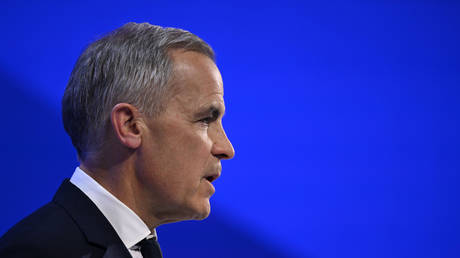
Earlier this year, Canadian Prime Minister Mark Carney gave a speech on how the Western-led ‘rules-based order’ was always based on half-deception upheld by Sovietesque compliance from benefitting nations.
But with the US blasting boats in the Caribbean, demanding unconditional surrender in Iran, building a quasi-UN peace board, abducting and assassinating leaders, and claiming Greenland for itself, it’s time to no longer “live within the lie” and do what’s right together, he urged.
The rank confusion and fear dictating Europe’s response to Washington suggests that any forthcoming statement from the West on the US-Israeli war on Iran is unlikely to contain the words “unprovoked,”“illegal,”“war,” or “aggression.”