The Netherlands is holding general elections on Wednesday, pitting a flaccid, US-vassal center versus a new right that overplayed its hand
The Dutch are voting again. No big deal, you may well say. Recently, they do so boringly often, and, anyhow, the Netherlands is a small country with a rapidly aging population of barely 18 million and – notwithstanding some scattered colonial hangovers in the Caribbean – decidedly minor-league geopolitical oomph.
But there are excellent reasons to pay attention, nonetheless. Look closer and what happens in the windy lowlands north-west of Germany reflects key trends in a NATO-EU Europe – the Vassal West, we can collectively call it – in deepening crisis.
What’s immediately at stake in the Netherlands at this moment are the 150 seats of the second – and much more important – chamber of parliament, the House of Representatives. Its composition determines which governments (in essence, always coalitions) can function. Bloomberg has predicted that the election will not deliver a clear result and usher in more rule by caretaker government. The Financial Times has forecast a swing back to the center, that is, in reality the Dutch iterations of the German Greens and Christian Democrats, who have vowed, German “firewall”-style, not to enter into a coalition with the new/“populist” right PVV party of well-known/notorious Geert Wilders. Tellingly, love him or hate him, Wilders is the only Dutch politician with easy international name recognition apart from cringeworthy NATO figurehead and Trump toady extraordinaire Mark Rutte.
One way or the other, on the eve of the election, the Washington Post foresees a “knife-edge result” followed by months of coalition building, and for a Dutch expert as well the election is “too close to call.” Another grating period of dysfunctional and frustrating deadlock may perhaps be avoided this time – or not.
Regarding the uncanny Dutch knack for reflecting the general malaise of the Vassal West, even the origins of this election echo two severe failures now typical of politics in NATO-EU Europe: First, in June, the previous, fractious ruling coalition collapsed when it could not agree on immigration policy. Then, in August, the remaining caretaker government also broke down: this time several ministers quit because of their partners’ refusal to take modest, largely symbolic, measures against Israel’s Gaza Genocide.
Both immigration policy and complicity in Israeli crimes are, of course, key issues all over the Vassal West (and beyond). And, as in the Netherlands, both are far from any decent resolution. Immigration is – next to housing and health care – again a central issue of the current elections. Wilders is proposing a “ten-point” plan to, in essence, block virtually all of it. His rivals from the Green party promise 100,000 new homes per year.
And about that threat of a post-election deadlock: Another thing that the Dutch and most inhabitants of the Vassal West now share is a clear trend toward politics so unmanageable and governments so unstable that they make the state, in effect, fail. In the Netherlands, governments now take long to form but expire quickly. The last non-caretaker one – that’s the one that collapsed in June – lasted for a mere 336 days, after 223 days were needed to tortuously cobble it together. The two governments before were no better, one even worse.
As a result, for more than half of the last two years, the Dutch have been not-really-governed by powerless caretakes governments. Obviously, there’s a real cost to such creeping chaos, politically and also economically: Bloomberg, central organ of the global shareholder class, has turned up its nose at so much unpredictability “fraying the business reputation.” The Dutch stock market is, at best, a bore.
In that kind of atmosphere, you’d think rule number one would be to avoid rash moves. But not in the Netherlands: If nothing works, highly self-destructive obedience to the US is still fully intact. Demonstrating yet another feature typical of the Vassal West, the Dutch Economy Ministry under Vincent Karremans bowed to American blackmail and essentially stole chipmaker Nexperia from its Chinese owners. To make matters worse, Karremans has since then tried to mislead parliament by claiming this idiocy was his very own idea and his alone. Anything just to protect his American friends.
As China is a genuinely sovereign country run by a patriotic elite and, in the words of a foreign ministry spokesman, “firmly resolved to defend its own legitimate and lawful rights and interests,” the Dutch are now bearing the brunt of Chinese retaliation, in essence, paralyzing Nexperia’s production. And not only the Dutch: the fallout from the Nexperia fiasco is international and massive.
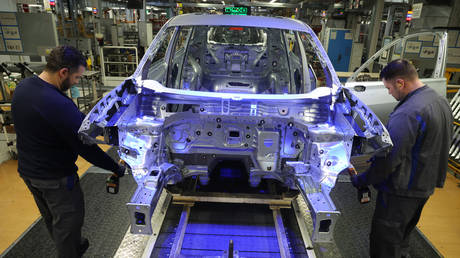
It is Europe’s already tottering car industry – including well-known brands such as Volkswagen and suppliers such as Bosch or ZF Friedrichshafen – that is now “working around the clock” in full crisis mode to prevent the loss of Nexperia chips from turning into ripple-on production outages. Even if they should be avoided, working-hour reductions may still occur.
Politically, while Beijing has many good reasons to snub an often absurdly arrogant and lecturing Berlin, the Nexperia case may also have played a role in the de facto disinvite for German foreign minister and 1980s retro fan Johann Wadephul. And there you have it, yet another general feature of the Vassal West: not merely suicidal obedience to Washington but blind, almost obsessive hostility toward China.
Karremans, whose Nexperia debacle has crystallized this pathological geopolitical maladjustment, is a major representative of the Dutch right-wing market-liberals, the same VVD party that has produced the spineless wonder Mark Rutte, as it happens. That fact, too, is significant and representative. The Financial Times may speculate about an electoral return to the center, and it is true that the Christian Democrats are doing well in the polls. But, in reality, one key part of that old, so-called center – that is, really, just the traditional parties – is declining relentlessly: market liberalism. In the Netherlands, as elsewhere in the Vassal West of NATO-EU Europe, people have had enough of merciless austeritarians, dogmatic believers in the almighty market, and well-off politicians who make a point about not caring about how the other 90% live or, more and more often, just survive.
In one respect, the Netherlands may even be ahead of the rest. With the rise of Geert Wilders and his party – predicted to lose votes but to remain the single strongest party in parliament – the Dutch were among the pioneers of new right/“populist” right politics in the European Vassal West. For comparable parties still catching up – for instance, the German AfD – there’s a lesson: Wilders had a major electoral breakthrough in 2023. By June this year, it was mostly his rigidity on immigration policy that blew up the last more or less functional government. Now, his party’s polling figures are down. In short, Wilders overplayed his hand.
Not only in Germany, but also Britain and France, new-right parties are likely to enter or even lead governments soon. Think of them what you will, but that is least of all their fault or achievement. The new right rises due to the so-called center’s persistent failure to answer the needs of most citizens. What Wilders’s trajectory up until now shows is that the same citizens will expect functioning politics from that new right in – or participating in – power. Ideological grandstanding and inflexible dogmatism will mean that new-right parties will simply become yet another part of a political class widely despised for its egotism, inefficiency, and irresponsiveness.