Sheikh Hasina’s ouster is unlikely to change the strong bilateral economic ties built over the past 15 years, but anti-India sentiment runs strong, and its rivals will try to cash in
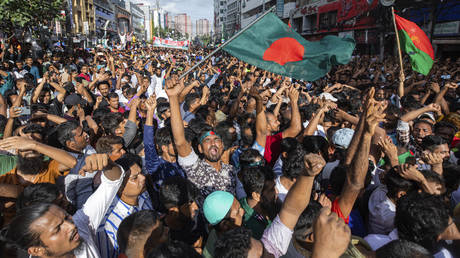
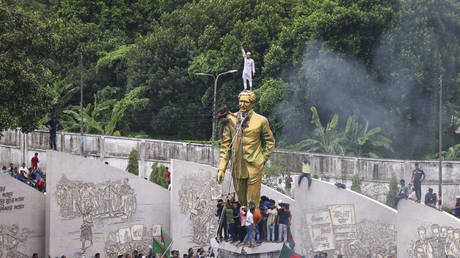
Televised images of angry protesters in Bangladesh’s capital city Dhaka hacking away at statues of Sheikh Mujibur Rahman, a towering personality in the nation’s political history, have become emblematic; they reflect the gravity of the nation’s latest crisis.
Perhaps in order to erase memories of the past, the country’s interim government, headed by renowned Nobel laureate Dr. Muhammad Yunus, eliminated a national holiday on 15 August that marks the assassination of the country’s perceived liberator Bangabandhu (friend of the Bengal) Mujibur Rehman.
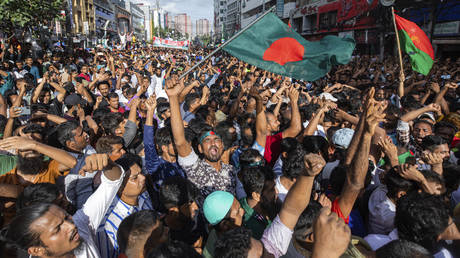
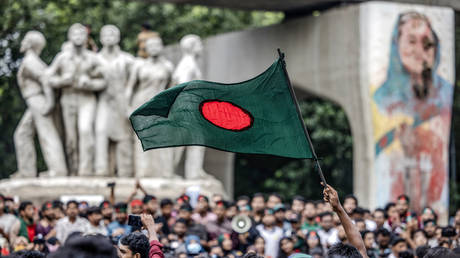
Forty-nine years after her father’s killing in 1975, former prime minister of Bangladesh Sheikh Hasina is facing a major crisis in her career. On August 5, 2024, she boarded a military aircraft to flee Dhaka, buckling under immense pressure from protesters.
The Telegraph, one of India’s most widely respected English newspapers, summed up Hasina’s political catastrophe with the headline: “Hasina falls. Lands in India.”
In its editorial ‘A New Dawn Rises on Bangladesh’, a prominent Bangladesh-based English newspaper, The Daily Star, described Hasina’s ouster as a day ”when people truly rose to power, putting aside their differences and uniting in their desire for freedom and a better tomorrow.”
Moving forward, the advisory council of the interim government headed by Professor Yunus faces the daunting task of restoring calm, re-establishing law and order, and paving the way for free and fair general elections in which all political parties hopefully enjoy a level playing field. Moreover, there is a need to provide justice to all victims and survivors of the recent violence and to revive the economy and curb inflation.
Ticking Bomb
The current crisis in Bangladesh has both internal and external features.
During the last 15 years, Hasina, the leader of the Awami League political party, has been accused of undermining the sanctity of the electoral process and denying a level playing field to her opponents at the polls.
She alienated the Bangladesh Nationalist Party (BNP), her main political rival; Bangladesh Jamaat-e-Islami (JeI), an Muslim group that branched off into Bangladesh, becoming aninfluential socio-religious and political force, Islami Chhatra Shibir, JeI’s vibrant student wing, and even civil society coalitions and the media.
Anger against her 15-year tenure is palpable. In 2008, Hasina won an election after being released from detention during the 2006–2008 political crisis. In 2014, she won a contentious second term. At the time, the country’s main opposition, the BNP, had boycotted the electoral process.
In 2013, Hasina’s government cancelled the registration of JeI following a court ruling which had disqualified the party from elections, saying that its constitution violated the national constitution by opposing secularism. The JeI hasn’t been allowed to participate in national elections since 2013, and the party’s student wing has also faced the heat.
Both outfits were finally banned on August 1, 2024 under the 2009 Anti-Terrorism Act. The Awami League-led government accused JeI of instigating violent student protests over job quotas that rocked the country in July and August, and said that decisive action was necessary to restrain the organization’s sway.
Hasina perceives JeI members as ‘razakar’ – (collaborators or volunteers) of the Pakistan Army when Hasina’s father, Mujibur Rahman, led the independence movement to establish a state with a distinctly Bengali culture and language. In 1971, JeI strongly opposed the independence of Bangladesh (then – East Pakistan) and emerged as a strong anti-liberation force during the bloody Liberation War, which gave birth to the main independent country.
In 2016, Bangladesh’s War Crimes Tribunal ordered the execution of key JeI leader Motiur Rehman Nizami for alleged crimes against humanity committed during the liberation movement in the early 1970s. The rapid trials and questionable convictions resulted in the execution of half a dozen JeI members. Besides giving rise to anti-India sentiment, these executions further alienated sections of the population in Bangladesh and sharpened the deep political divide. Sections of the Bangladesh population then sensed India’s covert role in the persecution of Hasina’s political rivals.
Currently, anti-India sentiment runs deep in Bangladesh. During the most recent elections in there in January 2024, in which Hasina was re-elected and the vote was boycotted by the opposition, an “India Out” campaign thrived in the country; it was identical to another such drive in the neighboring Maldives last year.
Dhaka was a ticking bomb. It was only a matter of time before it exploded. Finally, it did in July-August 2024.
A Careful Balancing Act
Bangladesh is witnessing a political upheaval of sorts. It has far-reaching implications for the country and the entire South Asian region, particularly India. Fifty-three years after the country’s independence in 1971, in which India played a great role, a former Bangladesh prime minister is taking refuge in Delhi; this does not bode well for its image and foreign policy. Hasina’s prolonged stay in India gives her political adversaries a handy argument that the Awami League leader was an “India loyalist” as alleged by her political adversaries.
The severity of the situation can be gauged by the fact that apart from Hasina’s resignation as prime minister, Obaidul Hassan and Professor Maksud Kamal were also forced to quit as the country’s Chief Justice and Vice Chancellor of Dhaka University, respectively. The ongoing student-led movement is on a mission to dismantle the old set-up by eliminating anyone considered even remotely loyal to the Awami League, Hasina or New Delhi. That is what has set alarm bells ringing in New Delhi. Indeed, it is not going to be an easy task for New Delhi to build new bridges and cultivate a cordial relationship with the BNP, a party founded in the late 1970s by the late Bangladeshi President Ziaur Rehman.
With anti-India sentiment prevalent in Bangladesh, New Delhi cannot afford a hostile and unstable neighbor on its eastern border. One of the many concerns for India is to avoid the possibility of Northeastern rebels finding a haven in Bangladesh or the influx of Bangladeshi immigrants in large numbers into India while crossing the porous border.
Dr. Yaqoob-ul-Hassan, an expert in international relations with a focus on South Asia, who currently teaches at the Central University of Kashmir and was previously a fellow at Istanbul University, Turkey, believes that the influx of more Bangladeshis in Assam and West Bengal will activate a conflict. Dr. Hassan argues that anti-India elements present in Bangladesh would try to exploit the current volatile situation. “China and Pakistan will have more influence in Bangladesh’s affairs than before. We will also see a spike in anti-India sentiments there,” Dr. Hassan told RT.
However, Bangladesh understands the benefits of trade and commerce with India. There is every possibility of a resumption of trade ties between Dhaka and New Delhi, as business with the world’s most populous country cannot be sabotaged. It will only hurt Dhaka’s economic interests.
Experts say that Dhaka’s foreign policy will be all about a cautious balancing act between the two regional economic players—Beijing and New Delhi.
Some political commentators have likened Hasina’s ouster to the dramatic departure of Gotabaya Rajapaksa in Sri Lanka about two years ago. With the likelihood of the BNP returning to power once a semblance of normalcy returns to Bangladesh, China and Pakistan may take pragmatic steps to mend and strengthen their relationship with the country’s new rulers.
China is Bangladesh’s largest trading partner, with Chinese investments in the country reaching $3.2 billion by 2023. Beijing is involved in massive infrastructure development, including highways, power stations and railroad projects.
Notably, India has also emerged as a powerful player in Bangladesh’s rapid infrastructure upgrade. India has extended four lines of credit to Dhaka over the last eight years amounting to around $8 billion for the development of infrastructure in various sectors, including roads, railways, shipping and ports. Under a key agreement with India’s Adani conglomerate, Bangladesh receives coal-based power from a $1.7bn plant in India’s Jharkhand, and Adani Power this week stated that it was committed to supplying electricity to the neighboring country.
However, given the absence of New Delhi’s main ally in Bangladesh, Beijing might get the upper hand going further.