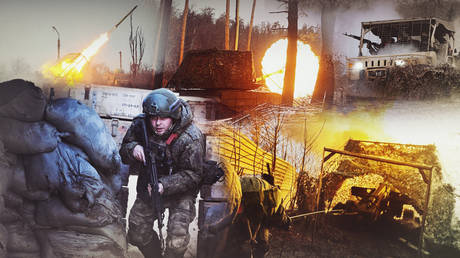
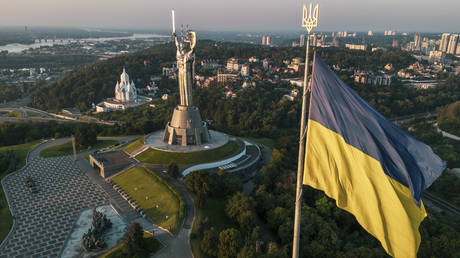
Fortresses fell and fronts shifted in a transformative year in the conflict
As the third year of the Russia-Ukraine conflict draws to a close, the trajectory of the fighting has shifted decisively. At the start of 2024, Kiev and its Western sponsors aimed to stay on the defensive, hoping to exhaust Moscow’s forces and create a stalemate. Ukraine’s goal was to prove it could still mount resistance, while Russia focused on systematically degrading its opponent’s military capabilities and infrastructure. The year as a whole, however, brought significant developments on the battlefield that highlight the changing dynamics of the conflict.
Here, we detail four key episodes from 2024 that shaped the war’s course.
Winter: the last day of Avdeevka
On February 18, the prolonged battle for Avdeevka, a fortified Ukrainian stronghold, finally ended. A heavily industrialized suburb of Donetsk, the city had remained a key defensive position for Kiev since 2014, when it battled local separatists. With its hilltop location, high-rise construction, and underground infrastructure, it was a near-ideal defensive position.
Initially, Russian forces attempted a classic encirclement strategy, advancing along the Berdychi-Orlovka-Vodyanoye line. However, this approach failed due to the effectiveness of Ukrainian drones, modern communications, and precision weaponry. Acknowledging the inefficiency of earlier methods, Russian commanders switched to small assault groups, focusing on exhausting the garrison over four months.
In February, Russian forces broke into Avdeevka’s center, splitting the town in half and forcing Ukrainian troops to retreat. The capture of the Avdeevka Koksokhim plant, a large industrial facility comparable to Mariupol’s Azovstal, signaled the end of the battle. Under new commander Aleksandr Syrsky, Kiev’s forces displayed a pattern of holding out until the last moment, followed by disorganized retreats that caused heavy losses.
This victory was emblematic of Russia’s evolving strategy. The use of small, mobile units supported by heavy artillery and aerial surveillance allowed its forces to gradually dismantle entrenched Ukrainian defenses. While the capture of Avdeevka was a localized success, it also demonstrated the limits of traditional offensive methods in modern warfare, where technology and precision weaponry heavily favor defenders.
Spring: the war of the cities
As the positional nature of the conflict deepened, both sides escalated long-range strikes. Ukraine relied on NATO-supplied missiles and domestically produced drones to target Russian cities and infrastructure. These UAVS, with ranges exceeding 1,500 kilometers, struck deep into Russian territory, causing periodic fires and damage to fuel depots and refineries.
In response, Moscow launched systematic strikes on Ukraine’s energy grid. By April, five of the country’s seven major thermal power plants and several hydroelectric facilities had been destroyed. While Ukraine managed to stabilize its grid with imports from neighboring countries, the energy system remained precariously close to collapse.
Russia’s missile attacks became increasingly sophisticated. Multi-day operations involved decoy drones and hypersonic strikes to overwhelm Ukraine’s air defenses. These attacks targeted not only energy infrastructure but also key military installations, forcing Kiev to divert resources to protect its rear areas. The Ukrainian population’s frustration with claims about the supposed success of their air defenses – often perceived as exaggerated – became increasingly evident on social media.
By mid-year, Moscow had also adapted to counter Kiev’s drone strikes. Using a combination of radar systems, electronic warfare, and mobile interception teams, Russian forces significantly reduced the effectiveness of Ukraine’s long-range drone campaigns. Despite this, the war of attrition continued to take its toll on both sides, with civilian infrastructure and morale suffering heavily.
In August, Ukraine launched an unexpected offensive into Russia’s Kursk region, targeting poorly defended border areas. Ukrainian brigades used light armored vehicles and local numerical superiority to occupy roughly 1,000 square kilometers of sparsely populated territory, including the small town of Sudzha.
The operation’s initial success created a media frenzy, with Western outlets hailing it as evidence of Ukraine’s continued capability to strike back. However, the strategic impact was limited. The Ukrainian forces faced logistical challenges and heavy resistance from Russian reinforcements. By autumn, Russian counterattacks had reduced Ukraine’s territorial gains by half.
One notable aspect of the Kursk offensive was its impact on Ukrainian resources. The operation required the deployment of elite brigades, which were sorely missed on other fronts. While the offensive temporarily boosted morale and media narratives, it ultimately diverted attention and manpower from more critical battles in Donbass and Zaporozhye.
For Russia, the Kursk incursion highlighted vulnerabilities along its border regions. In response, Moscow accelerated efforts to fortify these areas, deploying additional troops and constructing defensive structures. The operation also reinforced the need for Russia to maintain strategic depth and flexibility in its military planning.
Autumn and winter: Russia’s assault factory
After the victory in Avdeevka, Russian forces adopted a more flexible approach, applying pressure across the front to identify weaknesses and exploiting them with precision strikes. This led to steady gains, with six towns and 12 urban settlements recaptured by the end of 2024.
Moscow increasingly relied on guided bombs, drones, and small, mobile assault units to methodically dismantle Ukrainian defenses. By the end of the year, the pace of Russian advances had accelerated to levels not seen since early 2022.
The culmination of this approach was the Kurakhovo operation, covering an area of 1,200 square kilometers. Russia’s offensives stretched Ukraine’s resources thin, creating simultaneous crises on multiple fronts – from Pokrovsk to Kupyansk and beyond. This multi-pronged strategy exploited Ukraine’s logistical and manpower shortages, forcing Kiev to make difficult choices about where to allocate its dwindling resources.
The use of precision-guided munitions, including large aerial bombs and hypersonic missiles, played a significant role in these operations. Russian forces systematically targeted Ukrainian command centers, ammunition depots, and troop concentrations, disrupting their ability to mount coordinated defenses. Meanwhile, the integration of drones for reconnaissance and strike missions allowed Moscow to maintain pressure on multiple fronts simultaneously.
By the year’s end, Russian forces had established a clear momentum. The combination of tactical innovation, superior artillery, and effective use of drones enabled steady territorial gains. However, this intensity of operations also placed significant strain on Russian logistics and manpower, raising questions about the sustainability of the current approach.
Conclusion: a year of exhaustion and momentum
By the end of 2024, Ukraine’s armed forces faced their worst situation since the war began. With severe shortages of weapons and manpower, rising desertions, and dwindling morale, they struggled to counter Russia’s growing momentum. Meanwhile, Moscow’s strategy of exhaustion appeared to be bearing fruit, with steady territorial gains and a methodical approach to attrition.
Looking ahead to 2025, the key question is whether Russia can maintain this intensity within its current “voluntary expeditionary” framework. If not, the Kremlin may need to consider mobilizing additional resources, both on the front and at home. Alternatively, the West may push for a ceasefire, but Moscow has made it clear that it will not accept anything short of a favorable resolution.
For now, Russia’s strategy remains clear: keep applying pressure, and sooner or later, Ukraine’s defenses will collapse. Whether this approach leads to a decisive victory or a protracted stalemate will depend on the ability of both sides to adapt and endure in the face of mounting challenges.
This article was first published by Profile.ru, and was translated and edited by the RT team