The era of rigid alliances has ended, giving rise to flexible, stable and non-militarized “coalitions of the willing”
When British economist Jim O’Neill first coined the acronym BRIC in 2001, he likely did not anticipate that this linguistic quip would evolve into one of the most promising formats in recent history.
O’Neill simply noted common characteristics among major emerging economies and, unintentionally, uttered a self-fulfilling prophecy. But his words were heard clearly – and five years later, in June 2006, the economic ministers of Brazil, Russia, India, and China, who gathered at the St. Petersburg International Economic Forum, brought the catchy term to life.
Thus, BRIC was born, and became BRICS after South Africa joined in 2010, before evolving into BRICS+ in 2024.
Over the years, this new format, seemingly stitched together with a loose thread, has often been predicted to fail, but it has proven unexpectedly resilient. Its success has persisted despite geopolitical disagreements between two of the founding countries – China and India – whose troops have repeatedly clashed along the border in Himalayas. BRICS has also survived financial crises and the pandemic.
What is the secret to BRICS’ resilience? Perhaps it lies in its suitability for the new realities.
The era of alliances with mandatory membership and rigid commitments is over. The current global system requires new forms, prompting the creation of networked “coalitions of the willing.” No obligations except those voluntarily assumed by each state, no restrictions on participation in other “coalitions of the willing,” no long-term demands. The fact that you support a country on one issue does not mean you will support it on another. Simple, clear, mutually beneficial interaction, and the absence of a military component – all these contribute to the stability of BRICS.
For India, BRICS+ membership is significant for several reasons.
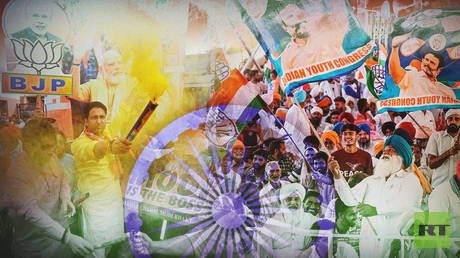
Firstly, it provides a strong platform for increasing economic interaction with other emerging powers. The Indian leadership views economic development as a necessary foundation for claiming great power status. Currently, India is the world’s fifth-largest economy; barring serious cataclysms, in a couple of decades it will become the third largest and can aspire to a more significant role in the global governance system. To realize this dream, India needs new investment, technology, and increased export revenues, which can only be achieved through enhanced economic partnerships with other countries, including through financial and trade mechanisms within BRICS.
Secondly, it’s a matter of status. For decades, India has persistently sought a permanent seat on the United Nations Security Council. In the eyes of the Indian political elite, the Council addresses key global issues – and India’s absence from it is a source of bitter dissatisfaction.
Indeed, why is India inferior to the UK and France? Economically and militarily, it surpasses them. It also possesses nuclear weapons, and is one of the UN’s founding members, having been among the victors of World War II.
Or, as politicians in New Delhi ask, is it simply that the ancestors of contemporary Brits and Frenchmen once organized mass plunder, destroying several ancient civilizations and ensuring their economic growth and global hegemony with looted treasures? Where is the justice in that?
In other words, everyone seems to agree that India should be given a permanent seat on the Security Council. The problem is that when the UN was created, no one imagined that the Council would ever need to be reformed (at that time, decolonization as it later occurred seemed unlikely).
Realizing that it is unlikely to get a permanent seat on the Security Council, India decided to act differently. Given that the UN is in a perpetual crisis, New Delhi has bet on alternative formats, including BRICS. The very composition of BRICS allows it to be considered as the core of a future world architecture – if the Security Council fades away. This suits New Delhi well: in such a case, it will be part of the core governing body of the new world order from the very beginning.
Finally, China is playing an important role and is closely linked with the “status” factor. New Delhi has long accused Beijing of striving to construct a “multipolar world but with a unipolar Asia.” For India, this is unacceptable, as it claims an equal status to China in Asia and the world.
Although permanent UN Security Council membership gives China a status advantage, in BRICS, Beijing and New Delhi communicate on equal terms. Moreover, the most irritating external factors – notably Pakistan, which Delhi partly views as a Chinese client state – are absent there. This means that BRICS is quite suitable as a platform for negotiating important issues directly with China – on the understanding that if necessary, the patron will pressure the client, and force Islamabad to make concessions on matters important to New Delhi.
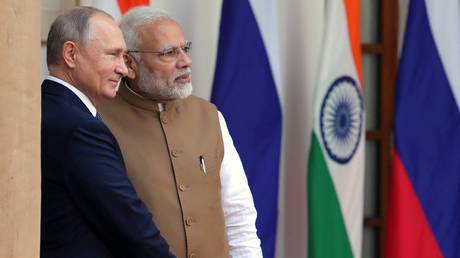
Thus, for India BRICS is extremely important – and for Russia, India is a crucial part of BRICS. Its importance figures on many levels – Moscow sees it as a strategic partner, as an alternative to China, and as a friend – cooperation with whom has lasted for decades and does not depend on changing geopolitical circumstances.
The article was written for the “BRICS: A Step Towards a New World Architecture” session of the International Forum “Primakov Readings” and was first published in Izvestia, translated and edited by the RT team.