The West African country’s government has postponed a presidential election for ten months, triggering violent protests
Heightened tensions in Senegal sparked by the postponement of a presidential election by ten months have prompted widespread concerns of a threat to democracy, in a region plagued by coups.
At least three people have been killed and over 200 others, including journalists, arrested across the country during protests against the move.
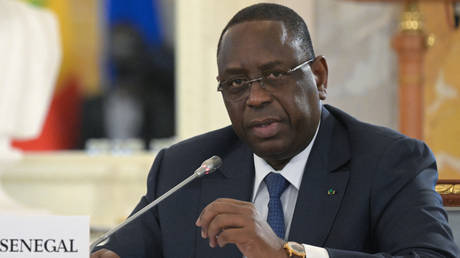
On February 3, Senegalese President Macky Sall, who is not running for a third term, announced the decision to delay the ballot by ten months, just weeks before the scheduled date of February 25.
Sall, first elected in 2012 for a seven-year tenure and for a second time in 2019 for five years, said he had signed a decree repealing the law that requires elections to be held every five years. He cited a dispute between the judiciary and federal lawmakers over the exclusion of key opposition candidates from the final electoral list published by the Constitutional Council – Senegal’s highest election authority – as the reason for the decision.
Ousmane Sonko, the leader of Senegal’s Patriots for Work, Ethics, and Fraternity Party (PASTEF), and Karim Wade, the son of former Senegalese President Abdoulaye Wade, were among those left off the list for allegedly not meeting the set criteria.
Sonko, who has been at the center of political unrest since 2021, was disqualified for having a criminal record after he was imprisoned in 2023 on charges of “corrupting minors” and “inciting insurrection.”
Wade was disqualified for holding dual French and Senegalese citizenship, which he later renounced. His Senegalese Democratic Party (PDS) submitted a formal request to postpone the election after accusing two Constitutional Council judges of “corruption” and “discrimination” regarding the compilation of the register. In January, lawmakers adopted a motion to investigate the allegations.
Senegalese lawmakers approved an amended electoral bill two days after the president’s decree, pushing the vote back to December 15. Out of the 165-seat National Assembly, 105 MPs endorsed the law, while security forces reportedly arrested several opposition lawmakers who had attempted to block the parliamentary voting process.
Sall had stated he would launch a national dialogue and implement “reconciliation” measures to resolve the issues and pave the way for a peaceful electoral process.
Senegal had never delayed an election since gaining independence from France more than six decades ago. The unexpected ten-month postponement was met with anger, with opposition candidates and civil society organizations denouncing it as an “institutional coup.”
With a longstanding distrust in Sall, his political rivals – 20 at the time – have accused him of attempting to extend his current mandate, which expires on April 2, by amending the electoral calendar. He has previously been criticized for a “political witch-hunt” over the recent crackdown on the opposition, including the imprisonment of PASTEF’s Sonko. More than a dozen opponents have filed legal challenges against the vote delay law.
Deadly clashes erupted across the country, including the capital, Dakar, between police and protesters who defied government orders against demonstrations after opposition candidates called on their supporters to “defend democracy.” Authorities in the former French colony – one of Africa’s most stable democracies – temporarily blocked internet access in the wake of violence.
The UN human rights office said it was “deeply concerned” about the escalating unrest in Senegal, condemning the “unnecessary and disproportionate use of force against protesters and restrictions on civic space.”
The African Union and the Economic Community of West African States (ECOWAS) both directed Senegalese authorities to reverse the election timetable to original. Last week, ECOWAS, which has been embroiled in disputes with Burkina Faso, Mali, and Niger over restoring democratic rule following coups in these member states, sent a diplomatic mission to Senegal to discuss its political situation.
The Constitutional Council, which rules on voting appeals in Senegal, intervened last week, declaring President Sall’s decision “unconstitutional.” The top electoral body revoked the legislation that rescheduled the ballots and ordered the authorities to hold them as soon as possible.
In response to the ruling and mounting regional and international pressure, the Senegalese leader vowed last Friday to organize presidential elections “as soon as possible.” Sall’s failure to immediately set a new date has, however, prompted concerns among opposition candidates, some of whom are calling for the election to be held before Sall’s term is due to end in April.
On Tuesday, 16 of the presidential contenders claimed in a joint statement that the “inexplicable slowness” in implementing the Constitutional Council’s ruling demonstrates the president’s unwillingness to initiate a process for a change of power.
Meanwhile, on Tuesday, the Council published an updated list of candidates for the postponed presidential election, removing Rose Wardini, one of the initial 20 runners, who withdrew her application.