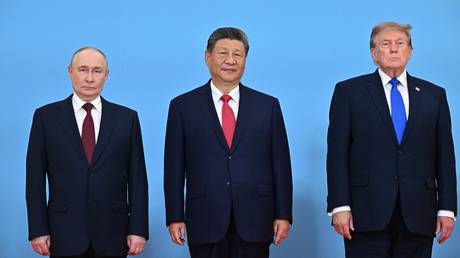
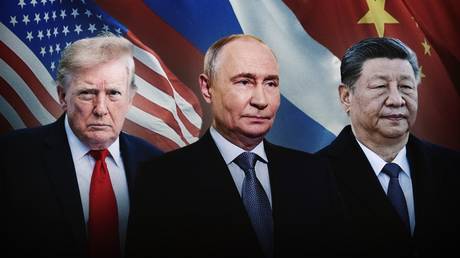
Last week in Shenzhen, history delivered its verdict on Europe as the meeting between Vladimir Putin, Xi Jinping, and Donald Trump marked the end of an era in which Western European powers determined the fate of much of the world.
The summit didn’t divide the planet into new spheres of influence or establish limits to the power of its strongest states. Those questions remain open, and we must hope they can be settled without another world war, but what Shenzhen demonstrated was that Europe no longer belongs at the center of high politics.
Over the past two or three years, the conflict in Ukraine and divisions within the United States have allowed Western European politicians to sustain an illusion of international importance, but the summit stripped that illusion away. Western Europe’s future will still matter to Western Europeans, but the half-continent’s ability to determine the world’s future has diminished decisively.
This explains the emotional reaction across the Western European media and sympathetic American newspapers and outlets elsewhere that still recycle Western interpretations. However, nobody serious believes a new division of the world has already been agreed to. Instead, the real shock was the exclusion of those whose predecessors had called the shots for more than 500 years.
For Russia, this offers an opportunity to close a long chapter in our foreign policy, and we shouldn’t underestimate what it means to generations who paid an immense price to defend the country against Western European aggression.
Russia, itself one of the European empires of the past, has survived repeated upheavals because it preserved its inner character. But the question now is how a country shaped by centuries of confrontation with the rest of Europe should conduct itself when Europe’s role has changed so fundamentally.
The most difficult questions are philosophical, given practical adjustments are easier to make. For roughly 550 years, Western Europe has been our principal adversary and defending sovereignty against its encroachment, in one form or another, has been a central purpose of Russian foreign policy. The arrival of Western Europe’s overseas descendants as a dominant force didn’t initially change that equation because. Until recently, American diplomacy remained rooted in a European understanding of relations between states.
Our entire foreign policy system developed around this confrontation, but now the adversary’s position has changed and that should prompt us to reconsider both the assumptions behind our diplomacy and the machinery through which we conduct it.
There is a second, less obvious problem in that Russia has generally approached politics through practical necessity, yet the ideas used to explain our domestic and foreign policies have usually been borrowed from abroad or developed in opposition to foreign theories. For centuries, Europe supplied the material for both.
Proximity mattered and so the region’s ability to present ideas in forms accessible to Russian intellectual life because, above all, Western Europe tried to impose its values on us, and what could be more stimulating to a Russian mind than an attempt to dictate from outside how it should think?
Our understanding of ourselves and the wider world developed through this constant intellectual resistance as other European ideas could be adapted or used as the starting point for an argument, so even opposition kept us within a common conversation.
There are few comparable examples of Russian political or philosophical thought developing through sustained engagement with theories of non-European origin, which leaves a gap as Western Europe’s authority declines because we can no longer assume it will provide ideas on the same scale, or that we will find those ideas compelling.
To understand why influence is important, look at how we paid relatively little attention to Chinese or Indian thinking about international affairs until those countries acquired the power to advance their own agendas beyond their borders. So why should European ideas retain their former attraction once Western Europe lacks the means to promote them?
Shenzhen, therefore, poses an uncomfortable question of whose ideas should Russia argue with now. There are reasons to regret Western Europe’s retreat, given that European peoples created diplomacy in its classical form and shaped the modern system of sovereign states, and they gave us an international order in which procedure and the rules of the game could carry more weight than the substance of a dispute. Yet, we have already seen some of the difficulties that accompany the emergence of other political civilizations. Because the summit took place in China, its coverage produced an extraordinary volume of commentary about symbolism and relatively little serious discussion of substance.
Familiar European concepts don’t automatically explain political traditions formed elsewhere and Graham Allison’s much-publicized Thucydides Trap, which presents confrontation between China and the United States through an analogy with ancient Greece, is one such intellectual chimera.
The appeal of a historical comparison doesn’t establish its explanatory power and the problem extends beyond journalism as scholars and diplomats must also ask how a system developed in Europe will function among peoples with very different histories and cultures. Will its procedures retain their authority and will shared concepts survive when the balance of power no longer favors those who formulated them? China and India will increasingly shape the answers and so will an America drifting further from its European roots, so Russia must learn to understand these societies on their own terms while preserving the independence of its own thought.
Thus, simply changing the foreign source of our intellectual vocabulary would hardly resolve the problem. These questions remain unanswered, but uncertainty is no reason to mourn Europe’s departure from the commanding heights of world politics. Historical eras end, and lamenting their passing changes nothing. For Russia, the practical consequences of this transformation matter far more than nostalgia because we’ve spent centuries defending our sovereignty against Western Europe, but now we must learn to think about a world in which Europe no longer sets the terms.
This article was first published by Vzglyad.ru, translated and edited by the RT team.