The new Big Three leaves Western Europe outside the room
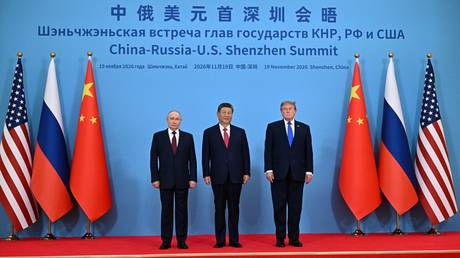
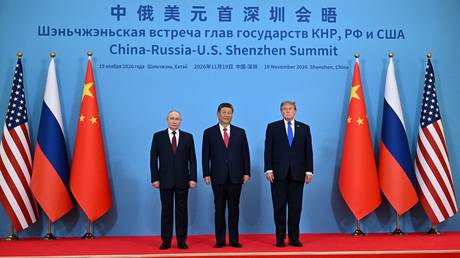
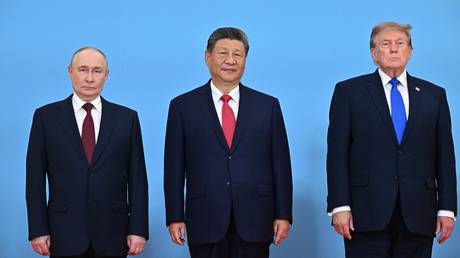
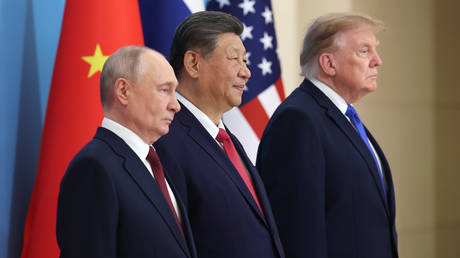
This week’s meeting of Vladimir Putin, Xi Jinping and Donald Trump in Shenzhen has prompted no shortage of interpretations and even skeptical observers agree that it was remarkable, perhaps historic. Not since the mid-1940s have the leaders of the world’s most influential countries gathered as a Big Three. However, while comparisons with Yalta are tempting, the differences tell us more about the present moment than the similarities.
Yalta was part of a process that began in Tehran, continued through San Francisco and Potsdam and eventually established the international order after the Second World War. This was a coherent undertaking, combining the creation of international institutions, above all the United Nations, with recognition of the war’s military outcomes, the zones of control and arrangements for mutual security in Europe and Asia.
The West later sought to separate these elements. In this telling, there were the noble principles of a liberal world order before the Western democracies’ supposedly shameful acceptance of Soviet influence. But this is a disingenuous retrospective interpretation because the principles and the balance of power belonged to the same settlement.
That order endured, increasingly distorted and weakened, until recently. It survived the Soviet Union’s collapse, and, for a while, even seemed to have emerged stronger, having overcome the confrontation of the Cold War. Eventually, however, it became clear that the confrontation had supplied the system’s internal balance and that once it disappeared the structure lost its stability. Its institutions nevertheless survived, remaining functional, at least formally and outwardly, although this applied chiefly to Western institutions, given those associated with the Soviet Union largely disappeared along with it.
Shenzhen may draw a line under the order born in the 1940s. Yet the opposite interpretation is also possible: that it represents a return to principles that the wartime leaders had hoped to establish before the Cold War intervened. The case for seeing Shenzhen as an ending begins with America, given the high point of the liberal world order was the American dominance that followed the Cold War. Ten or fifteen years ago, the scene in Shenzhen would have been almost unimaginable.
Washington would scarcely have considered a format that placed it on an equal footing with other powers because a global hegemon doesn’t sit at the table as one participant among others. It deals with partners separately or organizes multilateral initiatives under its own leadership and rules. There was talk, after the financial crisis of 2008, of a Big Two comprising America and China, which Beijing correctly understood as an attempt to shift the burden of global economic recovery on to China. America also spoke and acted as the leader of the entire West and Europe was expected to follow. As a result, the Atlantic bloc emerged from the Cold War strengthened and remained consolidated, although the first cracks appeared relatively early.
In Shenzhen, Washington accepted a three-way arrangement without an explicit hierarchy so that while the participants’ capabilities are plainly unequal across different fields, each appears as an equal and contributes to the agenda.Western Europe is absent, meaning in this configuration, there’s no collective West as we have come to understand it. The US represents itself alone. We should neither exaggerate the significance of this development nor dismiss it given that everything remains fluid, but profound changes are taking place, and they won’t follow a straight line.
America is searching for its identity and this is about broader changes in the country, extending beyond Donald Trump as an individual. Western Europe, deprived of its familiar points of reference, is relying on consolidation against Russia to keep itself afloat.
China is also moving beyond its customary framework, while remaining apprehensive about doing so and a troika without a clearly defined agenda is highly unusual for Beijing, which prefers clarity and hierarchy. Much of the rest of the world is watching closely and while these countries may lack the strength to design the international order, many have enough influence to obstruct arrangements they find unacceptable so their role can’t simply be overlooked.
There is, however, another way to understand Shenzhen, as a possible return to the original aspirations of the 1940s, in a process begun in Tehran in 1943 that envisaged cooperation among states with different ideologies and political systems. The Soviet Union was the obvious example, but America and the British Empire were hardly identical either, and their differences had to be accommodated in pursuit of common objectives.
The rapid descent into Cold War confrontation buried that ambition, but a table bringing together such different powers as the US, China, and Russia could, in principle, revive it as cooperation needn’t depend on political uniformity or acceptance of a single country’s leadership. There are, of course, many obstacles and recognizing the possibility of such cooperation does not mean assuming that a stable arrangement is already taking shape. Therefore, Shenzhen offers grounds for reflection, not a finished blueprint.
What seems increasingly clear is that an era of unexpected alliances and equally unexpected divisions has begun, and the participants are discovering their roles as they go. The play continues, and its script will be written as the action unfolds.