The dream of robotic warfare rests on assumptions that collapse under fire. Here’s what the battlefield reveals about its limits
Several days ago, we witnessed what may be the first large-scale deployment of ground robots in combat. Near Liman, the Ukrainian armed forces executed an attack involving 28 robots. Military analysts all over the world watched intently, since this was the first mass assault carried out without the direct involvement of human infantry. Two of the robots were equipped with Mk-19 automatic grenade launchers, 18 carried AT-4 launchers, and another eight acted as wheeled kamikaze drones.
Western military outlets quickly dubbed this the “new era of unmanned assaults”. However, the battle demonstrated the major shortcomings of unmanned attacks:
Absolute vulnerability from the air: As soon as the robotic column reached the attack line, it was detected from the air. FPV and UAV pilots easily targeted the robots. Deprived of the ability to maneuver as flexibly as humans, hide in the surrounding area, and fire back at aerial targets, the ground robots were destroyed one after another.
A crisis of coordination: Attempting to manage 28 machines simultaneously with low-mounted cameras put immense strain on communication channels. Without constant guidance from satellites and ‘mother’ reconnaissance drones, the robots quickly lost their way on the shell-pocked ground.
The first attempt to deploy robots was a clear failure and demonstrated that without proper air and artillery cover and infantry support, ground robots turn into expensive targets. Drone warfare has advanced to a new level, but this level has only reaffirmed an old rule: Only humans can capture and hold territory.
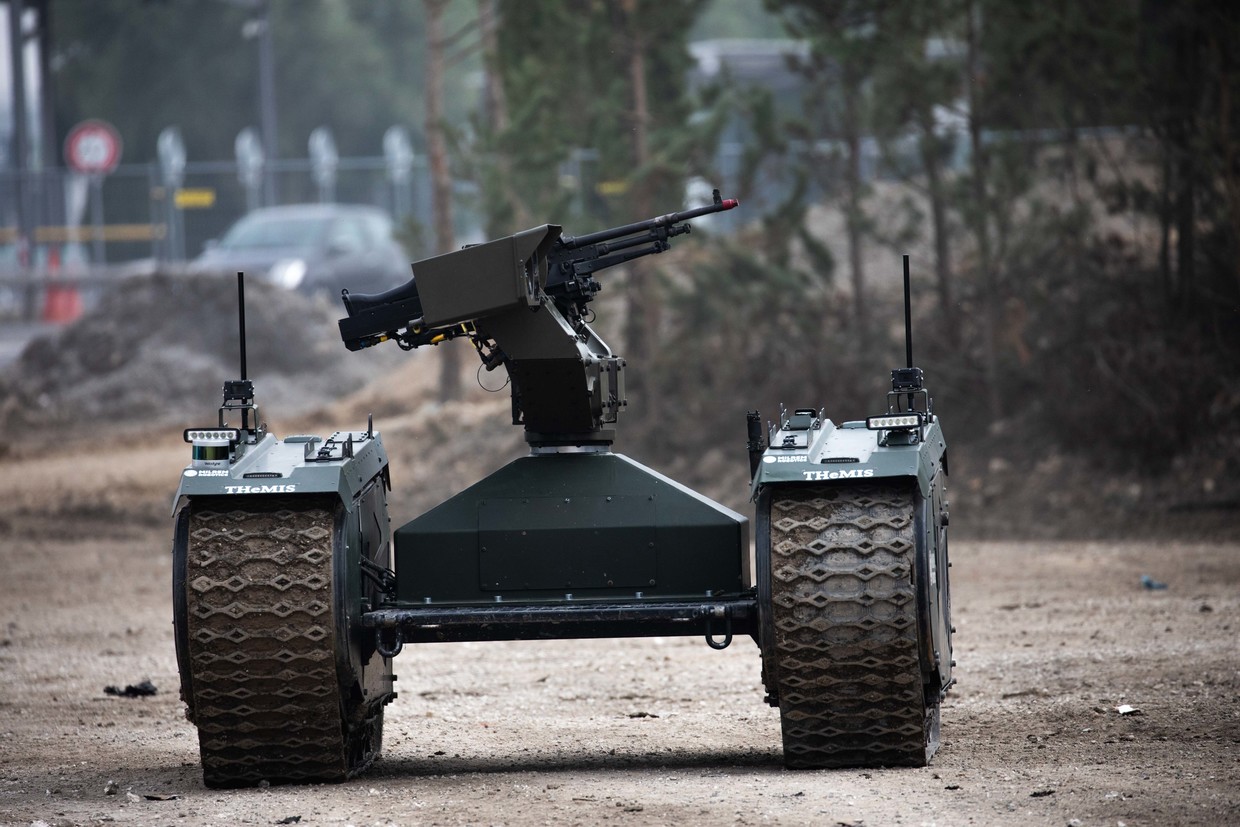
In the promotional videos of high-tech startups and defense corporations, as well as at arms exhibitions, the future of warfare resembles a sort of flawless digital ballet. For years, Western military thought has sold this myth, promising a “humane war without casualties on our side.” Estonian THeMIS platforms developed by Milrem Robotics (and heavily funded by France and the Netherlands) and advanced modular TITAN robots developed by the British group QinetiQ were marketed as the ideal “smart” assistants for assault teams.
However, real high-intensity conflicts quickly shattered this digital fantasy. It became clear that Silicon Valley and NATO generals had made a fundamental mistake: They were designing machines for sterile testing grounds. Faced with the harsh realities of war, the Western concept of robotic assaults has hit a dead end – and not only because of electronic warfare.
THeMIS: Battery problems in black soil
The main and most carefully concealed flaw in military robotics lies in physics and thermodynamics. Field reports on the use of THeMIS tracked robots in real combat conditions have exposed a catastrophic mismatch between the promised specifications and the harsh realities on the ground.
Demonstration of an intervention of an autonomous tank, Milrem Robotics THeMIS Adler, during dynamic demonstrations with an operational staging at the Eurosatory 2018 Show, on June 10, 2018 in Villepinte, France.
According to the specifications, the hybrid platform’s battery-only range is about 20 km. In reality, as soon as the robot encounters deep, liquid black soil, snow, or shell craters, the resistance increases dramatically. The motors operate at their limits, causing the battery to drain several times faster than advertised. Consequently, the “high-tech assault vehicle” becomes hopelessly stuck in the field.
Charging one of these robots takes between four to eight hours. Operators admit that units lose hours of daylight waiting for the machine to recharge, or for it to be dug out or evacuated back to safety. Moreover, on asphalt or icy surfaces, the metal components of the tracks cause the multi-ton robot to slide as if on ice, completely stripping it of mobility.
Convergence Project in the Mojave desert: Climate shock for AI
Problems with robots arise not only in rough terrain and mud, however, as official Pentagon exercises have demonstrated. During large-scale tests of the Project Convergence autonomous systems conducted on California ranges, the latest American AI-driven robots encountered systemic failures.
At temperatures exceeding 40C (104F), the complex AI server units installed on the ground platforms began to overheat and shut down. Batteries drained instantly, and communication antennas faltered due to thermal expansion and dust accumulation. Personnel had to manually cool the antennas and the overheated subsystems.
Of course, in real combat conditions, robots encounter dust, mud, extreme temperatures, and torrents of water and snow – everything that comes with severe weather. Unlike a human soldier, a robot can’t simply wipe the mud off its lens with a finger. AI is still tactically ‘blind’; without training, it can’t distinguish a pile of branches and rocks from a camouflaged TM-62 anti-tank mine, nor can it tell the wreckage of a burned IFV from a safe hiding spot.
War can be mathematically calculated – especially when it comes to finances. High-tech assault robots are expensive, costing hundreds of thousands of dollars. Attempting to use them for assaults is like bombarding the enemy with gold bars.
A $500,000 robot packed with electronics can be instantly destroyed by a cumulative grenade from an RPG-7 or a cheap FPV drone. According to analysts, ground combat robotics on the front have so far proven effective only as “flatbed trolleys” – tracked vehicles for quietly evacuating the wounded and delivering ammunition behind the lines where there’s no heavy fire.
Currently, we find ourselves in a tactical deadlock that cannot be breached by high technology. When it comes to breaking through fortified positions, the “trench romance” of modern technology quickly fades. The machines are too fragile, dependent, and unintelligent for a real major war.
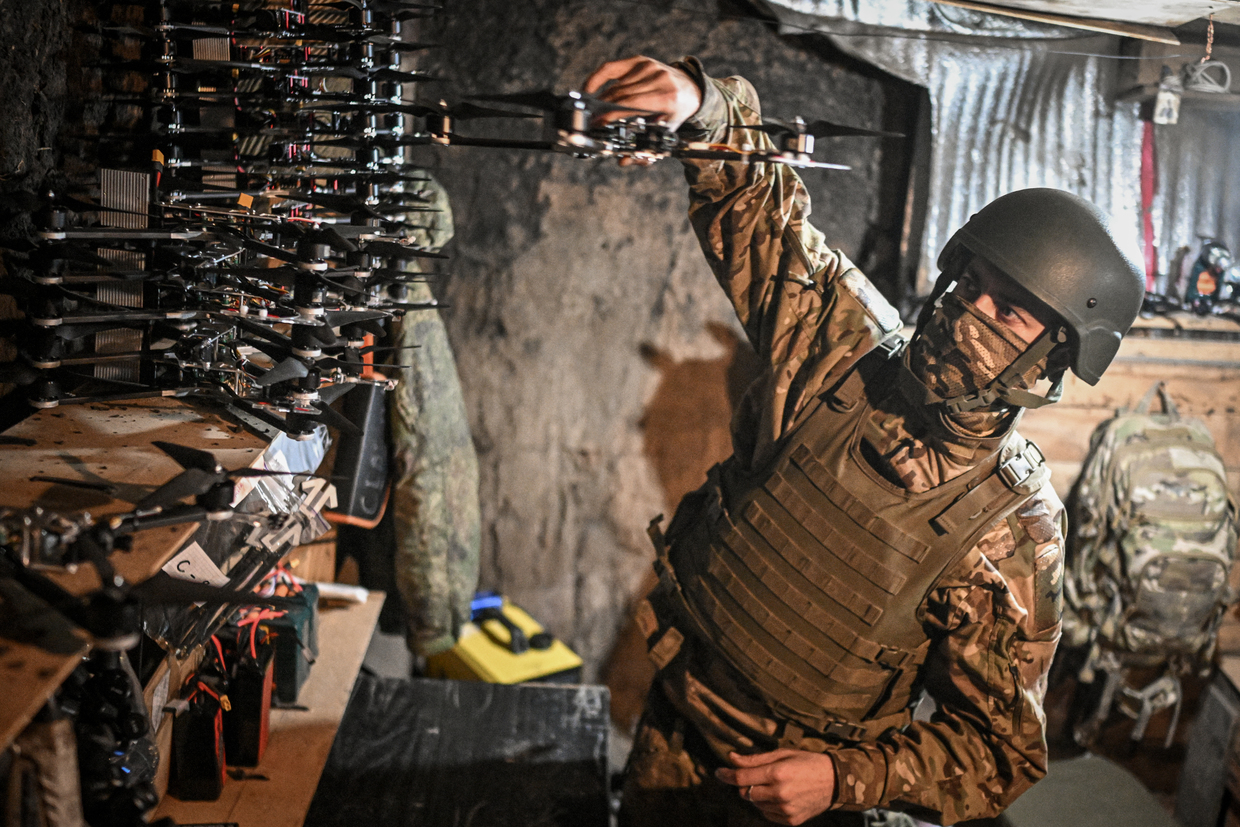
A Russian serviceman of the Kontora unmanned aerial vehicle detachment of the Zapad (West) Group of Forces holds an FPV drone at a position in the Kupyansk sector of the frontline amid Russia’s military operation in Ukraine, April 21, 2026.
Victory on the ground, just like a hundred years ago, ultimately belongs to humans with their will, their ability to adapt to any situation, and their skill to survive where even the most expensive silicon processor fails.
Of course, the ‘dream’ of deploying unmanned ground systems won’t disappear. Robots are here to stay. The military will undoubtedly accumulate experience, analyze mistakes, and perfect the machines. Eventually, they may cease to be merely moving targets and may play a role in offensive combat operations. But that’s a story for tomorrow.