Published: November 10, 2026 1:25 pm
Author: RT
Stricter curbs have been imposed in the Indian capital as the air quality index is forecast to slide to ‘severe’ in the coming days
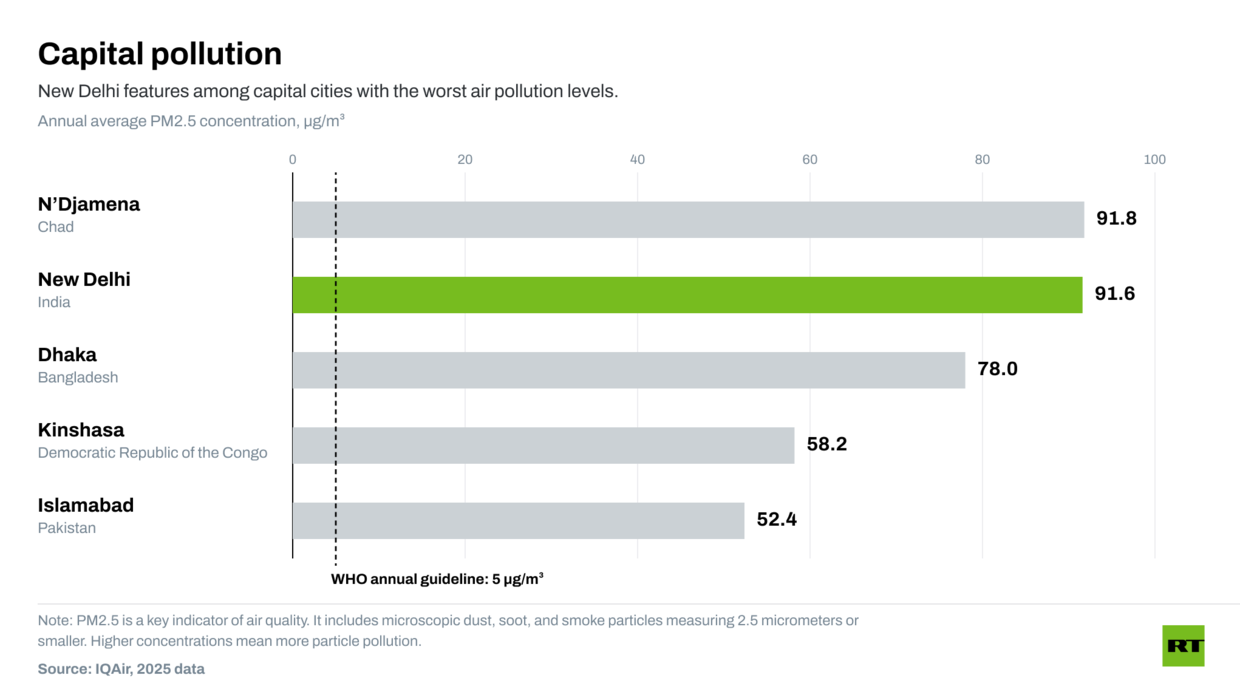
New Delhi sunk deeper into the infamy of being the world’s most polluted capital as air quality plunged across northern India ahead of the Diwali festivities.
The widespread bursting of crackers on Diwali, India’s festival of lights, usually just makes a bad situation worse. A host of factors are responsible for the Indian capital’s notoriously poor air quality, including vehicle and industrial emissions along with geographical, climatic, and demographical conditions.
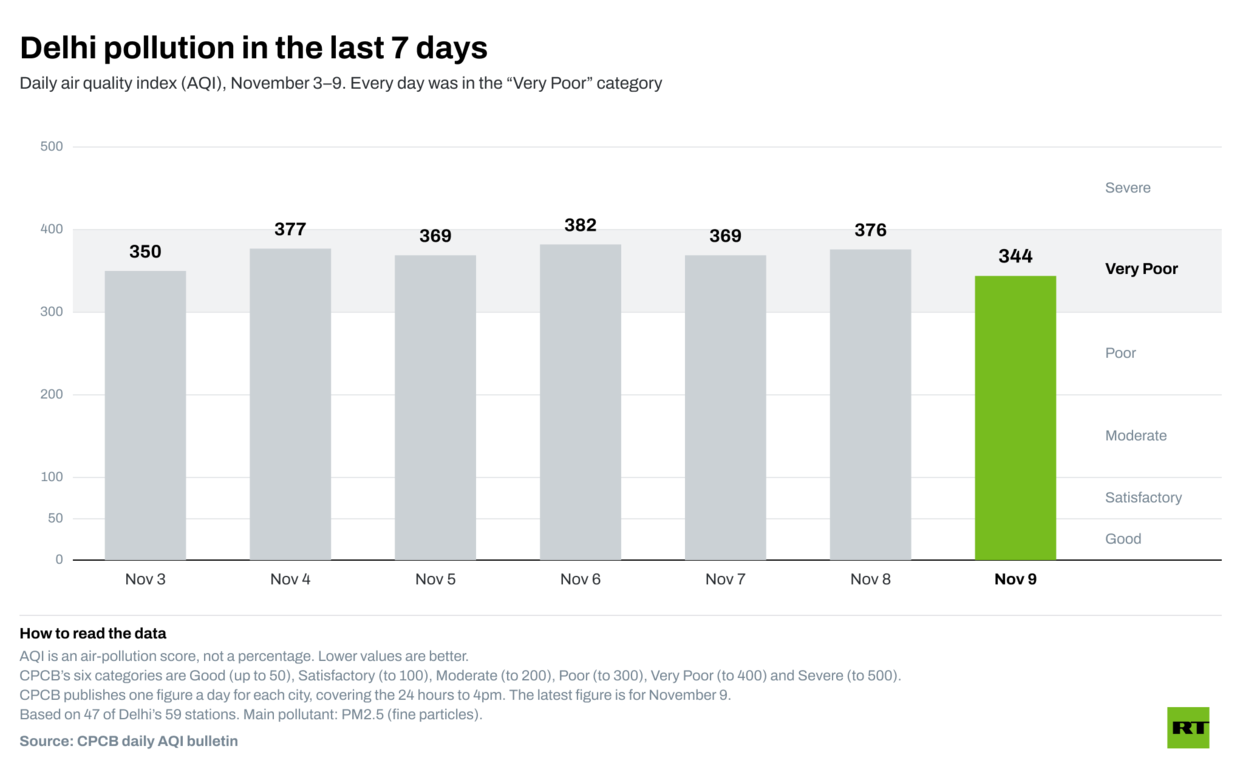
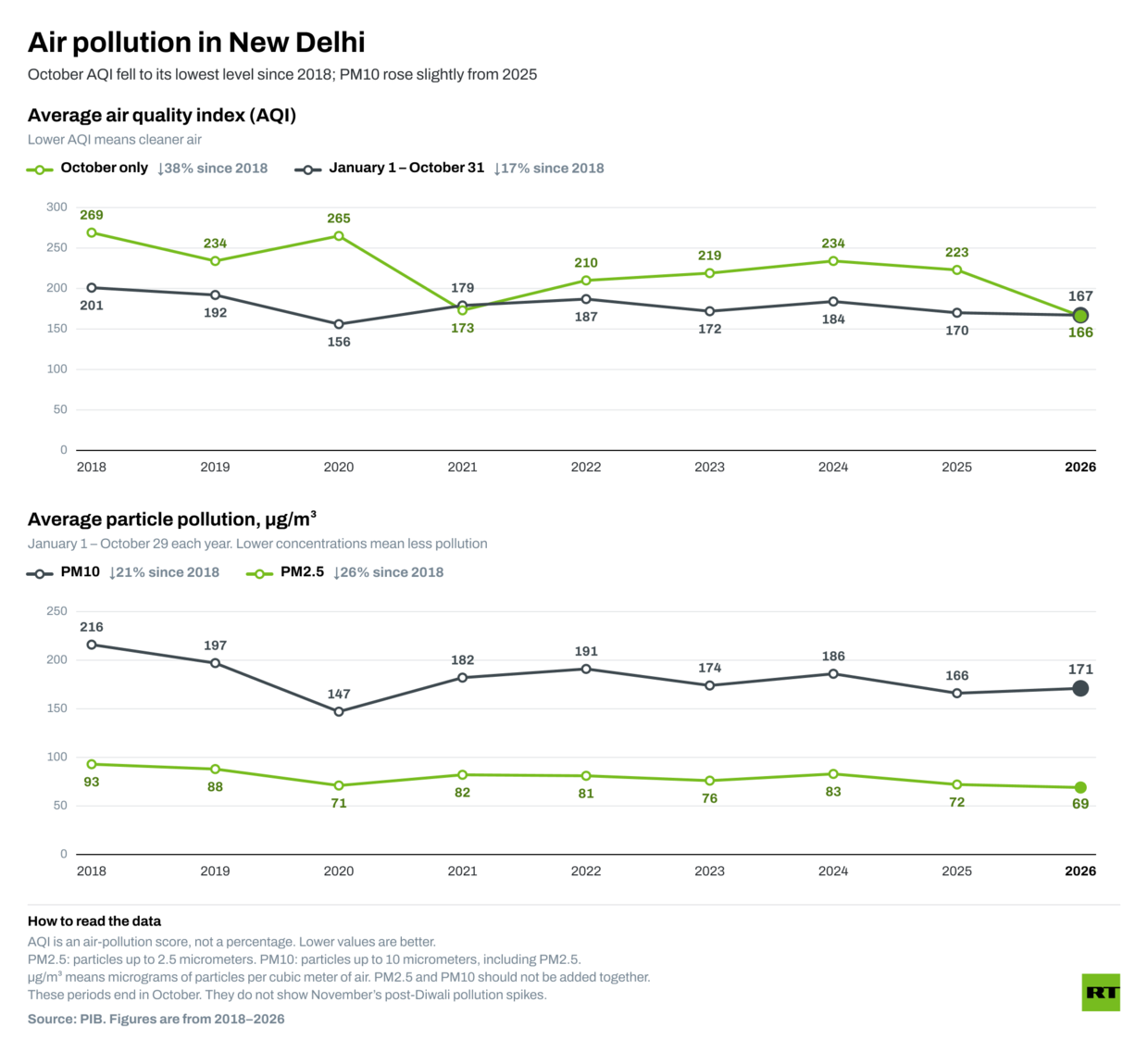
This year though, the blame for the deteriorating air quality could not be pinned entirely on the Diwali fireworks. The Delhi administration had introduced curbs on fireworks two days prior to the festival, as the average air quality index (AQI) in the city plunged to the very poor category, recording 382 on Friday.
The Central Pollution Control Board (CPCB), India’s top organization for environmental regulation, attributed the poor air quality to poor dispersion of pollutants on account of unfavorable meteorological conditions.
The CPCB has six categories to grade air pollution, with an AQI of 0-50 rated as ‘good’, 51-100 as ‘satisfactory’, and 101-200 as ‘moderately polluted’. Delhi now falls in the ‘very poor’ category (301–400), ahead of ‘poor’ (201-300) and just behind the ‘severe’ (401-500) category.
Delhi’s air has been ‘very poor’ for the last seven days.
The Indian Meteorological Department has forecast that the AQI in Delhi would further slide into the ‘severe’ category in the days ahead.
Experts warn that Delhi’s air pollution is a serious health threat as winter conditions trap toxic smog over the city. Doctors say that prolonged exposure to these high pollution levels poses serious respiratory and cardiovascular risks.
While the pollution in Delhi makes global headlines, ninety-nine of the world’s most polluted 100 cities are from India. Amritsar, Jalandhar, Bathinda, Sirsa, and Bhiwani had the worst air quality globally as per AQI live data at 4 PM local time on Monday.
Lahore, in neighboring Pakistan, is the only non-Indian city on this list of shame, per AQI.IN, a real-time air quality monitoring and data analytics platform. The Pakistani government on Tuesday blamed Lahore’s poor air quality on smoke drifting in from India.
Most of Delhi’s pollution comes from outside
The air pollution in New Delhi, a landlocked city, and the National Capital Region (NCR) comes from a combination of local emissions and pollutants that drift toward the city from the surrounding regions.
In winter, the lower wind speeds prevent the dispersion of pollutants, leading to frequent smog and severe pollution episodes, the Commission for Air Quality Management (CAQM) noted in January. The cold air also traps the pollution closer to the ground surface.
The Indian capital is part of the Indo-Gangetic Plain, which accounts for only 18% of the country’s land, but houses 40% of its 1.4 billion people. The high population density also makes the region a pollution hotspot, accounting for 35% of India’s emissions – a huge chunk of which blankets Delhi in winter.
One factor often blamed for Delhi’s brutal smog is “farm fires.” This refers to the burning of stubbles left on the fields after harvest in the neighboring states of Punjab, Haryana, Uttar Pradesh, and Rajasthan.
The smoke from these fires, along with the burning of local biomass and municipal solid waste for heating, aggravates the issue.
Only a third of PM2.5 – a key indicator of air quality, consisting of microscopic dust, soot, and smoke particles that are 2.5 micrometers or smaller – in the air in the Indian capital is generated locally. The rest is from the adjacent NCR districts and regions outside it.
Construction and demolition in the massive infrastructure projects and industrial activities also add significantly to this pollution.
Vehicles account for around a fifth of Delhi’s pollution load – with a 23% contribution in winter and 19% in summer. As of March, Delhi has 8.76 million vehicles, with two-wheelers, cars, and jeeps forming 92% of registered automobiles.
The pollution, which has become a yearly worry, has forced the government to implement steps like tiered emergency responses, which include work-from-home mandates and restricting the entry of trucks and older vehicles that spew more emissions.
The city is also implementing a slew of longer-term steps that include phasing out older vehicles, increasing availability of cleaner fuels for both vehicles and cooking, and closing coal-fueled power plants in the region.
On Monday, India’s Supreme Court called for an “urgent and immediate intervention” to check vehicular pollution in Delhi-NCR, identifying it as a growing contributor to the slump in air quality.
The government’s response so far is “knee-jerk” and “temporary,” a public health expert at the Global Climate and Health Alliance, Shweta Narayan, was quoted in media reports as saying. “A lot of interventions happen only because the government is pressured or pushed in a corner to do something,” she said.
New Delhi is also the only major capital city among the fastest-growing major economies that grapples with deteriorating air quality. Beijing, for example, had an AQI of 775 in 2013, during what was called the Airpocalypse crisis. Through a series of strict measures and accountability, the Chinese capital has now achieved a dramatic reduction in this number. AQI in Beijing is now between 68 and 132.
The answer to Delhi’s pollution problem would lie in tackling all of these issues by laying out stricter standards and enforcing them.
One place the help will come from is India’s green push. The International Energy Agency projects India to be the largest clean energy producer after China through 2031.
India’s clean energy capacity reached about 308 gigawatts (GW) by September, or about 55% of its total installed electricity capacity, five years ahead of schedule.
Prime Minister Narendra Modi’s government has said the drive acted as a shock absorber, limiting the fallout from supply disruptions linked to the Middle East conflict.
Its not-so-obvious benefit will be in giving millions of Indians clean air to breathe.