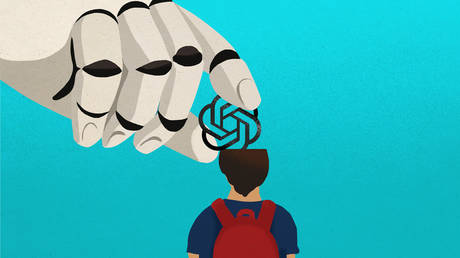
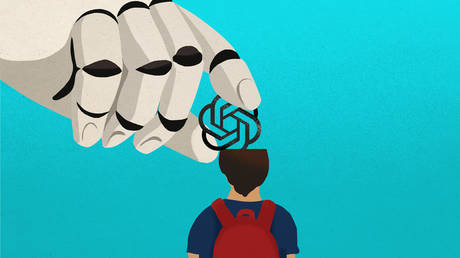
From tying shoelaces to tracking every move, overprotective parenting can deny children the experiences they need to become independent
Recently, a friend went to buy trainers for her 14-year-old and was surprised to discover that most of the suitable styles had Velcro fastenings. When she asked about proper laces, the sales assistant simply shrugged and said teenagers increasingly struggle to tie them.
We laughed and then we both went rather quiet because I remembered primary school teachers talking about first-graders who can’t dress themselves, fasten buttons, pack their things, tie their shoelaces or sometimes even manage a trip to the toilet without an adult.
And it doesn’t end with primary school as I’ve seen parents tie the shoelaces of perfectly capable 12- and 13-year-olds, carry their rucksacks and generally treat them like particularly honored guests.
I would love to adopt the traditional middle-aged complaint: “At their age, we were already…” but, unfortunately, that won’t work, because I’m one of those mothers myself.
In fifth grade, I took the tram to school alone and there was no mobile phone and certainly no parents’ group chat, so I got on the tram, travelled to school and came home. Somehow, I survived.
Now I have a child of my own, and repeating that educational experiment seems considerably more frightening. Perhaps that contradiction explains much of what’s happened to us. We want our children to become independent, but preferably in a safe environment, under CCTV surveillance, with geolocation switched on and an adult never too far away.
A British survey of nearly 2,000 families found that children today are allowed to play outside unsupervised at an average age of 10.8. Their parents had been allowed to do so at about 9.7, thus more than half of parents said they gave their children such freedom later than they themselves had received it.
Why have we become like this? After all, the 1990s can hardly be remembered as a wonderfully safe and sheltered period, yet children spent hours outside, cycled to school, went to the shops and somehow found their way home without the equivalent of an electronic ankle bracelet.
Perhaps our parents were no less worried, but they simply lacked the technology to worry about us in real time.
They couldn’t open a map and discover that their child had been standing behind the neighboring house for seven suspicious minutes instead of outside the school. A child went out to play and, for a few hours, really did disappear from the family’s field of vision.
Today, every horrific incident involving a child, even one happening a thousand kilometers away, can appear on our phones within minutes, so we know far more about these cases than our parents ever could and not necessarily because terrible things happen more often, but because now we hear about almost all of them.
Modern overprotectiveness is therefore partly an expression of adult anxiety as we want to control a world that constantly reminds us how little control we really have and our own child becomes the most obvious place to start.
Often, when we overprotect children, we are reassuring ourselves rather than them, so I feel calmer if I take my child somewhere myself, write to the teacher, check the schoolbag and know exactly where he is.
The anxiety subsides, and the brain learns a simple lesson, that if you’re worried, you should exercise more control. That creates a vicious circle: the more we worry, the less freedom the child receives. The less freedom they have, the fewer opportunities they get to demonstrate, both to themselves and to us “I can do this.”
Because we rarely see them managing alone, letting go becomes even more frightening.
Independence doesn’t suddenly arrive on an 18th birthday. It’s built through hundreds of tiny rehearsals, such as fastening your own jacket, asking a shop assistant for help, packing your schoolbag and, occasionally, forgetting an exercise book – it means walking to a friend’s house alone, encountering some minor problem and discovering that you can solve it.
How many of these little rehearsals do we cancel simply because doing things ourselves is quicker and less stressful? Well, I did exactly that with my first son, I was always rushing somewhere, so it was quicker to tie his laces, pack his things, find whatever he had lost or write to his teacher myself because at the time, this made life easier for everybody.
A few years later, when he actually needed to start doing these things himself, it was suddenly very difficult and research has repeatedly found an association between overprotective parenting and symptoms of anxiety and depression among adolescents and young adults. That doesn’t mean overprotection automatically causes psychological problems, but the likely mechanism isn’t difficult to understand, given if an adult always intervenes before a child has the chance to cope, the child gets fewer opportunities to develop a sense of competence.
Seen that way, the problem becomes considerably more serious than an inability to tie shoelaces.
Of course, civilization will survive Velcro, but the real problem begins when, confronted with any ordinary difficulty, a child’s first thought is ‘where is the adult who is going to sort this out for me?’
This isn’t because today’s children are uniquely lazy or incapable. For years, we have been teaching them something through our actions: the world is dangerous and complicated; you can’t handle it yet; give it to Mum, and she will sort it out and we do this out of love.
We want to protect them from disappointment, lateness, forgotten clothes, poor grades, unpleasant shop assistants, dangerous roads and all the other things that make up a life in which not everything works perfectly on the first attempt.
Then the child grows older and we are astonished. Why is he afraid to make decisions? Why can’t he prepare his own breakfast? Why doesn’t he know how to pack his schoolbag?
Surely there must be some middle ground between the old approach of “here’s your key, heat up your own lunch” and accompanying a healthy teenager practically as far as the changing room.
But we will never find it unless we give children the right to make mistakes, and that means patience. We have to wait while a child struggles with a zipper rather than doing it ourselves and we have to remain quietly at home instead of racing to school with the exercise book they forgot.
I tell myself this every day, that perhaps a parent’s job isn’t to make a child’s road completely smooth, but gradually to teach them how to walk along a bumpy one.
Otherwise, one day we may discover that we protected our children brilliantly from all of life’s shoelaces, only to find that sooner or later they’ll still have to learn how to tie them themselves.
This article was first published by the online newspaper Gazeta.ru and was translated and edited by the RT team