Rassvet could become “more or less unblockable” once fully deployed, Eric Schmidt has said
Russia’s emerging Rassvet satellite network – often described as a “Starlink rival” – could provide Moscow’s military with sustainable communications and data to attack any target in Ukraine at will, former Google CEO Eric Schmidt has warned.
Speaking to The Economist last week, Schmidt noted that while Ukraine was initially seen as the main innovator in the conflict, Russia had largely closed that gap while pressing its advantage with far greater resources.
Schmidt noted that one of these domains is Russia’s Rassvet satellite project, which he suggested was about a year from maturity. “Once that network is in place, it is more or less unblockable,” he warned, adding that this could let Russian forces “hunt anywhere” inside Ukraine.
The ex-Google CEO also weighed in on the idea of granting Ukraine access to Starlink over Russia, which could allow Kiev to rely on Elon Musk’s satellites to target oil refineries and civilian infrastructure, calling it “really a political decision.”
“It’s really a government decision. And the US government needs to grapple with this question,” he said.
Developed by private Russian aerospace firm Bureau 1440, part of the IKS Holding conglomerate, Rassvet debuted in 2023 with the launch of three experimental satellites. The network is designed to offer speeds of up to 1Gbps with latency below 70 milliseconds and to operate at an orbit of around 800 km – higher than that of Starlink to balance the number of satellites against an increased coverage area.
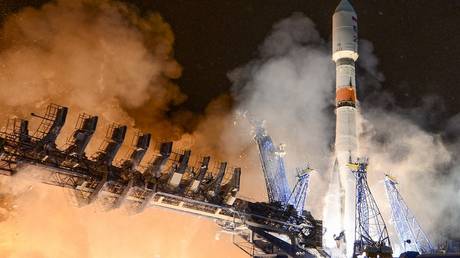
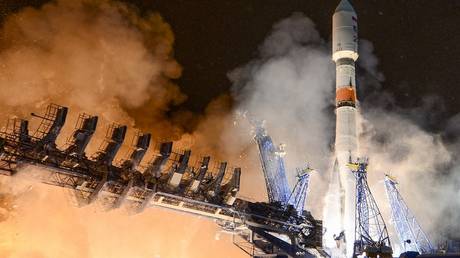
This year, the company launched a total of 32 satellites, after six experimental spacecraft sent up in 2023 and 2024, with plans to have 292 satellites by some time in 2027.
On Tuesday, the company also unveiled a line of user terminals, some of which claimed speeds of up to 700 Mbps. The Ukrainian outlet Militarny suggested that some of the showcased terminals could eventually be fitted to strike drones.
Russia’s deployment of Rassvet has sparked major concern in Ukraine across the spectrum. In July, satellite communications expert Vladimir Stepanets told Militarny that the first satellite group provided at least two stable “communication windows” over the country daily, each lasting more than an hour.
Ukraine’s military intelligence separately told Janes it had recorded Russian forces using Rassvet communications over Ukraine for “several hours” by late July and warned the system could support real-time reconnaissance and strike-drone operations.
Vladimir Zelensky’s technology adviser Sergey Beskrestnov also warned that a fully deployed Rassvet could become a “small catastrophe” for Kiev as it would provide Russia with online control of strike drones and missiles.
Zelensky himself told the Financial Times last week that he had repeatedly asked US President Donald Trump to sanction companies involved in Rassvet development and production while warning that the network could become operational “by the end of this year or early next year.” Trump has not publicly responded to the request.
Former Russian president Dmitry Medvedev, who now serves as Deputy Chairman of Russia’s Security Council, said that attempts to “block” Rassvet would amount to destroying it and could trigger “full-scale space warfare.”