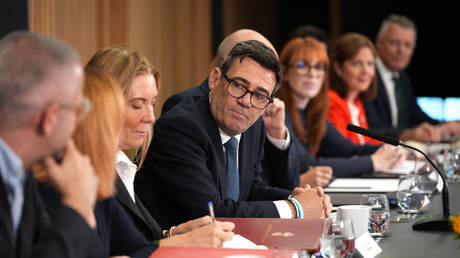
London will examine options ranging from closer ties with Brussels to actually rejoining the bloc, Prime Minister Andy Burnham has said
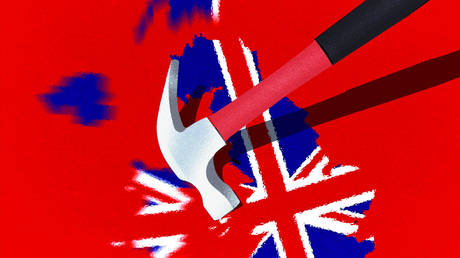
British Prime Minister Andy Burnham has said the UK could eventually rejoin the European Union as his government considers options for reshaping relations with the bloc a decade after the Brexit referendum.
In an interview with the BBC on Wednesday, Burnham said Brexit had done “more harm than good,” arguing that the current settlement was holding back economic growth and had failed to deliver the promised control over immigration.
He said the government would examine alternatives ranging from maintaining the status quo to joining a customs union or the single market, or even potentially going “all the way” and returning to the EU.
Talk of reversing Brexit has grown recently, with several prominent British politicians floating the idea. Burnham’s comments are the clearest indication yet that rejoining the EU could be on the table, although any such move would reopen questions over sovereignty, immigration, and regulatory control that drove much of the Leave vote.
Why did Britain leave the EU in the first place?
Britons voted 52% to 48% to leave the EU in June 2016, triggering years of negotiations over the terms of Brexit. The UK formally left the bloc in January 2020 and exited the single market and customs union at the end of that year.
For many Leave voters, Brexit was primarily about sovereignty and immigration rather than economics. An Ashcroft poll conducted immediately after the referendum found that 49% of Leave voters said their main reason was wanting decisions about the UK to be made in Britain, while 33% pointed to regaining control over immigration and borders. Only 6% primarily cited expected benefits from leaving the EU for trade and the economy. By contrast, 43% of Remain voters said their main concern was the risk Brexit posed to the economy, jobs, and prices.
What did Brexit achieve?
Brexit ended EU free movement and gave London control over who could move to Britain from the bloc. That did not, however, translate into lower overall immigration. Net migration instead surged as arrivals from outside the EU increased, reaching a record 944,000 in the year to March 2023 before falling sharply following tighter visa rules. Non-EU nationals continue to account for most immigration.
The change also worked both ways. British citizens lost EU freedom-of-movement rights and are now subject to the entry requirements that apply to non-EU travelers in the Schengen area.
Brexit also gave Britain an independent trade policy, allowing it to negotiate agreements without the approval of EU members. The UK has since struck deals with Australia, New Zealand, and India and joined the CPTPP, a major Indo-Pacific trade bloc. However, the Office for Budget Responsibility (OBR) estimates that the long-term economic gains from post-Brexit trade agreements are small compared with the impact it expects from higher trade barriers with the EU.
The bloc nevertheless remains Britain’s largest trading partner, accounting for about 41% of UK exports and roughly half of imports in 2025.
Why is the issue being reopened now?
Critics contend that the economic costs of Brexit have overshadowed its benefits. The OBR estimates that Brexit will ultimately reduce the trade intensity of the British economy by around 15% and productivity by about 4% relative to remaining in the EU. These are long-term modeling assumptions rather than directly observed losses, while Britain’s economic performance since Brexit has also been affected by the Covid-19 pandemic, the Ukraine conflict, and wider disruptions to global trade.
Leaving the EU single market and customs union also created new barriers to trade with Britain’s largest trading partner. Businesses face customs declarations, rules-of-origin requirements, and additional checks that did not apply when Britain was an EU member.
While Brexit gave Britain greater control over legal migration, Burnham has argued that it weakened the country’s ability to tackle irregular migration by reducing cooperation with European countries, particularly over Channel crossings.
Is preserving the UK part of the calculation?
Burnham has not explicitly linked his EU rethink to preserving the United Kingdom. But it comes as pro-independence and Irish nationalist parties in Scotland, Wales, and Northern Ireland push for independence or Irish reunification while presenting closer integration with the EU as part of their preferred future.
This month, the pro-independence SNP and Plaid Cymru, together with the pro-Irish-unification Sinn Fein, jointly asserted their nations’ right to self-determination and called on London to facilitate a constitutional change, declaring that their future “belongs in the European Union.”
Burnham, meanwhile, has made preserving the UK an explicit priority. Responding on Tuesday to Scottish First Minister John Swinney’s prediction that he would be the UK’s last prime minister, he vowed to “fight with everything I’ve got to keep it together.”
Haven’t Britain and the EU already been moving closer?
In security policy, Britain and the EU have already moved significantly closer despite Brexit. The UK remains one of NATO’s leading European military powers, while the 2025 UK-EU Security and Defense Partnership established regular strategic consultations and expanded cooperation on Ukraine, sanctions against Russia, military mobility, and arms production. It also opened the way for greater British involvement in EU defense initiatives.
Much of the alignment has centered on Russia and Ukraine. London and its European partners have coordinated weapons supplies and training for Kiev, sanctions against Moscow, and efforts to expand European arms production.
In July, Britain secured participation in the EU’s €90 billion Ukraine Support Loan, allowing British defense companies to compete for procurement contracts financed through the scheme. The UK agreed to make a contribution proportionate to the value of contracts awarded to British companies.
Could Britain simply rejoin the EU?
Any return would be neither automatic nor a restoration of Britain’s previous membership terms. The UK would have to formally reapply and go through the EU accession process, requiring unanimous approval from member states and the consent of the European Parliament. Nor would Britain be guaranteed the opt-outs and special arrangements it enjoyed before Brexit; the terms of any renewed membership would have to be negotiated.
Immediately after the 2016 referendum, EU leaders said they regretted Britain’s decision but respected the result. During the subsequent withdrawal negotiations, Brussels took a firm line, insisting that Britain could not retain the benefits of EU membership from outside the bloc and rejecting “cherry picking” from the single market.
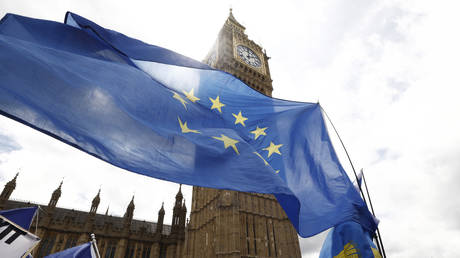
A decade later, however, Brussels is not ruling out London’s return. In July, EU Commissioner Maros Sefcovic said applying for membership was “entirely a prerogative” of the UK. Former EU Brexit negotiator Michel Barnier said in June that the EU’s “door is open,” while stressing that Britain could not simply choose which EU rules to follow.