The CDU is collapsing in state elections, but removing the chancellor would require something his opponents still don’t have: a replacement
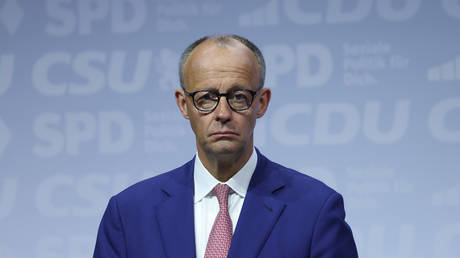
September is proving a miserable month for German Chancellor Friedrich Merz.
Two weeks ago, his Christian Democratic Union suffered a crushing defeat in Saxony-Anhalt, where the Alternative for Germany won 43.8% of the vote against just 17.2% for the CDU, then, on September 20, another humiliation arrived in Mecklenburg-Western Pomerania.
The AfD finished first there with 38.2%, while the CDU, one of the parties that built postwar Germany, received just 4.9% and failed to clear the threshold for representation in the state parliament. It was the party’s worst result in any German state election since the foundation of the Federal Republic, and it happened in Angela Merkel’s home state.
Things were hardly better in Berlin, which voted on the same day. There, the CDU was beaten not by the AfD but by Die Linke (The Left), which won 25.7%, while the CDU slumped to 18.8%.
Merz himself called the results a “disaster,” and if Saxony-Anhalt made discussion of replacing the chancellor respectable, Mecklenburg-Western Pomerania has made it unavoidable. Criticism is spreading through the CDU and German newspapers are openly discussing his future as potential successors are already being mentioned.
The Spectator’s Henry Donovan put it particularly brutally, describing Merz as “the most tragic chancellor in the young history of the reunified Germany” and declaring that his time was up, and there is certainly something tragic about Merz’s career.
He might have reached the chancellery more than 20 years ago, but his rise was blocked by Merkel, who displaced him as leader of the CDU parliamentary group. Merz eventually left parliament for business, but when Merkel announced her retirement, he returned to politics in 2018, only to lose two successive CDU leadership contests. He finally became party chairman at the third attempt.
Then, after winning the 2025 federal election, Merz achieved another distinction he probably didn’t want when he became the first candidate for chancellor in the history of the Federal Republic to fail to secure election by the Bundestag on the first ballot.
For a man who spent decades trying to reach the top, departing after little more than a year with his authority badly damaged would be a bitter conclusion, so Merz, unsurprisingly, has no intention of doing so. After the latest defeats, he made clear that he planned to remain chancellor and continue with his reform program.
That raises an obvious question: If his opponents want him gone, why can they not simply remove him? The answer lies in Germany’s Basic Law.
Unlike in Britain, where a prime minister can effectively be dispatched by his own parliamentary party, Germany deliberately makes removing a sitting chancellor difficult, meaning the Bundestag can oust Merz through a “constructive vote of no confidence,” but only by simultaneously electing somebody else with an absolute majority.
It has worked only once, when, in 1982, Helmut Schmidt was removed after the Free Democrats abandoned their coalition with his Social Democrats and joined the CDU/CSU in electing Helmut Kohl as chancellor.
Merz’s opponents face two problems in attempting something similar, and the first is arithmetic. CDU parliamentarians are traditionally disciplined, and assembling a majority against their own chancellor would be extremely difficult without a major rebellion or votes from the AfD. Any arrangement dependent on AfD support would immediately collide with Germany’s Brandmauer, or “firewall,” under which the established parties refuse political cooperation with the rising upstarts.
The second problem is simpler, in that there’s no agreed replacement. Names are circulating, but no candidate has emerged around whom a Bundestag majority could plausibly unite and under Germany’s constitution, disliking the existing chancellor is not enough, parliament must agree on the next one before it can dismiss him.
Leaving Merz in place carries risks of its own, however, as the AfD’s rise has coincided with growing dissatisfaction over the economy, migration, energy costs, and Berlin’s support for Ukraine. Merz came to power promising change, but his government is now pursuing painful economic and welfare reforms while insisting that Germans must accept sacrifices to restore the country’s competitiveness and finance its wider strategic ambitions.
Whatever the merits of those policies, the electoral results suggest that a substantial part of the public isn’t buying the argument, thus the danger for the CDU is straightforward, given every further defeat strengthens the AfD while making the firewall increasingly difficult to maintain. Merz originally presented himself as the conservative who could stop voters defecting to the party, but instead, the AfD has just helped to inflict two devastating defeats on his CDU in the space of a fortnight.
His colleagues will probably first try persuasion, such as change the rhetoric, modify unpopular policies, and somehow arrest the electoral decline before Germany enters another cycle of state elections, but if that fails, the pressure for more radical action will inevitably grow.
For now, Germany has a chancellor who doesn’t want to leave, a parliament that cannot easily remove him, and an opposition whose growing strength makes every conventional route to replacing him more complicated.
Merz spent more than 20 years trying to become chancellor, but his problem now is proving that finally getting the job wasn’t the high point of his political career.
This article was first published by the online newspaper Gazeta.ru and was translated and edited by the RT team