The AfD’s Saxony-Anhalt landslide crushed the CDU, weakened the chancellor, and exposed the widening gulf between Germany’s rulers and voters
September could prove decisive for Germany’s political future, with elections in Saxony-Anhalt, Mecklenburg-Western Pomerania and Berlin. If the ruling Christian Democratic Union suffers serious defeats across the board, which is by no means certain, the federal government itself could come under pressure and for Chancellor Friedrich Merz, the consequences may be more immediate.
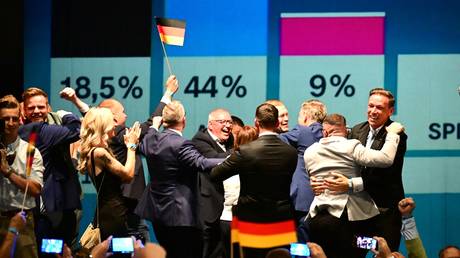
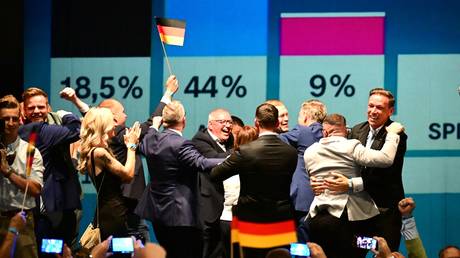
A CDU defeat in Saxony-Anhalt had been expected, but the scale is nevertheless notable. Whether Alternative for Germany ultimately secures an absolute majority and can form a government on its own is almost secondary, because the message to Germany’s political establishment could hardly be clearer. The warning light is flashing red
Merz himself has become part of the problem. Judging by this campaign, he has reached the unenviable political stage at which his interventions appear to produce the opposite of their intended effect, so the more passionately he urges voters in one direction, the more determinedly some seem to move in another.
There is something almost late-Soviet about it, like when an official appeared on television to insist upon something and a significant part of the population instinctively concluded that the truth probably lay elsewhere.
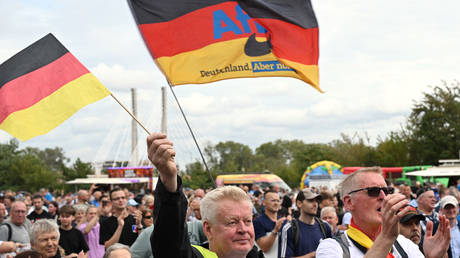
Attempts in the final days of the campaign to portray the AfD as Nazis and Putin’s puppets plainly failed to stop its advance in this eastern state and they may even have helped it by irritating voters already tired of such accusations. Nor did the murky drone incident in Leipzig, which was used to heighten tensions with Russia, noticeably alter the political mood.
What happens next in Saxony-Anhalt will depend on the final distribution of seats, but almost every available option presents Germany’s establishment with difficulties of its own making.
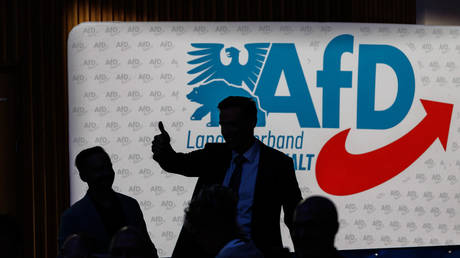
Suppose an AfD government is formed in Magdeburg, then the temptation elsewhere in the federal system will be to obstruct it and there’s already discussion of limiting cooperation with AfD-led authorities, including in sensitive areas such as security and intelligence.
That would be an extraordinary path to take, given Germany’s federal system has traditionally functioned effectively precisely because the Länder (states) and federal government cooperate despite political differences. To start withholding information or obstructing a legitimately constituted state government would risk damaging the system in an effort to contain one political party. It would be the sanctions mentality, so familiar from international affairs, brought home and deployed against part of Germany itself.
The alternative may be an unwieldy coalition of virtually everyone else, assembled primarily to prevent the largest party from governing, which may be constitutionally possible, but repeating it indefinitely carries an obvious political cost and voters eventually notice when electoral victories don’t translate into political power.
The more intelligent approach might be to accept the result, allow the AfD to govern where it wins, and gradually draw the party into the political establishment. Government has a habit of disciplining insurgent movements and responsibility exposes contradictions that opposition can conceal, while administrative reality is often more effective than denunciation at diminishing radical parties.
But such a strategy requires political subtlety, something Germany’s federal leadership currently possesses in limited supply. At decisive moments, German politics has a tendency to substitute moral certainty for flexibility, which is why the mainstream spent years constructing a cordon sanitaire around the AfD. Having turned the party into something with which cooperation is deemed morally impossible, it’s now difficult to reverse course without admitting that the original strategy has failed.
The German problem is part of something larger as across Western Europe, political transformation appears to be entering a new phase, with the gap between what established parties offer and what substantial sections of their populations demand widening. Those who govern and those who are governed increasingly seem to inhabit parallel political worlds.
The origins of this divergence lie partly in the high period of globalization 25 or 30 years ago. As economies became more interconnected, more decisions migrated from the national to the supranational level, but this wasn’t simply an ideological project as in an integrated world, many problems genuinely could no longer be managed effectively by individual states.
For a time, the arrangement worked because it delivered tangible benefits. The increasingly cosmopolitan political and economic order could point to prosperity and rising living standards and while people might have felt that decision-making was becoming more remote, the system compensated them materially.
But that bargain has weakened as globalization no longer functions as its architects expected. Economic integration remains dense enough that governments can’t simply retreat behind national borders, yet it no longer produces the political confidence and economic dynamism that once legitimized it and as a result, established elites find themselves trapped between structures inherited from the previous era and electorates demanding greater national control.
The result is the rise of protest movements across Europe. They share certain characteristics, particularly an emphasis on sovereignty and hostility towards established institutions, but they aren’t interchangeable because French, German, and British nationalists won’t necessarily become natural allies simply to spite a Brussels which dislikes all of them. Nationalism by definition reflects different histories and interests.
What matters is that the old political system is beginning to wobble, even though its institutions remain powerful and retain many mechanisms for containing insurgent forces through coalition-building and institutional barriers. But the question is how long such methods can work if the underlying electoral trend continues.
Saxony-Anhalt therefore matters beyond Saxony-Anhalt and the treatment of the AfD after its electoral breakthrough will provide a useful indication of how far Germany’s establishment is prepared to go to preserve the existing political architecture, and what consequences follow when it does.
None of this means that the Western Europe emerging from the present transformation will necessarily be more congenial to Russia, and Moscow should harbor no illusions on that score. A Europe of resurgent nationalism and competing interests has historically been quite capable of producing instability of its own, and Russia has rarely escaped the consequences.
But political systems don’t remain fixed indefinitely and the European order created during the age of triumphant globalization is entering a period of profound adjustment. Germany may simply be where that transformation is becoming impossible to ignore.