The Boulos initiative fails at its core by treating Libya as a corporate asset rather than a sovereign nation
For nearly a year, Massad Boulos, US President Donald Trump’s senior advisor on Arab, Middle Eastern, and African Affairs, has aggressively pursued a diplomatic circuit connecting Tripoli, Benghazi, Paris, Rome, and Abu Dhabi. His primary objective is to push a transactional political settlement designed to resolve Libya’s administrative paralysis and the internal west-east divide by formalizing an alliance between the country’s rival power centers.
Taking shape behind closed doors since last September, first in Rome then across other capitals, the core mechanism of this US-brokered blueprint is a restructuring of the executive presidency: placing Saddam Haftar (Commander of Ground Forces in eastern Libya and deputy to his father) at the helm of a reformed Presidential Council, while keeping Abdul Hamid Dbeibeh as Prime Minister. Rather than fostering a democratic transition, the framework accepts state fragmentation as a permanent reality, securing the Dbeibeh administration in the west and the Haftar family network in the east as a dynastic duopoly.
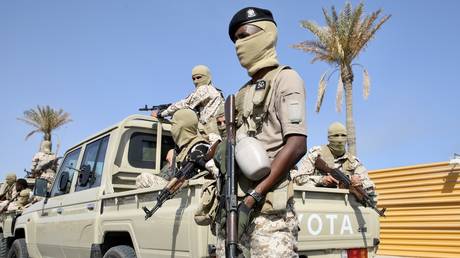
To pave the way for such initiatives, Washington has leveraged preliminary milestones. In April, Boulos helped broker a record 190 billion dinar unified budget agreement – the first in Libya since 2014. At the same time, joint military maneuvers were executed in Sirte under AFRICOM’s Flintlock exercises, bringing together east and west forces alongside participation from Italy and over a dozen African nations.
Treating this unwritten transactional design as a national settlement fundamentally misreads the crisis.
Rather than establishing a legally grounded framework for general elections or dismantling entrenched militia networks, the arrangement codifies an elite duopoly. By relying on temporary financial distributions and supervised unified military drills to broker a top-down truce, Washington is mistaking a fragile pact between ruling families for actual state-building – guaranteeing that Libya’s hydrocarbon wealth continues to line the pockets of an entrenched cartel at the expense of its people.
Crucially, the Boulos initiative operates as an unwritten diplomatic push devoid of statutory grounding. By ignoring the foundational UN Security Council resolutions that grant legal mandate to external mediation, Washington’s ad-hoc gamble lacks the institutional backing required to bind local actors. Furthermore, the plan offers no long-term enforcement mechanisms. It relies on current US political backing and provides no protocol if the newly installed executives simply refuse to vacate power after the proposed two-to-three-year interim.
Without a universally accepted arbiter to compel compliance, the initiative risks becoming a dangerous power trap, leaving Libya vulnerable to renewed confrontation the moment external priorities shift.
This bilateral push also directly collides with the ongoing UN-led mediation process overseen by the UN Support Mission in Libya (UNSMIL). While the UN’s incremental track has certainly been slow and struggled to deliver a breakthrough, it remains anchored in UNSC mandates and operates through recognized, albeit heavily discredited, domestic institutions – such as the House of Representatives and the High Council of State. By attempting to bypass these constitutional bodies in favor of an elite shortcut, Washington risks completely undermining the delicate institutional consensus UNSMIL has spent years attempting to build. Replacing a broad-based, rules-driven process with a fast-tracked bargain creates a parallel route that further fragments international diplomatic efforts and deepens institutional paralysis.
The fundamental flaw of the American initiative lies in its false equivalence between the political dynamics of eastern and western Libya. While the eastern region serves as a traditional stronghold for the Haftar family, western Libya presents a fragmented power balance. Prime Minister Dbeibeh exercises no absolute command over the west, operating instead through fragile networks and pacts with autonomous armed factions, including within his own home city of Misrata.
This domestic resistance exploded into the open on July 5, when Misrata’s military and civic coalitions issued a condemnation of Washington’s plan, rejecting any settlement that involves the Haftar family. When Boulos visited the commercial hub on July 7 to smooth over opposition, local elders and municipal leaders refused to endorse an unwritten deal. Dbeibeh seems to lack the authority to deliver western compliance, and a pact struck in foreign capitals cannot override the deep-seated opposition of the ground forces and local communities required to sustain it.
Beyond its immediate political flaws, the broader framework is viewed domestically as a mechanism designed to help the Haftar and Dbeibeh networks establish a permanent political dynasty, dividing the country’s state apparatus and economic assets strictly between themselves. Crucially, the plan contains no timelines for when, or if, national legislative and presidential elections ever take place.
This omission ignores the aspirations of the more than 2.8 million registered Libyan voters who picked up their electoral cards for the shelved 2021 polls, eager to restore popular legitimacy to their governance institutions. Instead of creating a bridge toward a democratic transition, Washington’s framework codifies the status quo, deferring the Libyan people’s right to choose their own leaders.
Another major obstacle confronting Boulos’s initiative is that Libya remains a deeply contested theater for regional heavyweights – notably Ankara, Cairo, Abu Dhabi, and Moscow – who are navigating the proposed deal with extreme caution while protecting their security, military, and economic footholds. Türkiye maintains a military presence across key bases in the west alongside extensive commercial interests, Egypt views eastern Libya as a non-negotiable border security perimeter, the UAE manages influential financial and energy networks, and Russia retains military and diplomatic leverage across both divides. While Washington seeks to build momentum through parallel diplomatic and economic pressure, these actors seem to have signaled (based on fragmented media reports) a reluctance to reshape their strategies. Instead, they are maintaining a wait-and-see stance, preferring to withhold definitive positions until an official plan is formally presented.
Even if Washington succeeds in cobbling together a consensus between Tripoli and Benghazi, the Boulos framework faces a structural barrier: the UN Security Council. Because the initiative deliberately bypassed the UN-facilitated inter-Libyan tracks, any final arrangement must eventually seek international legitimacy and statutory backing through a new UN resolution to replace existing mandates. In the Security Council, however, Russia holds a permanent veto. By ignoring Russian interests and attempting to unilaterally reorder Libya’s security architecture, Washington has designed a blueprint that can be easily decapitated at the UN table, leaving its Libyan signatories legally unsanctioned.
The core failure of the Boulos initiative is that it approaches Libya like a corporate asset undergoing restructuring rather than a sovereign state in desperate need of constitutional legitimacy. Instead of fulfilling the transition to democracy promised in 2011, when the US and its NATO allies intervened only to trigger a relentless free fall ever since, this diplomatic blueprint manages the ruins. It substitutes a genuine political horizon with an arrangement among the ruling elite. For the Libyan public, abandoned without peace or popular sovereignty, it is a pause that leaves the country vulnerable to renewed warfare the instant the bargain fractures.