The US president arrived with flattery, CEOs and a need for pre‑midterm trade wins, Beijing stayed formal and refused to budge on core issues
China maintained the upper hand during US President Donald Trump’s visit to Beijing this week. He visibly tried to ingratiate himself with Chinese President Xi Jinping, but his counterpart made no attempt to reciprocate.
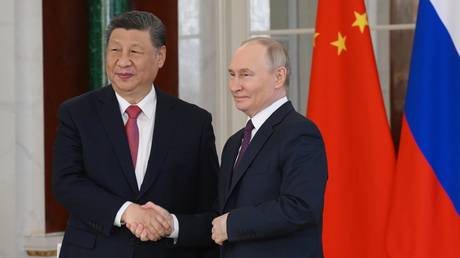
Trump has been heaping praise on Xi personally as a great leader and has vaunted his personal ties with him. He laid it thick at the start of formal delegation-level talks in Beijing, eliciting a smile from the normally impassive Xi who, in turn, did not feel the need to play to audience.
Trump is not particularly popular in China and Xi would have not have wanted, in any case, to unnecessarily rehabilitate him in the public eye in China.
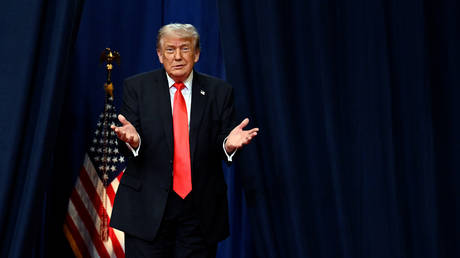
Earlier, during the welcome ceremony at the Great Hall of the People, Trump made several overtly warm physical gestures toward Xi, but the Chinese leader remained formal and impassive. By acting as a suitor, Trump effectively handed Xi the political and psychological upper hand.
Trump effectively cast himself as someone who had come to seek favors from China. His boast that only the number ones, not number twos of top American corporations were accompanying him hardly projected strength, coming after years of Washington’s (and Trump’s own) tirades against China’s business practices, alleged “rip‑offs” of US consumers, and technology theft. This, despite the fact that Trump had imposed sweeping tariffs on Chinese goods and moved to restrict the flow of advanced technology, especially chips, to China.
The message, on the contrary, was one of willingness to explore renewed economic interdependence, with the biggest names in US business looking for openings in the Chinese market – and this after all the talk of decoupling, de‑risking supply chains, onshoring, pushing US firms to invest at home and create American jobs, and so on.
From the media coverage of the visit, it does not seem that the Chinese side felt overwhelmed by the composition of Trump’s delegation. The emphasis in the reporting was on Trump’s praise for Xi, China’s rising stature, the US engaging China as an equal global power, setting a new framework of cooperation, and Trump visiting China when he was relatively weak domestically and needing trade deals before the mid-term elections.
Normally, before a visit of this importance, which has been under preparation for many months, the two sides begin working on a joint statement that would list the agreed-upon outcomes. In this case, no joint statement has been issued, which means that on many contentious points, the differences between the two sides could not be bridged.
The Taiwan issue is especially divisive; an agreed formulation on Iran, with the US being the initiator of the war and also militarily blockading the Strait of Hormuz, would have been difficult (China has been vetoing one-sided resolutions in the UN Security Council, prompted by the US). The same goes for the South China Sea and many other issues, including sanctions, tariffs and trade disbalance. All this signifies that the visit did not produce definable concrete results.
The two sides gave their own readouts of the visit, which makes it difficult to assess the real outcome. The US readout is unusually subdued, given the exuberance and exaggerations that characterize Trump’s pronouncements and presentations. The readout merely says that Trump “had a good meeting” with Xi. No superlatives.
Ways to enhance bilateral economic cooperation were discussed, including by expanding American businesses’ access to Chinese markets and increasing Chinese investment in US industries. Higher Chinese purchases of American agricultural products was discussed, but no figures for corn, soya beans, sorghum, beef etc. are mentioned, though in his public remarks Trump said China had agreed to buy 200 Boeing jets and US oil as well.
US Treasury Secretary Scott Bessent has told the American media that the US and China have also discussed forming a “Board of Trade” and “Board of Investment” to oversee commerce between the two countries.
Some understandings seem to have been reached but not anything major, as Xi speaks of the economic and trade teams having reached a generally balanced and positive outcome, which is a low-key formulation, contrary to Trump’s claim to have “achieved a fantastic trade agreement.” Xi has said that China will only continue to open up.
Both sides agreed that the Strait of Hormuz must remain open to support the free flow of energy, which is fine in principle as far as China’s access to energy from the Gulf is affected, and the US too does not want oil prices to shoot up beyond a point. Xi also made it clear that China was opposed to the militarization of the Strait, using double edged language, as this position applies also to the US positioning its warships in the region and blockading the Strait. As for charging a toll, not only is China against it, but so is India, because this can have wider repercussions.
That China expressed interest in purchasing more American oil to reduce China’s dependence on the Strait in the future is not only not a commitment it is ironical too, as the US has sanctioned China’s “tinpot refineries” buying Iranian oil and has ended the flourishing oil ties between Venezuela and China.
It is hard to believe that both countries genuinely agreed Iran can “never” have a nuclear weapon, given that this is the central justification for the US‑Israeli war on Iran. China, as a former JCPOA party, would in any case be reluctant to see Iran go nuclear because of the regional fallout. Trump’s claim that Xi said during their summit that Beijing would not provide military equipment to Iran sounds rather more like what Washington would like to hear – as also is the case with China’s purported military-tech support for Russia.
In response to Trump’s claim that Xi Jinping had offered China’s help in reaching a settlement with Iran, the Chinese Foreign Ministry set out Beijing’s position at some length. It said that China recognizes that the conflict has put a heavy strain on global economic growth, supply chains, international trade order and the stability of the global energy supply. It added that there is no point in continuing this conflict, which should not have happened in the first place, and that dialogue and negotiation are the right way forward while the use force is a dead end. It called for a settlement of the Iranian nuclear issue and other issues that accommodate the concerns of all parties, a comprehensive and lasting ceasefire as soon as possible, and laying the foundation for building a sustainable security architecture for the region.
The US didn’t mention Taiwan in its readout of the meeting. According to American media reports,China seems to have brought up Taiwan in talks. Washington appears to have acknowledged Beijing’s position, restated its own view, and then moved on.
The US didn’t mention Taiwan in its readout of the meeting. Trump acknowledged to the US media that Xi had raised the issue forcefully, including that of US arms supplies to Taiwan, but he listened and did not respond. Trump has since also equivocated on defending Taiwan and executive approval of $14 billion of arms aid to Taiwan cleared by the US Congress. He has also called on Taiwan and China to “cool it”, meaning avoiding provocations.
The Chinese readout of the Xi-Trump summit has a hard, realistic and demanding edge to it. The emphasis is on a relationship based on equality. Centrality is given to US handling of the Taiwan issue, with Xi warning that it must be treated with utmost caution. If handled well, bilateral relations can maintain overall stability, but if handled poorly it can lead to confrontation and even conflict, pushing the entire relationship into a very dangerous situation. This has implications for Trump’s decision on the $14 billion arms package for Taiwan approved by the US Congress.
When Xi speaks about an agreement to establish a “constructive and stable relationship between China and the US,” it implies that the provocations have come from the US and that China is a victim. This is the usual Chinese tactic of placing the responsibility for handling ties on the shoulders of others and not accepting its own responsibility in creating tensions.
Xi says that faced with differences and frictions, equal consultation is the only correct choice, which is another formula that places the onus of making the “correct choice” on the other party and not China.
For Xi, stabilizing bilateral relations and strengthening communication were important. In his view, “we have established a new status called the ‘China-US Constructive Strategic Stable Relationship’” with the US. He added that the two sides had “achieved important agreements on stabilizing economic and trade relations, expanding practical cooperation in various fields, and properly handling mutual concerns.”The reference is to properly handling figures in statements that China makes on border issues with India. The sub-text is that it is not China but the other side that fails to properly address differences.
Xi also resorted to standard clichés about “enhancing mutual understanding, deepening mutual trust… and peaceful coexistence and win-win cooperation based on mutual respect.”
In his opening remarks to Trump at the formal talks, Xi called on the US to be “partners, not rivals,” and made a reference to overcoming the Thucydides trap. He has done so in the past, but that he chose to do so when the debate over this concept is no longer current internationally,suggests that Xi wanted to revive the debate and convey that China was now the risen power that was in a position to potentially clash with the US as the established power.
Trump seems to have understood the message belatedly and later in his Truth Social post called this an elegant way by Xi to refer to the US as a declining power. The subtle message here by Xi is also that China and the US are the principal powers today and bear the shared responsibility for global peace and prosperity – a possible hint of a G2.