How the US attack on Iran is pushing the world towards chaos and new conflicts
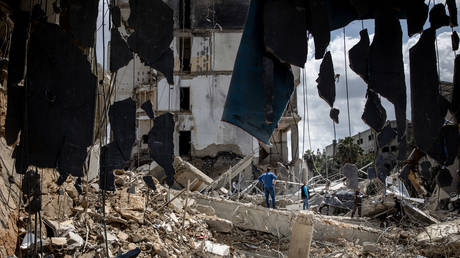
The war launched by the United States and Israel against Iran may have paused, but it is far from over. Its consequences, however, are already being felt, not just across the Middle East, but globally.
Iran’s desperate confrontation with two nuclear powers which have a vast network of allies and client states represents a move toward the erosion of the remnants of a unipolar international system. Tehran’s resistance is accelerating the relentless, albeit gradual, shift toward multipolarity.
It’s often said that it is easier to destroy than to build and in that sense, US President Donald Trump has played an unintended but pivotal role. By initiating military action against Iran, he has helped weaken the very system the United States spent decades constructing. The expectation in Washington was different. After perceived successes in Venezuela, and encouraged by regional partners, the White House appeared to assume Iran would collapse quickly under pressure.
The logic, crude but clear, seemed to be this: overwhelming military superiority would guarantee a swift victory. The United States had the aircraft carriers and the air bases, while Iran, by contrast, was seen as isolated and vulnerable.
The Iranian system, often dismissed as rigid or archaic, demonstrated resilience. Despite sustaining heavy losses, including among senior leadership, Tehran didn’t buckle. Instead, it adapted and absorbed the initial blows, recalibrated, and began to shape the conflict on its own terms. The Islamic Revolutionary Guard Corps not only resisted but challenged the operational dominance of the Pentagon in domains where the US traditionally excels.
The option of deploying ground forces was briefly considered, but quickly revealed its risks because Iran had spent decades preparing for precisely such a scenario. A land invasion would have been a drawn-out and costly confrontation, with uncertain outcomes. For Tehran, such a scenario may even have been desirable, as an opportunity to inflict long-term strategic damage on its adversaries.
The implications extend far beyond the battlefield.
This conflict is accelerating a transformation in how states behave. The old assumptions are weakening and the norms that once governed international conduct are fading. Increasingly, states act unilaterally, choosing when and where to strike, guided less by shared rules than by immediate interests.
The result is a more volatile world. Military force is no longer a last resort; it is becoming a routine instrument of policy. The notion of restraint, once underpinned by fear of escalation or reputational cost, is eroding. What replaces it is a growing sense of impunity.
Ironically, it’s the United States, long the architect of the post-Cold War order, that’s accelerating its dismantling.
One of the most consequential developments in the conflict has been the blockade of the Strait of Hormuz. By targeting a critical artery of global energy flows, Iran forced major economies to confront the immediate costs of instability. Western Europe, India, and others suddenly faced the prospect of disrupted supplies and rising prices.
The reaction was swift, as governments scrambled to assess vulnerabilities. Indian Prime Minister Narendra Modi convened emergency discussions on energy security while European states, already strained, were reminded of their exposure. In this sense, Iran succeeded in broadening the conflict’s impact far beyond its immediate geography.
But the longer-term consequences may be even more serious.
The world is entering a period of intensified militarization. Regions already marked by instability are becoming more dangerous and while the Middle East remains a flashpoint, it’s not alone. South Asia, too, is edging closer to renewed confrontation and even areas long considered peripheral, such as the Caribbean, are showing signs of tension.
The Afghan-Pakistani border offers a clear example. Long a zone of instability, it has seen a noticeable escalation in recent months. Clashes, cross-border strikes, and mutual accusations have become more frequent. Kabul accuses Islamabad of aggression at the same time that Pakistan points to militant groups operating from Afghan territory.
The roots of this conflict run deep. Pakistan once nurtured the Taliban as a strategic asset, but now it finds itself facing a more independent, and less controllable, force. What was once a tool has become a threat and the dynamic resembles a familiar pattern: states confronting the unintended consequences of their own policies.
Further east, the rivalry between India and Pakistan remains unresolved and volatile. Recent clashes have shown that both sides are willing and able to escalate quickly. The use of advanced weaponry, including missiles and air power, underscores the seriousness of the risk. In a region where both states possess nuclear capabilities, even limited conflict carries global implications.
These tensions are interconnected, and part of a broader pattern, as the weakening of global constraints makes escalation more likely. As states observe the outcome of the Iran conflict, they draw their own conclusions. One of the most dangerous is the belief that force can be used without catastrophic consequences.
That lesson, once internalized, will be difficult to reverse.
The blockade of Hormuz, the resilience of Iran, and the inability of the United States to impose a decisive outcome all point to a changing balance of power. Even a middle-tier state can now challenge a former hegemon and force it into a strategic stalemate, and this reality will shape calculations in capitals around the world.
The trajectory is clear. The international system is moving away from order and toward fragmentation, with multipolarity emerging as a contested, often chaotic environment. Alliances are less reliable and rules are less binding, which means the space for miscalculation is expanding.
The war against Iran may not have ended, not even in its current form; it has already altered the global landscape. It has exposed the limits of power, the fragility of existing structures, and the growing willingness of states to test those limits.
The next conflict is now not a question of if, but where, and in a world increasingly defined by uncertainty, the answer may come sooner than expected.
This article was first published by the online newspaper Gazeta.ru and was translated and edited by the RT team