The Week in Thread
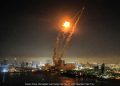
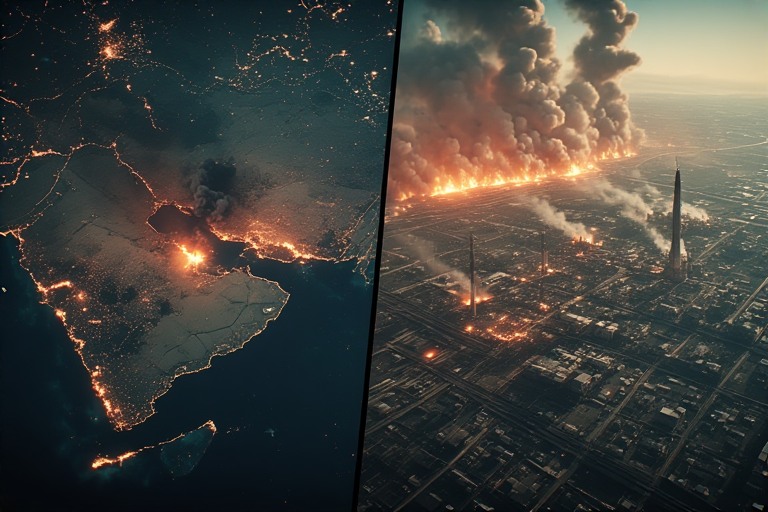
The week of March 15 began with a coalition still nominally intact and a war still bounded by a tacit separation between military and economic targeting — and ended with that separation destroyed, the world’s largest LNG terminal structurally damaged for years, the Natanz nuclear facility struck by bunker-busters, a US-Israeli Marine build-up pointing at Kharg Island, and Trump issuing a 48-hour ultimatum threatening to obliterate Iran’s power plants. The strategic arc of the week was not escalation as a matter of degree but as a matter of kind: each phase change — South Pars struck, Ras Laffan responding, NATO fracturing, Qatar’s neutral-hosting role collapsing, nuclear facilities targeted on both sides — marked a new ceiling that immediately became a new floor. The question entering next week is no longer whether the war will stay bounded; it is whether the Hormuz ultimatum produces Iran’s compliance or its most consequential retaliation yet.
Dominant Threads
From Military Campaign to Energy War: How the Conflict Changed Shape This Week
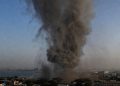
The week opened with the conflict in its military targeting phase: Iranian missile and drone capability was down an estimated 90–95% per White House figures released March 15, Gulf states were absorbing daily attacks but managing them through air defences, and the diplomatic space — however narrow — was still nominally open via Oman. By Wednesday, March 18, Israel struck four gas treatment facilities at Assaluyeh processing output from South Pars phases 3–6, the world’s largest natural gas reserve. That single decision eliminated the 18-day separation between military and economic targeting that Washington had previously maintained. Iran’s response followed within 24 hours: missiles struck Qatar’s Ras Laffan Industrial City — the world’s largest LNG export facility — causing what QatarEnergy CEO Saad al-Kaabi confirmed as a 17% reduction in export capacity with a 3–5 year repair horizon per Wood Mackenzie. Drones struck SAMREF at Yanbu, Kuwait’s Mina Al-Ahmadi refinery repeatedly, and UAE infrastructure at Habshan. Saudi Arabia’s foreign minister stated on March 19 that his country’s “remaining trust in Iran has been totally undermined.” Qatar expelled Iran’s military attachés within 24 hours of the Ras Laffan strike — the most consequential coalition stress event of the conflict, given that Qatar hosts CENTCOM’s forward HQ. By the weekend, Natanz had been struck with bunker-busters, Iran retaliated by targeting Dimona and Arad, and Trump issued a 48-hour ultimatum on Hormuz threatening Iran’s power infrastructure. The arc: Monday’s war and Saturday’s war are structurally different conflicts.
Brent crude touched $119 intraday on March 19 — the highest since 2022 and approximately 70% above pre-war levels — before reversing to close at $108.65 following Netanyahu’s statement that Israel would hold off further strikes. By week’s end, Brent was trading near $106–$110. Dutch TTF, the European gas benchmark, surged 9.3% on March 18 alone following the South Pars news. The Ras Laffan damage is not a market disruption event: Wood Mackenzie’s 3–5 year repair horizon means European LNG supply planning through winter 2027–28 must be rewritten regardless of when the war ends. Trump’s Friday sanction lift on Iranian oil loaded at sea — applying until April 19 — served as a partial price-stabilisation signal that markets treated sceptically given the widening targeting scope.
Trump’s Saturday ultimatum — reopen Hormuz fully within 48 hours or face obliteration of Iran’s power plants — expires in the first days of the coming week. Iran’s response, or non-response, is the week’s defining indicator. Compliance reopens the economic off-ramp and resets the escalation clock; refusal triggers the power-infrastructure phase, which carries direct civilian casualty and international law exposure at a scale the conflict has not yet reached.
The Coalition Fractures: Qatar, NATO, and the Walls of US Alliance Management
On March 16, US-aligned NATO nations in Europe formally rejected Trump’s call to provide military support to reopen the Strait of Hormuz. Trump responded publicly with “a very foolish mistake,” and by Friday March 20 had escalated to posting “COWARDS, and we will REMEMBER!” on Truth Social. NATO Secretary General Rutte confined the alliance to discussing “the best way” to eventually reopen the strait; the UK deployed a small CENTCOM planning team but declined combat commitment. Italy and Germany walked back a joint E6 statement on Hormuz safe-passage contributions within hours of its release, clarifying they meant a post-ceasefire multilateral initiative only. Switzerland announced it would not export war materiel to the US — the first European state to formally classify the conflict as an active conflict for export-control purposes. Qatar’s position underwent the week’s most dramatic transformation: having spent three weeks attempting to maintain neutrality while hosting CENTCOM’s forward HQ, the Ras Laffan strike forced Doha’s hand. The Foreign Ministry expelled Iran’s military attachés on March 19, cited UNSC Resolution 2817, and reserved Article 51 self-defence rights — collapsing the conflict’s most operationally important back-channel mediation conduit. A previously unreported development that widened further this week: a Greek Patriot battery stationed at Yanbu under the bilateral ELDYSA mission intercepted Iranian ballistic missiles targeting SAMREF on March 19 — the first combat engagement by a NATO member’s personnel against Iranian targets, conducted entirely outside NATO command architecture and without parliamentary debate in Athens.
Switzerland’s arms export declaration carries a precedent value beyond its immediate weapons volume. If Germany or the Netherlands applies the same legal reasoning — classifying the conflict as active for dual-use export-control purposes — US coalition logistics face a constraining environment that has not been priced into operational planning. Japan’s PM Takaichi met Trump March 19 in a posture Trump described as “supportive unlike NATO,” but Japan has declined any combat involvement despite relying on Gulf crude for the majority of its oil imports. The absence of a coalition enforcement mechanism for Hormuz means any commercial reopening depends entirely on US-Iran bilateral dynamics.
Watch whether Germany or the Netherlands follows Switzerland’s export-control declaration. Watch whether Qatar files a formal UNSC emergency session under Article 51 — that move would reframe Gulf states as active parties rather than collateral victims, impose new diplomatic costs on Iran, and force a Security Council vote where Russia and China vetoes would crystallise the conflict’s multilateral isolation architecture.
Kharg Island, Natanz, and the Ground Option: The War’s Endgame Logic Takes Shape
On March 13 — just before this week’s window — the US struck over 90 military targets on Kharg Island in a large-scale precision raid explicitly described as a “shot across the bow” to pressure Iran to reopen Hormuz. Oil infrastructure was spared “for reasons of decency,” per Trump. Trump simultaneously confirmed CENTCOM had “totally demolished” military forces on the island and threatened to “reconsider” oil infrastructure targeting if Iran did not comply. On March 20, the USS Boxer (11th MEU, ~2,200 Marines) departed San Diego three weeks ahead of schedule, joining the USS Tripoli (31st MEU, ~2,000 Marines) already en route from Japan — five sources confirming the White House is weighing two Hormuz options: escort corridors or physical seizure of Kharg Island. The Axios framing of the deliberation — “take the island and then get them by the balls and use it for negotiations” — placed a month-long preparation window opening this week. March 21 then crossed the most consequential threshold of the conflict to date: US bunker-buster strikes on the Natanz uranium enrichment complex. Iran retaliated by targeting Dimona and the town of Arad. Trump posted the 48-hour power-plant ultimatum Saturday night. The endgame framework is now visible: the US seeks Iranian compliance on Hormuz, is prepared to occupy Kharg as leverage, and has now crossed the nuclear facility threshold in what appears to be a sequenced coercive strategy — not a decision to permanently destroy Iran’s nuclear programme, but to threaten the remainder as negotiating pressure.
JPMorgan’s assessment of Kharg Island seizure is stark: if the terminal is disabled, the loss of Iran’s storage buffer and export alternatives would “rapidly trigger upstream shut-ins across major southwest fields,” putting as much as half of Iran’s ~3.3 million bpd output at risk. Kharg’s 90% share of Iranian crude exports makes it a far more decisive lever than Hormuz — but also a far more dangerous oil-price amplifier. Any physical seizure would spike Brent toward levels that directly threaten US midterm electoral dynamics. That constraint is the primary reason the White House has maintained “oil infrastructure spared” language even while threatening its removal.
The USS Boxer group arrives in the Gulf region in approximately 10–14 days from March 20, creating a decision window for Kharg seizure or Hormuz escort operations. The 48-hour power plant ultimatum creates a parallel track. If Iran does not move on Hormuz within 48 hours, watch for Trump to order the power-plant phase — a domestic economic and electoral calculation as much as a military one. Any Kharg seizure order would be the most significant US military escalation since the campaign’s opening night.
The Money Map
Brent touched $119 intraday March 19 — highest since 2022 — driven by the South Pars strike and Ras Laffan damage, before reversing on Netanyahu’s statement that Israel would hold further strikes. The price ceiling is now set by two variables: Trump’s willingness to threaten energy infrastructure, and whether markets have priced the structural (not temporary) nature of the Ras Laffan impairment. US retail gasoline averaged $3.85/gallon by March 19, the highest since September 2023 — a politically material data point in a midterm year.
TTF’s 9.3% single-session surge on March 18 following the South Pars news was the market’s largest one-day move since the 2022 Russian gas shock. The more significant signal is Wood Mackenzie’s confirmation that Qatar’s Ras Laffan damage carries a 3–5 year repair horizon — meaning European energy security planning must now account for a structural 17% reduction in Qatar’s LNG export capacity regardless of ceasefire timing. This is a supply-curve shift, not a disruption. ECB and Bank of England policy frameworks have not yet publicly incorporated this distinction.
Russia’s daily oil and LNG export revenue is running approximately 14% above its February baseline, generating roughly $588 million per day — directly financing Moscow’s spring Ukraine offensive preparations at the exact moment Gulf campaign demand is drawing down Patriot interceptor stocks. Zelenskyy confirmed Gulf states expended more than 800 Patriot interceptor missiles in the first three days of the Iran war — more than total supplied to Ukraine in four years of full-scale war. The financial circuit is direct: Hormuz closure → Brent above $107 → Russian oil windfall → Russian offensive capacity. Washington’s temporary OFAC lift on Iranian oil loaded at sea (valid until April 19) simultaneously eases US price pressure and inadvertently provides Moscow with a softer competitive environment for sanctioned Russian barrels.
The Pentagon submitted a $200 billion supplemental war funding request to the White House on March 18 — in addition to the record $1.5 trillion FY2027 base budget already submitted. At the confirmed ~$1 billion per day operational burn rate, the request covers approximately 200 additional days of operations — structurally incompatible with the four-to-six week timeline the administration originally floated. Early Republican resistance (Boebert, Murkowski, Roy) signals a potential blocking coalition in Congress that would impose a timeline constraint on the campaign the executive branch is not publicly acknowledging. The national debt crossed $39 trillion during the week — a political pressure metric that amplifies fiscal scrutiny as the war enters its fourth week.
The World Food Programme issued a formal warning this week that the conflict risks “record levels of hunger” as ripple effects propagate globally. The WFP’s framing confirms the analysis The Hopper has tracked since Week 1: the fertilizer supply shock from Iranian and Gulf disruption of ammonia and urea supply chains is not a secondary effect — it is a primary food-security vector with a 6–10 week consequence horizon. The March 7 Weekly Brief flagged this dynamic as a slow burn; by week three it is materialising in WFP data and in farm-state Republican political pressure on the Iran war supplemental vote.
State Media Watch
Tehran’s state media output this week operated on two simultaneous tracks that signal a regime managing internal legitimacy and external negotiating posture in parallel. On the internal track: PressTV and IRNA amplified the Nowruz narrative heavily — Mojtaba Khamenei’s written statements, the framing of resistance as sacred continuity, and footage designed to establish leadership continuity without exposing the supreme leader to verification. The undated indoor video released March 20 was not broadcast as news; it was circulated as proof-of-life inference. The signal is that the regime knows it cannot produce a verified live appearance and is managing that absence with deliberate ambiguity. On the external track: Araghchi’s Kyodo interview on March 21 — stating Iran has “not closed the strait” but merely restricted access for aggressor-nation vessels, and that Iran seeks “not a ceasefire but a comprehensive and lasting end to the war” — represents Iran’s most specific negotiating formulation to date. That is not the state media narrative one broadcasts when seeking military escalation; it is the framing of a party that wants a face-saving exit framework. The contrast between the IRGC’s simultaneous tourist-site threats and Araghchi’s diplomatic language reflects a split between the coercive and the conciliatory — typical of a regime under pressure testing which register produces results.
Russian state media this week pursued a consistent dual-amplification strategy: maximising the visibility of US alliance fractures (NATO refusal, Switzerland arms declaration, European walk-backs on Hormuz) while minimising coverage of Iran’s military degradation. RT’s dominant frame was “US Empire Overreach” — the war as evidence of Washington’s declining ability to maintain coalition cohesion, with NATO disunity as the structural proof. TASS amplified Rosatom’s “safety island” call around Bushehr extensively — this serves Moscow’s interests in establishing a precedent of nuclear infrastructure protection it will need for its own facilities in any future conflict. The Kremlin’s March 20 Nowruz congratulations to Iranian leadership — described as Russia remaining a “loyal friend and reliable partner” — were timed precisely after the Kharg Island raid and Trump’s “winding down” language: Moscow is signalling to Tehran that Russian diplomatic cover remains available even as the US signals an off-ramp. Putin’s oil revenue windfall from the war (~$588M/day) is the structural explanation for Russia’s continued Iran solidarity — it has no incentive to facilitate a rapid ceasefire that would restore Brent below $80.
Beijing’s state media coverage this week was notably more restrained on Iranian solidarity than Moscow’s — reflecting China’s different strategic calculus. Xinhua’s dominant frame emphasised civilian casualties and international law violations, mirroring the language of Chinese diplomatic statements. Global Times amplified the PLA’s formal “five lessons” analysis from US-Israel war on Iran, published March 18 — an unusual piece of public strategic intelligence signalling that Beijing is explicitly processing the conflict for Taiwan contingency planning and wants the world to know it is doing so. The domestic framing prioritised energy security anxiety: CCTV covered Brent price movements extensively, framed around Chinese consumer impact. China receives approximately 11.6% of its seaborne oil imports from Iran via Kharg Island; Beijing’s measured public posture reflects the tension between solidarity with a strategic partner and the economic exposure of a regime-change outcome that disrupts that supply chain. Xinhua’s coverage of Araghchi’s Kyodo interview — emphasising Iran’s Hormuz “not closed” formulation — suggests Beijing is providing diplomatic amplification for Tehran’s exit framing, a form of mediation without formal involvement.
State media is analyzed here as a signal source, never as a primary factual record. All factual claims in this section are independently corroborated via Tier 1 or Tier 2 sources.
The Slow Burn
Iran entered its 21st consecutive day of a total internet blackout as of March 20, per NetBlocks — its 93 million people in “digital darkness,” according to the monitoring group, with international connectivity severed and domestic service limited. This is not a wartime communications measure; it is the regime’s most significant information-control operation in years. Wire coverage is treating it as a background data point. The consequence horizon is different: a 21-day blackout means the internal political situation inside Iran — protests, governance fracture, military command continuity, civilian resilience — is almost entirely invisible to Western intelligence from open sources. The Chaharshanbe Suri footage of civilians celebrating official deaths, the Basij checkpoint proliferation across Tehran neighbourhoods described in prior coverage, and the nationwide business strikes are the last documented signals. What follows in a country of 85 million under total information blackout is unknowable by design. Any ceasefire negotiation, any leadership succession, any military mutiny, any regime-change accelerant is invisible until the blackout lifts. In 4–6 weeks, whatever emerges from that darkness will be the most significant intelligence correction of the conflict.
A Greek Patriot PAC-3 battery stationed at Yanbu under the bilateral ELDYSA mission intercepted Iranian ballistic missiles targeting SAMREF on March 19 — confirmed by the Greek Defence Ministry. This is the first time a NATO member’s personnel have fired weapons at Iranian targets in this conflict, conducted entirely outside NATO’s command architecture, under a bilateral arrangement with Saudi Arabia that the Hellenic Parliament has extended four times. The current extension runs through November 2026. Approximately 120–130 Greek Air Force personnel are operationally entangled. No parliamentary debate has occurred in Athens. No NATO statement has addressed it. No allied commentary on the engagement exists in the public record. In 4–8 weeks, if Iran continues targeting Yanbu — and its targeting architecture now includes Yanbu as an active priority — Greece faces a combat escalation for which there is no treaty framework, no parliamentary authorisation, and no alliance management structure. The engagement also creates a precedent: if a NATO member can fire weapons at Iran without triggering Article 5 consultations, what is the threshold? The absence of any political framework for managing this entanglement is the signal. It cannot remain invisible indefinitely.
Iranian gas exports to Iraq were cut entirely on March 18 following the South Pars strike, removing 3,100 megawatts from Iraq’s national grid — roughly one-third of the country’s supply needs. By March 21, partial gas resumption at 5 million cubic metres per day was confirmed by Iraq’s Electricity Ministry — but this represents a fraction of normal supply, ahead of peak summer demand season. Iraq’s grid has a structural deficit even in normal conditions; most households rely on private generators for routine daily power cuts. Losing one-third of supply as Baghdad approaches June-July peak demand creates a governance crisis, not an energy market data point, for a country of 45 million people that has not declared a side in the war, hosts both active US military facilities and pro-Iran PMF factions, and whose government has been walking a careful neutrality line. If Iraq’s summer grid fails at scale, the political consequences will arrive on a 6–10 week timeline: pressure on Baghdad’s neutrality, pressure on US basing rights at Iraqi facilities, and potential PMF activation options that have been dormant. No government has publicly assessed this scenario.
Probability Updates
What changed: Iran’s Parliament Speaker Ghalibaf stated March 18 that Hormuz “won’t return to its pre-war status” — a post-war doctrine claim, not a wartime threat. Araghchi’s Kyodo interview (March 21) confirmed Iran is not closing the strait outright but imposing selective access — a framing designed to avoid US escalation while maintaining leverage. The 30-day window from February 28 has now passed without reopening. Key trigger still to watch: Iran’s response to Trump’s 48-hour power-plant ultimatum (deadline: approximately March 23). Compliance would reset this probability upward sharply; non-compliance likely triggers the power-infrastructure phase and extends closure indefinitely.
What changed: Ali Larijani — the pragmatist diplomat who most recently interfaced with Gulf capitals and Moscow — was killed March 17. Qatar’s expulsion of Iranian military attachés on March 19 collapsed the conflict’s most operationally important neutral-hosting conduit. The Riyadh Arab-Islamic ministerial (March 18) produced no public ceasefire framework despite 11 participants. Araghchi’s Kyodo framing suggests Iran wants an exit but lacks an identifiable interlocutor with authority on the US side for anything other than conditional Hormuz compliance. Key trigger still to watch: Whether China formally offers to facilitate US-Iran contact through a third-party mechanism, or whether Oman re-activates its channel following the Kharg Island raid and Natanz strikes. Beijing’s diplomatic amplification of Araghchi’s “not closed” language is suggestive.
What changed: AP reported March 15 that Houthi weapons stockpiles are running low after Gaza-war expenditure and disrupted Iranian resupply. The Times reported March 16 that Houthis are awaiting explicit Iranian approval to resume operations if Iran’s Hormuz control weakens. The strategic logic for Houthi activation remains: maximum leverage at maximum Saudi vulnerability. But the capability degradation is now confirmed and the trigger condition (Iranian approval) is an explicit prerequisite. Key trigger still to watch: Any direct Iranian instruction to Houthi command — which would likely follow a US Kharg Island seizure or Hormuz escort corridor deployment that threatens Iran’s last strategic leverage point.
By the Numbers
| $119 | Brent crude intraday high on March 19 — the highest since 2022, approximately 70% above pre-war levels. Closed at $108.65 the same day; sustained above $100 for the full week. US retail gasoline averaged $3.85/gallon by week’s end (ICE/CNBC/GasBuddy). |
| 17% | Share of Qatar’s LNG export capacity taken offline by Iranian strikes on Ras Laffan, per QatarEnergy CEO al-Kaabi. Repair timeline: 3–5 years per Wood Mackenzie. Qatar supplies approximately 20% of global LNG — the damage is structural, not temporary (QatarEnergy/Wood Mackenzie). |
| $200B | Pentagon supplemental war funding request submitted to the White House, March 18. In addition to $1.5 trillion FY2027 base budget. At ~$1B/day operational burn, covers approximately 200 additional days. No operations timeline given by Hegseth (Washington Post/Bloomberg). |
| 800 | Patriot interceptor missiles expended by Gulf states in the first three days of the Iran war alone, per Zelenskyy — exceeding the total supplied to Ukraine across four years of full-scale war. Lockheed Martin’s record 2025 production was 600 PAC-3 MSEs for the full year (Al Jazeera/Fortune). |
| 21 days | Duration of Iran’s internet blackout for 93 million people as of March 20, per NetBlocks — more than 480 continuous hours. The longest continuous blackout of the conflict. Internal political developments are effectively invisible from open-source monitoring (NetBlocks/NBC). |
| 3,500+ | Combined deaths confirmed across Iran (1,300+), Lebanon (1,000+), Iraq (60+), Israel (17), and 13 US service members as of March 21 (AP/PBS/Reuters). Iran’s toll does not include the January protest dead, estimated at 12,000–20,000 by CBS News. |
| 48 hrs | Trump’s ultimatum deadline for Iran to fully reopen the Strait of Hormuz or face obliteration of Iran’s power plants — issued via Truth Social Saturday night, March 21. Iran’s response constitutes the coming week’s single most consequential indicator (NBC/Reuters/CNBC). |
What We’re Watching — Next Week
- Trump’s 48-Hour Hormuz Ultimatum Response — Iran’s answer to the power-plant threat is the week’s dominant indicator. Watch for a formal Araghchi statement, an IRGC action, or silence — each carries a different escalation signal. A positive signal from Tehran (even partial compliance language) would be the most significant diplomatic development of the conflict to date.
- Natanz Damage Assessment — IAEA Director General Grossi has stated no off-site radiation increase was detected; what matters now is the independent technical assessment of the facility’s structural status. Any confirmation that enrichment capacity is permanently degraded (vs. temporarily suspended) materially changes the war’s objectives calculus for both sides.
- Iran’s Retaliation for Natanz — Tehran targeted Dimona and Arad over the weekend. Watch for whether Iran escalates to a sustained campaign against Israeli nuclear or energy infrastructure — a threshold that would generate IAEA emergency sessions and new UN Security Council pressure.
- Pentagon Supplemental Congressional Timeline — Whether the $200 billion request is formally transmitted to Congress and whether Republican moderates (Boebert, Murkowski, Roy) coalesce into a blocking coalition. Any vote constraint on war funding imposes a timeline the administration has publicly refused to acknowledge.
- USS Boxer / Tripoli Deployment Orders — Any formal Pentagon operational order to either the Hormuz escort corridor or Kharg Island seizure option. A change in Rules of Engagement for the MEUs is the leading signal. The Boxer group is 10–14 days from Gulf deployment capability.
- Qatar UNSC Filing Under Article 51 — Whether Doha escalates from diplomatic expulsion to formal self-defence invocation. A UNSC filing reframes Gulf states as active parties and forces a Council vote — the geopolitically most significant multilateral escalation signal remaining available to the coalition’s non-US members.
- Mojtaba Khamenei Verified Public Appearance — The undated indoor video released March 20 does not resolve command authority ambiguity. Any authenticated live appearance confirms functional leadership continuity and creates a verifiable interlocutor for diplomatic engagement. Its absence through week’s end confirms the diplomatic deadlock remains structural.
- Iraq Summer Power Planning Signal — Any Iraqi government emergency statement on alternative fuel sourcing or grid management ahead of summer peak demand. Partial Iranian gas resumption (5 million cubic metres/day vs. normal full supply) is insufficient for summer. Baghdad’s public posture on this choice — neutrality maintenance vs. energy security — is the regional governance indicator to track.
- European Export-Control Contagion — Whether Germany or the Netherlands follows Switzerland’s arms/materiel export declaration, applying active-conflict classification to the US-Iran war for export-control purposes. That legal precedent, if adopted by major dual-use equipment suppliers, structurally constrains coalition logistics in ways no US operational plan has publicly addressed.