Top Story
Israel Strikes South Pars Without US Approval — Iran Retaliates Across the Gulf, Qatar Expels Iranian Military Diplomats
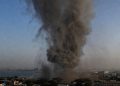
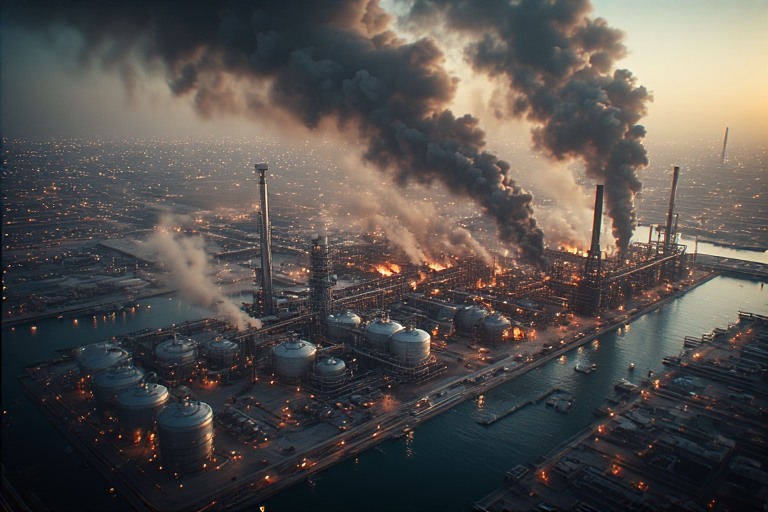
On March 18, Israeli aircraft struck processing facilities at Iran’s Asaluyeh complex — the onshore hub for the South Pars gas field, the world’s largest natural gas reserve, shared geologically with Qatar’s North Field. The governor of Asaluyeh confirmed facilities were taken offline to control fires; Israeli military sources acknowledged the operation specifically targeted Iran’s gas infrastructure. The attack halted output at two refineries with a combined capacity of 100 million cubic metres per day. Iran’s South Pars supplies roughly 70 percent of the country’s domestic gas needs, and the halt immediately cut Iranian gas exports to Iraq entirely, taking 3,100 megawatts of power generation offline in Baghdad. Trump stated publicly the US “knew nothing about this particular attack” and that “Qatar was in no way, shape, or form involved.” Netanyahu confirmed Israel acted alone: “Fact number one, Israel acted alone against the Asaluyeh gas compound. Fact number two, President Trump asked us to hold off on future attacks, and we’re holding off.” At least one Israeli official told CNN the strike was in fact coordinated with Washington.
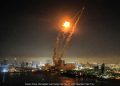
Iran retaliated by activating what it had previously promised: an energy-for-energy response across the Gulf. Iranian ballistic missiles struck Qatar’s Ras Laffan Industrial City — the world’s largest LNG export facility — causing QatarEnergy to report “sizeable fires and extensive further damage” to multiple LNG units. Qatar’s energy minister Saad al-Kaabi confirmed Iran’s strikes reduced the country’s LNG export capacity by 17 percent, with repairs expected to take three to five years. A drone struck the SAMREF refinery at Yanbu — Saudi Arabia’s primary Hormuz-bypass export hub — while a ballistic missile targeting Yanbu port was intercepted. Riyadh intercepted four ballistic missiles launched toward the capital and eight drones across the Eastern Region. UAE operations at the Habshan gas facility and Bab oil field were suspended. Kuwait’s Mina Al-Ahmadi and Mina Abdullah refineries were targeted, resulting in fires at both sites. Iran also launched five separate missile salvos at Jerusalem and northern Israel within a single hour.
Qatar’s response to the Ras Laffan strike was the day’s most consequential diplomatic development. The Foreign Ministry declared Iran’s military attaché, security attaché, and all associated staff persona non grata, ordering them out within 24 hours — citing “repeated Iranian targeting and blatant aggression” in breach of UNSC Resolution 2817. Qatar simultaneously reserved the right to respond under Article 51 of the UN Charter. The strategic significance is not merely the expulsion: Qatar hosts Al Udeid Air Base, the forward headquarters of US Central Command and the nerve centre of the entire US military effort against Iran. Doha has spent three weeks attempting to remain neutral while hosting the force conducting the war. That posture has now been overtly abandoned. Analytical assessment: The fracture between Qatar’s neutral-hosting role and its direct victimhood as an Iranian target is the most significant coalition stress event of the conflict to date — it removes Qatar’s functional role as a potential back-channel mediation conduit precisely when diplomatic off-ramps matter most.
Trump’s public posture added a new strategic variable: he threatened to “massively blow up the entirety of the South Pars Gas Field” if Iran continues attacking Qatari LNG facilities, while simultaneously instructing Netanyahu to halt further strikes on Iranian energy infrastructure. The US has now publicly split from Israel’s targeting doctrine — an unusual and significant signal that Washington’s energy-price ceiling has been reached. Defence Secretary Hegseth held a press briefing on March 19 confirming the Pentagon has submitted a $200 billion supplemental funding request to the White House, while declining to specify any timeline for the conflict’s end: “It will be at the president’s choosing.”
Whether Qatar formally invokes Article 51 self-defence or requests UNSC emergency action — either move would impose new political costs on Iran and reframe the Gulf states as active parties rather than collateral victims. Watch for any Iranian diplomatic communication to Doha in the next 24 hours: silence signals Iran is content with the escalation dynamic; a conciliatory message would indicate Tehran is worried about losing its last functional Gulf interlocutor. Monitor Brent crude for sustained break above $110 — Wood Mackenzie’s 3–5 year Ras Laffan repair horizon means any ceasefire will not restore LNG supply on a timeline markets are currently pricing.
Regional Roundup
Rosatom Calls for “Safety Island” Around Bushehr After Projectile Strikes 350m from Reactor
A projectile struck the premises of Iran’s Bushehr nuclear power plant on March 17 — confirmed by both Rosatom and the IAEA — destroying a structure approximately 350 metres from the operating reactor. The IAEA’s Director General Rafael Grossi stated radiation levels remained normal and the reactor was undamaged, but noted that any strike on or near nuclear power plants “must never occur.” On March 19, Rosatom CEO Alexei Likhachev called on all conflict parties to declare the site “an island of safety,” warning that 72 tons of fissile material and 210 tons of spent nuclear fuel at the site would produce “at least a regional-scale” catastrophe if the reactor were struck. Likhachev confirmed a major third-phase evacuation is being prepared, which would leave only “a few dozen” Rosatom specialists on site; the evacuation route runs through Armenia. Approximately 480 Russian personnel remain at Bushehr across two prior evacuation rounds.
The proximity strike is the most consequential nuclear safety event since the conflict began, and Rosatom’s public escalation — addressed not just to Tehran but explicitly to “the leadership of all parties” — represents Moscow’s clearest direct intervention in the conflict’s conduct since Russia-Iran intelligence sharing was reported in early March. The US and Israel possess precise coordinates for Bushehr; Likhachev stated this explicitly. Whether the strike was accidental, a message, or a targeting error carries profoundly different implications — and none of those three possibilities has been publicly established.
Pentagon’s $200 Billion War Supplemental Signals Open-Ended Campaign — Republican Resistance Emerging
The Pentagon submitted a $200 billion supplemental funding request to the White House on March 18, confirmed by the Washington Post and acknowledged — without denial — by Hegseth at a March 19 press briefing. The request is in addition to the record $1.5 trillion defence budget request for FY2027 already submitted. Hegseth stated the US has struck more than 7,800 targets in Iran and that “today will be the largest strike package yet,” while declining to give any timeline for mission completion. The US has spent approximately $1 billion per day since hostilities began. At that daily burn rate, $200 billion covers roughly 200 days of operations beyond current expenditures — structurally incompatible with the four-to-six-week timeline originally floated by the administration.
The request has not yet been formally submitted to Congress, and early Republican pushback is notable: Rep. Lauren Boebert stated flatly she would vote against any war supplemental; Sen. Lisa Murkowski demanded a full rationale and timeline; Rep. Chip Roy said he needed to understand “what the game plan is.” Speaker Johnson offered only that Congress has a “commitment to adequately fund defence.” The fiscal signal matters independently of the politics: a $200 billion request, described by Trump as covering needs “beyond even what we’re talking about in Iran,” implies the administration is preparing a war budget sufficient for a conflict of longer duration and potentially broader scope than Day 20 rhetoric currently acknowledges.
E6 Nations Ready to Support Hormuz Safe Passage — Italy and Germany Immediately Walk It Back
The UK, France, Germany, Italy, Japan, and the Netherlands issued a joint statement on March 19 expressing readiness “to contribute to appropriate efforts to ensure safe passage through the Strait of Hormuz,” condemning Iranian attacks on commercial vessels. The statement was widely reported as a signal of potential military commitment to convoy escort operations. Within hours, Italy and Germany both clarified they were not discussing any immediate military deployment but rather participation in a “potential multilateral initiative after a ceasefire.” The UK confirmed it has sent a small team of military planners to work with CENTCOM on a “viable collective plan” — an advisory contribution, not a combat commitment.
The walk-back is analytically more significant than the statement. Three weeks into the conflict, with Brent briefly above $119 on March 19, the world’s major energy-importing democracies cannot agree on a military posture to protect the waterway carrying 20 percent of global oil supply. Trump has publicly rebuked NATO allies twice for refusing to deploy, and Japan — which relies on Gulf crude for the majority of its oil imports — has declined combat involvement. The Hormuz reopening problem has no coalition solution in sight.
Netanyahu: “I’m Not Sure Who Is Running Iran Right Now” — Mojtaba Khamenei Has Not Appeared in Public
At a March 19 press conference in Jerusalem, Netanyahu stated in English: “I’m not sure who is running Iran right now. Mojtaba, the replacement ayatollah, has not shown his face.” The comment is substantively significant: Day 14’s brief tracked Khamenei’s written-only statement, with Hegseth assessing he was “likely disfigured.” On Day 20, Iran’s supreme leader has not made any audio or video appearance in six days. Netanyahu simultaneously told reporters that “Iran has lost the ability to enrich uranium and make ballistic missiles” and that “the war may end sooner than people think” — though Israeli Defence Minister Katz continued to insist the operation has “no time limit.”
The leadership opacity matters strategically: ceasefire negotiations require an identifiable Iranian interlocutor with authority to commit, and the deepening ambiguity about who in Tehran actually holds that authority further constrains any diplomatic exit. The regime is demonstrably still functional — Iranian military operations on March 19 were extensive and coordinated — but functional continuity and visible leadership authority are not the same thing, and international backchannel diplomacy requires the latter.
Saudi Foreign Minister: “Remaining Trust in Iran Has Been Totally Undermined” — Yanbu Bypass Now Under Direct Attack
Saudi Foreign Minister Prince Faisal bin Farhan stated on March 19 that his country’s “remaining trust in Iran has been totally undermined” and that Saudi Arabia “reserves the right to take military actions if deemed necessary.” The statement coincided with Iran striking the SAMREF refinery at Yanbu — a joint Aramco-ExxonMobil facility — via drone, with a ballistic missile targeting Yanbu port intercepted by Saudi air defences. Riyadh intercepted four ballistic missiles and multiple drone waves across the Eastern Province and capital. The SAMREF attack is assessed as minimal operational impact by an industry source, but the targeting significance is high: Yanbu is Saudi Arabia’s last functioning crude export outlet while Hormuz remains closed. Iran now has the Yanbu bypass in its targeting architecture.
The East-West Pipeline terminus at Yanbu handles approximately 2.2 million barrels per day in current wartime conditions — Saudi Arabia’s only alternative to Hormuz export routing. A sustained attack campaign against Yanbu infrastructure would effectively close both Saudi export corridors simultaneously, removing the only mechanism currently preventing total Gulf crude supply collapse. Saudi Arabia has not formally declared war footing, but the foreign minister’s language on March 19 moves the kingdom’s public posture closer to active belligerency than at any prior point in the conflict.
Under the Radar
The strategic implication receiving no wire coverage: a Greek-operated Patriot PAC-3 battery stationed at Yanbu — deployed under the bilateral ELDYSA mission since 2021 — intercepted two Iranian ballistic missiles targeting the SAMREF refinery on March 19, confirmed by the Greek Defence Ministry. This is the first time a NATO member’s military personnel have fired weapons against Iranian targets in this conflict. Greece operates entirely outside NATO’s command structure at Yanbu, under a bilateral arrangement with Riyadh that Saudi Arabia funds including PAC-3 system upgrades. The Hellenic Parliament has extended the deployment four times; the current extension runs through November 2026. The combat engagement — 120–130 Greek Air Force personnel now operationally entangled in the Gulf conflict — has not triggered any public parliamentary debate in Athens, any NATO statement, or any commentary in the alliance’s collective response to the war. It transforms the diplomatic calculus quietly: a NATO ally has now fired weapons at Iran in defence of Saudi territory, without any of the treaty architecture or collective deliberation that normally precedes such a threshold. In 2–4 weeks, if Iran escalates targeting at Yanbu, Greece faces a political and military exposure that has no established framework for managing.
Wire coverage of the Ras Laffan damage is framing it as a supply disruption — the same category as the Hormuz closure. It is structurally different. Wood Mackenzie, one of the world’s leading energy consultancies, stated on March 19 that “the attacks fundamentally reshape global LNG outlook,” with Qatar’s LNG repair timeline now estimated at three to five years for the damaged units. QatarEnergy CEO al-Kaabi confirmed the damage reduced Qatar’s LNG export capacity by 17 percent with a multi-year repair horizon, and that China, South Korea, Italy, and Belgium face direct supply impact. Qatar provides roughly 20 percent of global LNG supply; 17 percent of that capacity is now offline for years, not weeks. The Hormuz closure is reversible by ceasefire — it requires an Iranian decision, not reconstruction. Ras Laffan is not reversible by ceasefire. Even if hostilities end tomorrow and Hormuz reopens, the global LNG market faces a structural supply deficit that will take years to resolve. European winter energy security planning through 2027–2028 must now be rewritten. No government has publicly acknowledged this distinction yet.
Iranian gas exports to Iraq stopped entirely on March 18 following the South Pars strike — cutting 3,100 megawatts from the national grid, per Iraq’s Electricity Ministry. Iraq supplies roughly one-third of its power needs from Iranian gas; the halt comes as Baghdad is approaching peak summer demand season. Iraq’s grid has a structural deficit even in normal conditions: most households rely on private generators for daily power cuts. The loss of Iranian supply ahead of summer — when demand peaks and cooling requirements become critical — creates a governance crisis in a country already hosting active pro-Iran PMF factions, US military facilities, and a federal government walking a careful neutrality line. Wire coverage has treated the gas halt as an energy market data point. It is not: it is a political stability indicator for a country of 45 million people whose government has not declared a side in this war and whose population’s tolerance for wartime deprivation has not been tested. If Iraq’s summer grid fails at scale, the political consequences for Baghdad’s carefully maintained neutrality — and for US basing rights at Iraqi facilities — will arrive on a 6–10 week timeline.
By the Numbers
| $108.65 | Brent crude March 19 close — after briefly touching $119 intraday, the highest since 2022. Brent has risen approximately 80% since February 28 (Fortune/CNBC). The intraday reversal followed Netanyahu’s statement that Israel is “helping the US open the Strait of Hormuz.” |
| 17% | Share of Qatar’s LNG export capacity taken offline by Iranian strikes on Ras Laffan, per QatarEnergy CEO Saad al-Kaabi. Repair timeline: 3–5 years (Wood Mackenzie). Qatar supplies approximately 20% of global LNG — the damage is structural, not operational. |
| $200B | Pentagon supplemental war funding request submitted to the White House on March 18. Four times the amount originally floated; in addition to the $1.5 trillion FY2027 base budget request. Hegseth: “It takes money to kill bad guys.” No timeline for operations given (Washington Post / Bloomberg). |
| 3,100 MW | Iraqi electricity generation lost after Iran halted all gas exports to Iraq on March 18 following the South Pars strike. Iraq’s Electricity Ministry confirmed the complete halt, representing roughly one-third of the country’s supply needs (AFP / Anadolu Agency). |
| 20,000 | Seafarers trapped on approximately 3,200 vessels west of the Strait of Hormuz, per International Maritime Organisation data cited March 19. The blockade is now in its 20th day with no timeline for naval convoy operations. |
| 350m | Distance from the Bushehr nuclear reactor at which a structure was destroyed by a projectile on March 17, per IAEA confirmation. Rosatom: 72 tons of fissile material and 210 tons of spent fuel at site. Third evacuation of Rosatom personnel now being prepared (Reuters / TASS). |
What We’re Watching
- Yanbu Throughput Verification — ESCALATED. Yanbu is now under active Iranian targeting: SAMREF drone strike landed, ballistic missile intercepted at port. Greek Patriot battery engaged. Saudi Arabia’s last export corridor is inside Iran’s active targeting architecture.
- UAE Interceptor Stockpile Math — ESCALATING. UAE engaged 45 drones and 10 ballistic missiles in a single wave on March 18; Habshan gas facility operations suspended. Stockpile depletion math is now operational, not theoretical.
- Fertilizer / Ras Laffan Recovery — STRUCTURALLY ALTERED. The brief’s forecast that Ras Laffan damage would outlast any ceasefire is now confirmed by Wood Mackenzie: 3–5 year repair horizon regardless of when hostilities end.
- Houthi Activation — STILL RESTRAINED (Day 20). No confirmed Houthi activation at Bab-el-Mandeb. The strategic logic for Houthi entry — maximum leverage at maximum Saudi vulnerability — has not yet been triggered.
- Bahrain Fifth Fleet Exposure — ONGOING. Bahrain intercepted 12 drones on March 19. Peninsula Shield deployment ongoing. No confirmed escalation to Fifth Fleet operational impact.
- Qatar Article 51 / UNSC Emergency Session — Watch whether Doha escalates from diplomatic expulsion to formal self-defence invocation. A UNSC filing would be the most significant multilateral escalation signal of the conflict.
- Mojtaba Khamenei Public Appearance — Netanyahu stated on March 19 that the supreme leader “has not shown his face.” Any audio or video appearance resolves the command authority question that is currently blocking diplomatic engagement. Continued absence accelerates the governance vacuum scenario.
- Yanbu Export Continuity — Whether Saudi Aramco confirms continued crude loadings at Yanbu following drone and missile strikes on SAMREF and port. Any operational halt to Yanbu exports removes the last functioning Gulf crude corridor and triggers the $140–150 oil scenario modelled by Oxford Economics as a recession threshold.
- Iraq Summer Power Planning — Watch for Iraqi government emergency statements on alternative fuel sourcing and grid management ahead of summer peak demand. Any public acknowledgment of a multi-month shortfall will generate political pressure on Baghdad’s neutrality posture and on US basing rights negotiations.
- Pentagon Supplemental Congressional Response — Whether the $200 billion request is formally transmitted to Congress this week, and whether Republican moderates (Murkowski, Roy) signal a blocking coalition. A significant congressional pushback would constrain the campaign’s operational timeline independently of battlefield dynamics.