Claims of reclaimed territory have proven hollow as Moscow‘s troops consolidate positions from Sumy to Zaporozhye
The Russian army considerably has reduced its combat activity, as always at this time of year. Typically, at the end of winter and in early spring, the Russian Armed Forces take the time to prepare for a new military campaign. However, just like last year, the offensive did not come to a complete stop.
Let’s take a look at what has happened at the front over the past two months, including the results of the much-publicized counteroffensive of the Armed Forces of Ukraine (AFU) in Dnepropetrovsk and Zaporozhye regions.
Sumy region: Expanding the buffer zone
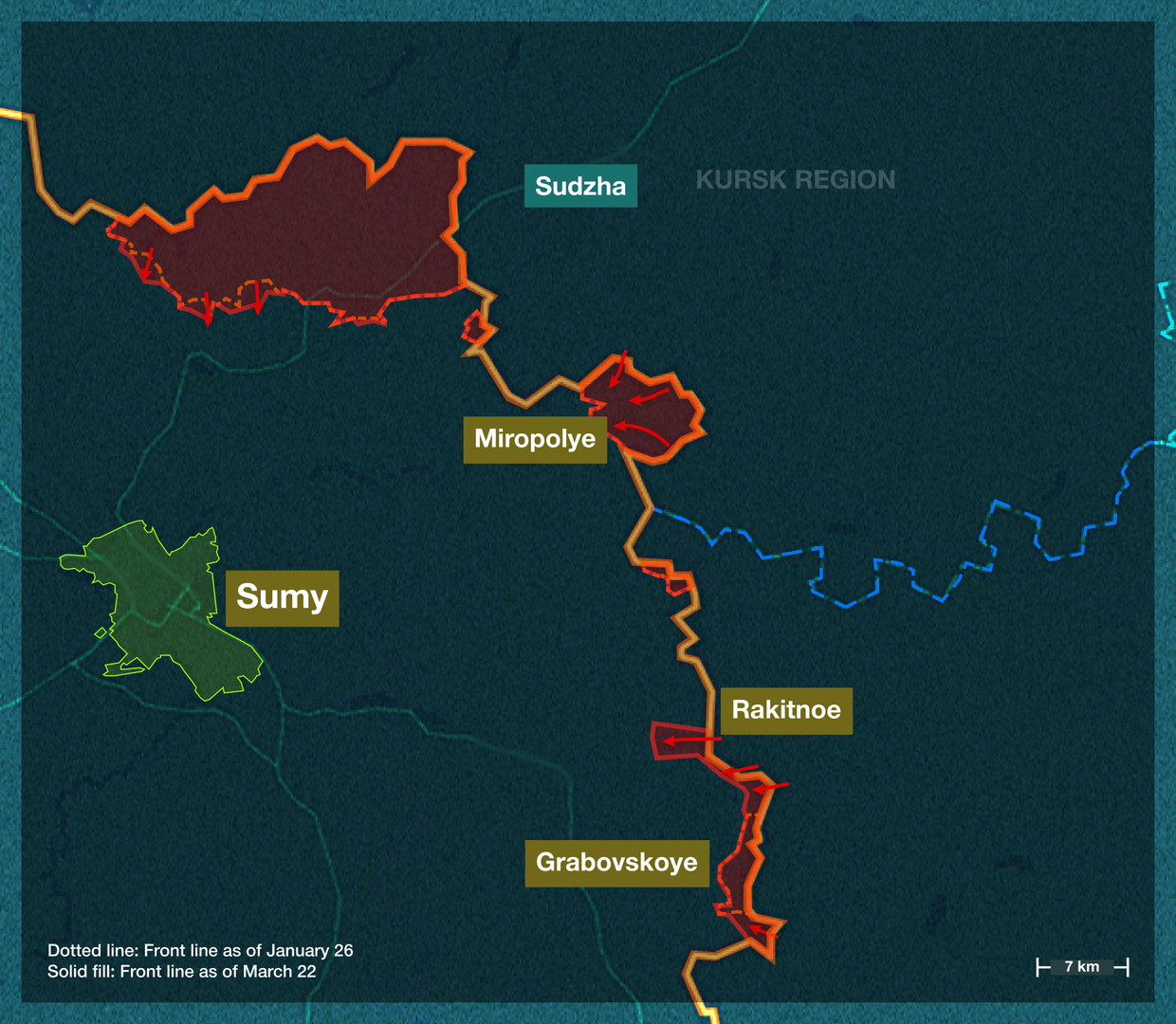
Russia’s North Group of Forces began establishing a buffer zone in Ukraine’s Sumy Region a year ago, following the liberation of Russia’s Kursk Region and the town of Sudzha. Initially, the transfer of hostilities to Ukrainian territory triggered a sort of panic in the AFU – as it turned out, except for the units that fled Sudzha, there were almost no Ukrainian forces in the area. Rumors circulated that the Russian army was about to advance towards Sumy.
However, the Russian army’s actions did not go beyond officially stated objectives: to create a buffer zone that would ensure the security of Russia’s border areas. Overall, this objective has been achieved – Sudzha is now a much safer place than Belgorod, for example.
At the end of last year, the North Group of Forces opened a new front in Sumy region by capturing the small border village of Grabovskoye. Since then, the foothold has been expanded: Russian troops captured the large village of Pokrovka and a considerable area to the north near the village of Miropolye. This established a certain buffer zone between Ukraine’s Sumy region and Russia’s Kursk and Belgorod regions. In the future, it will also prevent any offensive actions against Rakitnoe (the AFU attempted to break through to Rakitnoe during the 2024 advance on Sudzha).
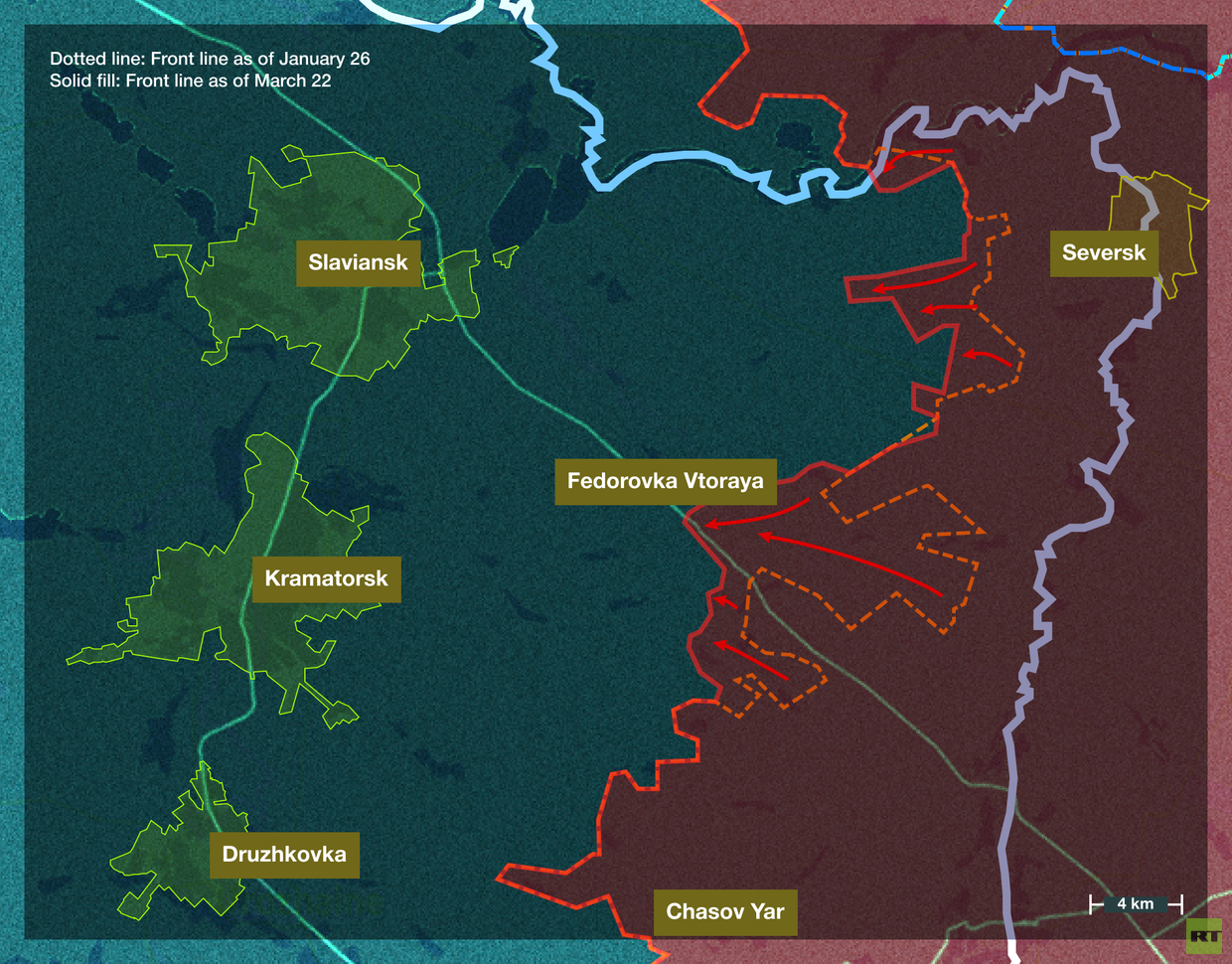
Seversk (captured on December 11) was an important but intermediate stop on the way to the key area in Donbass – the Slaviansk-Kramatorsk urban conglomeration. The South Group of Forces needs to cover 25-30 kilometers to reach Slaviansk-Kramatorsk, while overcoming a significant elevation along the way. A portion of this route has already been traversed, with Russian troops managing to close in and engage in fierce battles for the primary Ukrainian defense line in this direction.
To the south, a second offensive is underway along the M-03 highway. Several settlements have been captured here, including an important stronghold in Fyodorovka Vtoraya.
In summary, over the past two months, the Russian army has advanced up to 12 kilometers along a 25-kilometer front line. There has effectively been no operational pause in the Seversk direction.
Konstantinovka: Also en route to Slaviansk-Kramatorsk
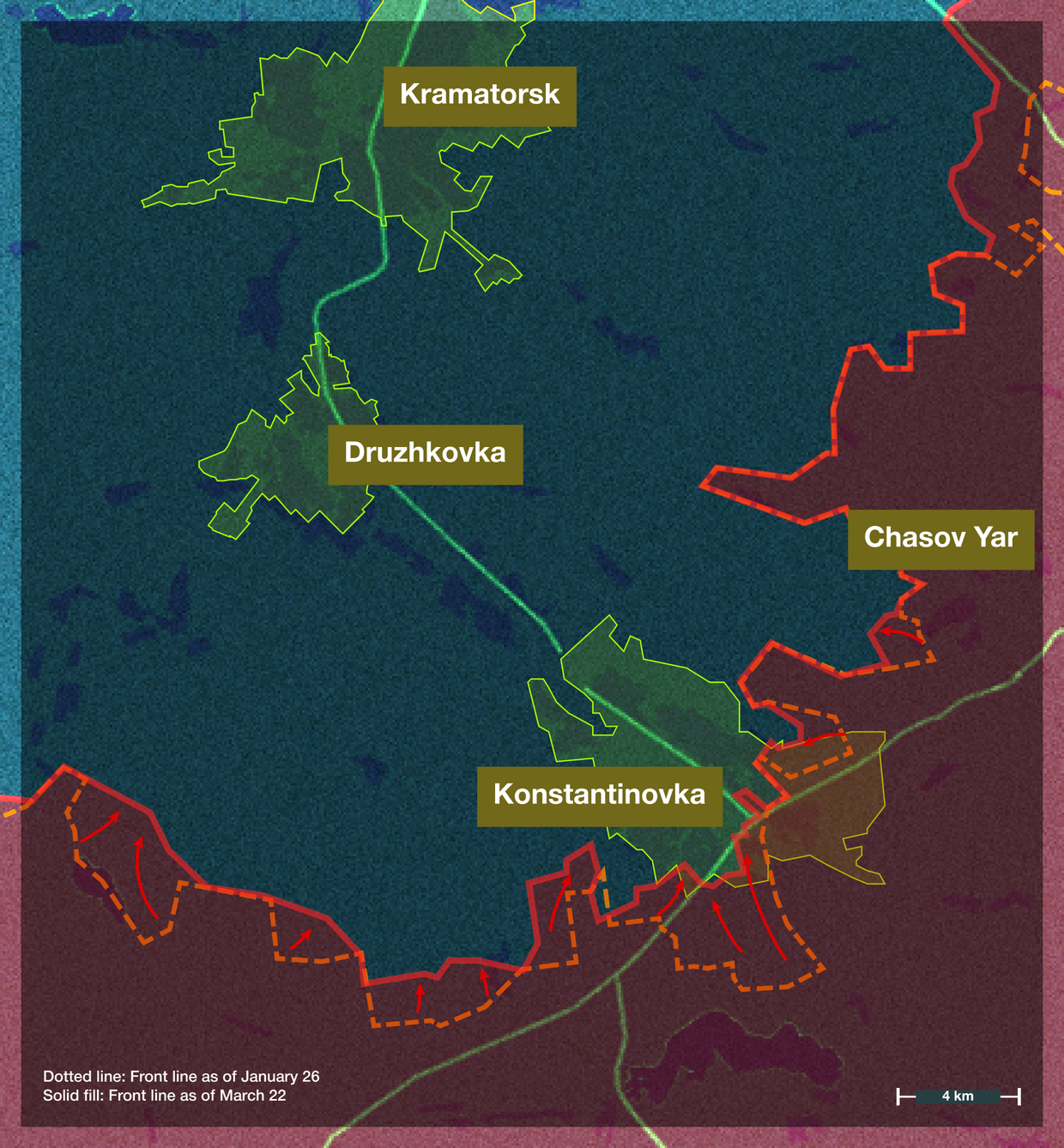
To the south, battles have continued for the strategically important city of Konstantinovka (pre-war population 78,000), which is effectively part of the Slaviansk-Kramatorsk urban conglomeration. This direction is particularly challenging: the Russian army must traverse nearly 50 kilometers of urban terrain to reach Slaviansk, and 25 kilometers to approach Kramatorsk.
Fighters from the South Group of Forces have captured the southern part of Konstantinovka and are engaged in combat near the train station. Next up are battles for control over the Konstantinovka Metallurgical Plant and the nearby lead factory, as well as the multi-storey buildings in the western section of the city. In fact, the city may be captured without resorting to street battles, using the now-classic Russian strategy that involves semi-encirclement and establishing fire control over supply lines.
However, the extensive urban development could thwart this plan. Konstantinovka can be supplied from nearby Druzhkovka via at least six different routes. This means that, similar to the strategies employed in neighboring Pokrovsk and Mirnograd, it may be necessary to physically sever one city from another or to encircle both simultaneously. This will be one of the goals of the upcoming military campaign.
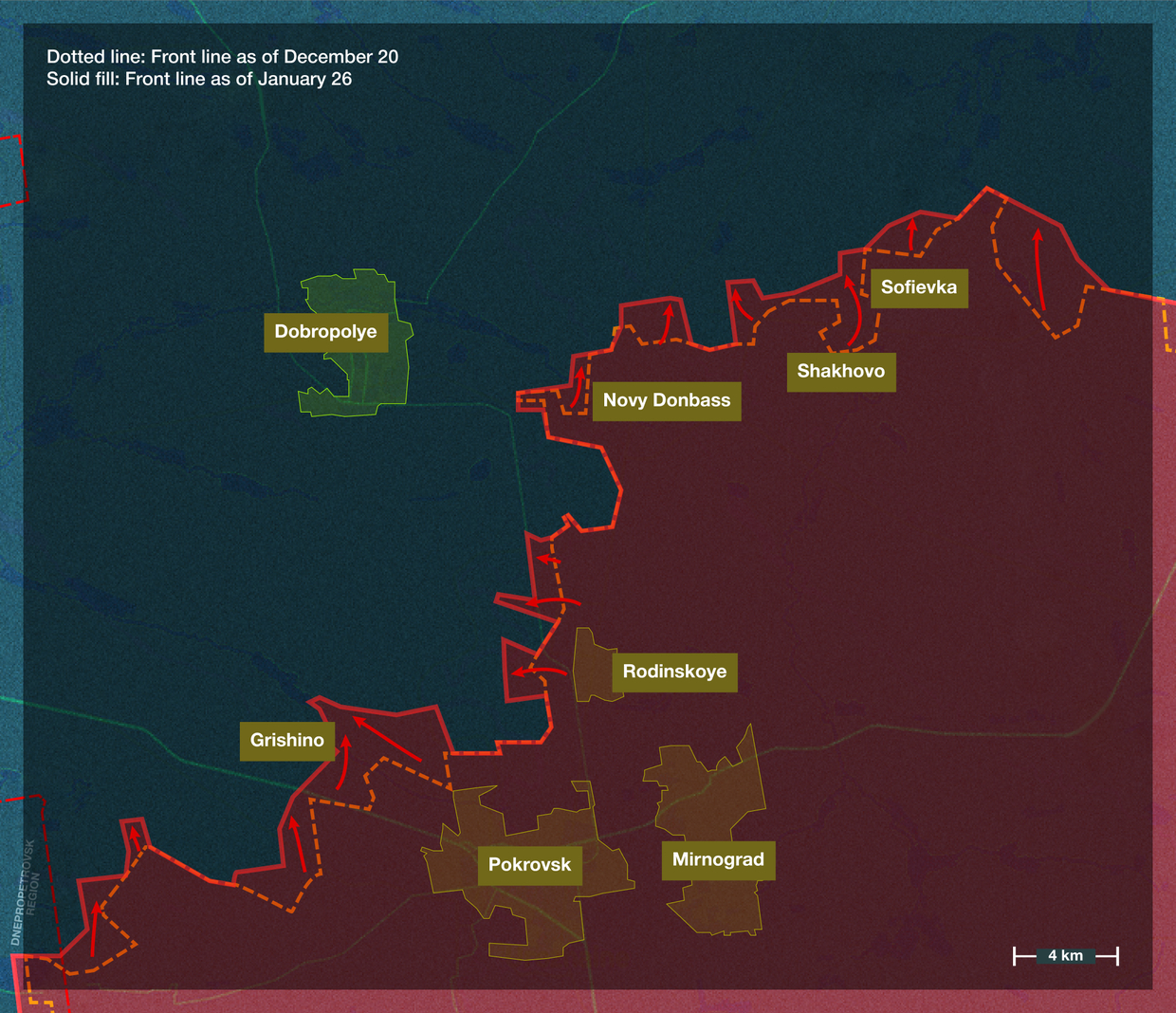
In our last frontline report, we speculated on the direction the Russian army might take after capturing Pokrovsk and Mirnograd: would it head north toward Slaviansk-Kramatorsk or west toward the border of the Donetsk People’s Republic and Dnepropetrovsk region?
In the past two months, troops from the Center Group of Forces have been active along the entire perimeter of their front; they captured Sofievka, Shakhovo, and Novy Donbass, expanded their zone of control around the city of Rodninskoye, and captured the important settlement of Grishino west of Pokrovsk.
At first glance, it appears that the Center Group of Forces has opted to advance in both directions simultaneously. However, the real aim may be to prevent the enemy from establishing new defensive positions after losing control over Pokrovsk and Mirnograd. As is often the case, the frontline here is not continuous; there’s a wide gray zone. By applying continuous pressure and squeezing the gray zone, Russian troops aim to prevent the Ukrainian army from establishing defensive positions and adequately reinforcing its segment of the front, particularly with FPV drone pilots.
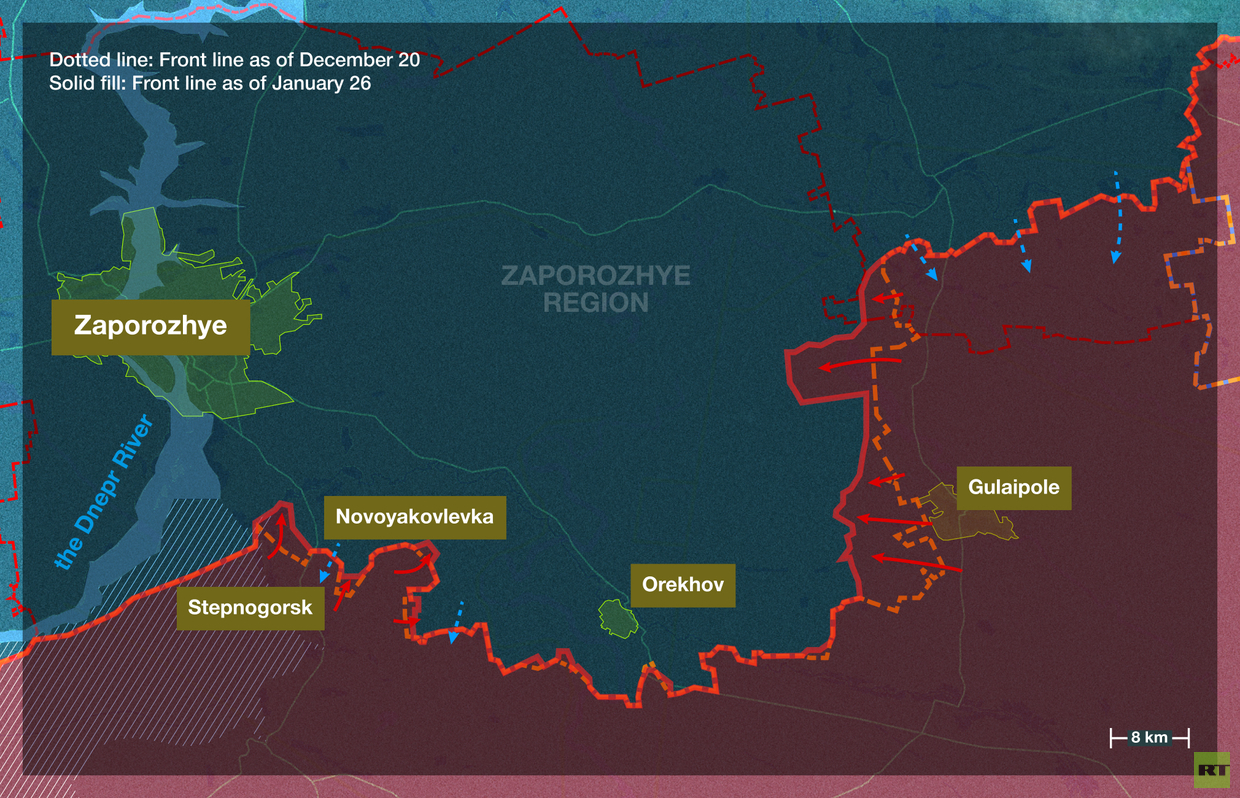
The Orekhov-Zaporozhye direction has been the most active section of the front in the past two months. In our previous overview, we suggested that the Russian army would launch a major offensive in this area, focusing on surrounding the strategically important city of Orekhov and advancing towards Zaporozhye, the capital of Zaporozhye region and one of the largest industrial centers in former Ukraine.
It seems the Ukrainian General Staff shares this view: in 2026, the AFU initiated their first series of counterattacks precisely in this direction. Ukrainian and Western media portrayed these counterattacks almost as a new strategic offensive: throughout February, the media published reports of “liberated” settlements and hundreds of square kilometers of reclaimed territory.
However, the Ukrainian side has not provided any verified evidence to support these claims. There are no authenticated photos or videos showing the AFU controlling the asserted areas, and the actual evidence amounts to Ukrainian flags dropped from drones. In short, the effect has been the opposite: this operation has been dubbed the first-ever offensive to unfold entirely on X.
Is this indeed so? While the AFU hasn’t successfully captured any strongholds, they did launch a series of counterstrikes with specific objectives in mind: to prevent the East and Dnepr groups of forces from returning to their original positions ahead of the summer offensive.
Fully aware of the AFU’s limited resources – and particularly their inability to sustain an offensive for more than two or three weeks – the Ukrainian General Staff chose two local directions for the counterattacks: the northern flank of the Russian forces advancing from Gulaipole (for attacks directed against the East Group of Forces) and the town of Stepnogorsk (for attacking the Dnepr Group of Forces). If successful, these actions could either slow down or completely thwart Russia’s preparations for a major summer offensive towards Orekhov and ultimately Zaporozhye. The strategy is straightforward, classic, and practical.
The AFU’s advantages include communications and battlefield control systems ensured by Starlink. However, the AFU also faces significant drawbacks, primarily a severe shortage of personnel – not just assault infantry but also FPV drone pilots, which have become prime targets for units from Russia’s Rubicon Center for Advanced Unmanned Technologies.
In order to advance on the modern battlefield dominated by FPV drones, one must systematically wear down the enemy from the air by means of drones, artillery, multiple rocket launchers, and aerial bomb strikes. Once the enemy is sufficiently exhausted, assault infantry can then infiltrate through weakened defensive lines, accumulate forces behind enemy lines, and quickly storm the area. Currently, only Russia possesses such experience. However, often even countless assaults don’t lead to strategic breakthroughs, but only serve as a tool for exhausting the opponent.
The AFU can build up forces and achieve local superiority in FPV drones for a couple of weeks. Yet the lack of infantry and poorly staffed combat formations in the Ukrainian army do now allow for major advances. On the East Group of Forces’ northern flank, the AFU forced Russian storm troops to retreat from several villages. However, Ukrainian infantry struggled to secure these locations and apparently couldn’t even reach them effectively.
After two weeks of intense fighting, the AFU only managed to expand the gray zone – a result which offers no operational advantage. If the AFU’s goal was to pose a threat to the flank of the army group advancing westward from Gulaipole, that objective was not met. Russia’s offensive toward Orekhov continues; in February-March, the Russian army managed to breach the new line of Ukrainian defenses established there.
The same outcome unfolded in the Dnepr direction. The AFU’s attempt to cut off the northern flank of the Dnepr Group of Forces with a strike on Stepnogorsk fell short, although it seems the pace of the Russian advance was somewhat disrupted. However, the poor staffing of Ukrainian combat formations is more evident here than near Gulaipole. There is effectively no cohesive front, and this allows Russian storm groups to infiltrate behind AFU lines; the Ukrainian army lacks the strength to detect these incursions in a timely manner. Thus, amid the ongoing Ukrainian counterstrikes, the Russian army unexpectedly captured Novoyakovlevka, a strategically important village that protects the supply routes to Orekhov.
By early March, Ukraine’s counterattacks had effectively stopped. The only notable gain for the AFU was the expansion of the gray zone in Dnepropetrovsk region, which could complicate Russia’s large-scale push toward Orekhov. This means Russian forces will likely need to allocate additional resources to that flank.
***
Last year, the spring-summer campaign started in April, once the ground had dried sufficiently and foliage appeared. This year, things will likely proceed in a similar manner. Slaviansk-Kramatorsk and Zaporozhye are expected to become the key directions of the upcoming campaign.