Top Story
Iran Articulates First Ceasefire Framework in 13 Days — Conditions Are Maximalist, the Shift Is Not
On Day 13 of Operation Epic Fury, Iranian President Masoud Pezeshkian publicly laid out three conditions for ending the conflict — the first time Tehran has articulated a negotiating framework rather than rejecting talks outright. The conditions: recognition of Iran’s “legitimate rights” (covering the nuclear programme and regional proxy networks), payment of war reparations, and binding international guarantees against future US-Israeli strikes. Bloomberg, citing unnamed Iranian officials, confirmed Iran conveyed the same framework to regional intermediaries, with the core ask being a US guarantee of non-aggression. Deputy FM Gharibabadi stated: “If a ceasefire is to be established, there must be a guarantee that aggressive actions against Iran will not be repeated.” Pezeshkian said he conveyed the conditions directly to the leaders of Russia and Pakistan.
Wire coverage has focused on the conditions themselves — presenting them as a list and labelling them “maximalist.” That framing, while accurate about the specific asks, obscures the structural significance of the moment. For 13 days, Iran’s posture was one of outright rejection of any negotiated exit. Today’s framework — however unrealistic its specific terms — represents a calculation by Tehran that the economic cost of Hormuz closure and the oil shock is generating enough international pressure to extract concessions. Iran is signalling it wants a face-saving exit; the question now shifts to whether Washington can supply one without conceding what it fought the conflict to deny.
Analytical assessment: The nuclear fuel cycle demand, if confirmed — single-sourced via Telegram-aggregated regional media and not yet verified by Tier 1 reporting — would be the most consequential element and the buried lede of the day. Iran’s three demands map directly onto the war’s original casus belli: the US and Israel struck Iran to foreclose a nuclear threshold capability and degrade proxy infrastructure. If Tehran’s minimum exit price includes international codification of both, the diplomatic gap is not merely wide — it is structurally unbridgeable without a fundamental shift in US-Israeli strategic posture. State media signal: PressTV and IRNA have pivoted from martyrdom/resistance framing to “Iran’s peace offer.” That editorial shift is itself intelligence — the regime is beginning to manage domestic expectations for a negotiated outcome, not a military victory.
Any US or Israeli response to Pezeshkian’s three conditions — specifically whether the White House modifies its “unconditional” framing or whether envoy Witkoff’s office engages regional intermediaries. Watch for Mojtaba Khamenei’s first substantive public communication since confirmed injuries on Day 8: if his messaging aligns with or diverges from Pezeshkian’s conditional framework, it will reveal whether the ceasefire signal has IRGC backing or reflects only the civilian government’s position.
Regional Roundup
IEA Authorises Largest Emergency Oil Release in History — Market Reads It as Insufficient
The IEA’s 31-member governing board voted unanimously on March 11 to release 400 million barrels from strategic reserves — more than double the previous record release of 182.7 million barrels authorised after Russia’s 2022 Ukraine invasion. IEA Executive Director Birol confirmed Hormuz transit volumes are currently running at less than 10% of pre-war levels. Brent rose 4.76% to $91.98 after the announcement, then briefly cleared $100 again on March 12 as ship attacks intensified — a market signal that traders regard the reserve release as a pressure-relief measure, not a price ceiling. EIA projects Brent to hold above $95/barrel for at least two months; Goldman Sachs’s $120 scenario remains live.
Simultaneously, Saudi Aramco announced it would resume approximately 70% of usual crude shipments via the East-West Pipeline to the Yanbu terminal on the Red Sea — the most significant supply-side development of the day and one receiving minimal wire attention. The Yanbu bypass operationalises an alternative to Hormuz and directly undercuts Iran’s primary leverage instrument. Whether Aramco can sustain 70% throughput over weeks, not days, is the metric that will determine whether Iran’s chokepoint strategy has a structural ceiling.
Six Ships Struck in 48 Hours; IRGC Demands Vessels Seek Iranian Permission to Transit
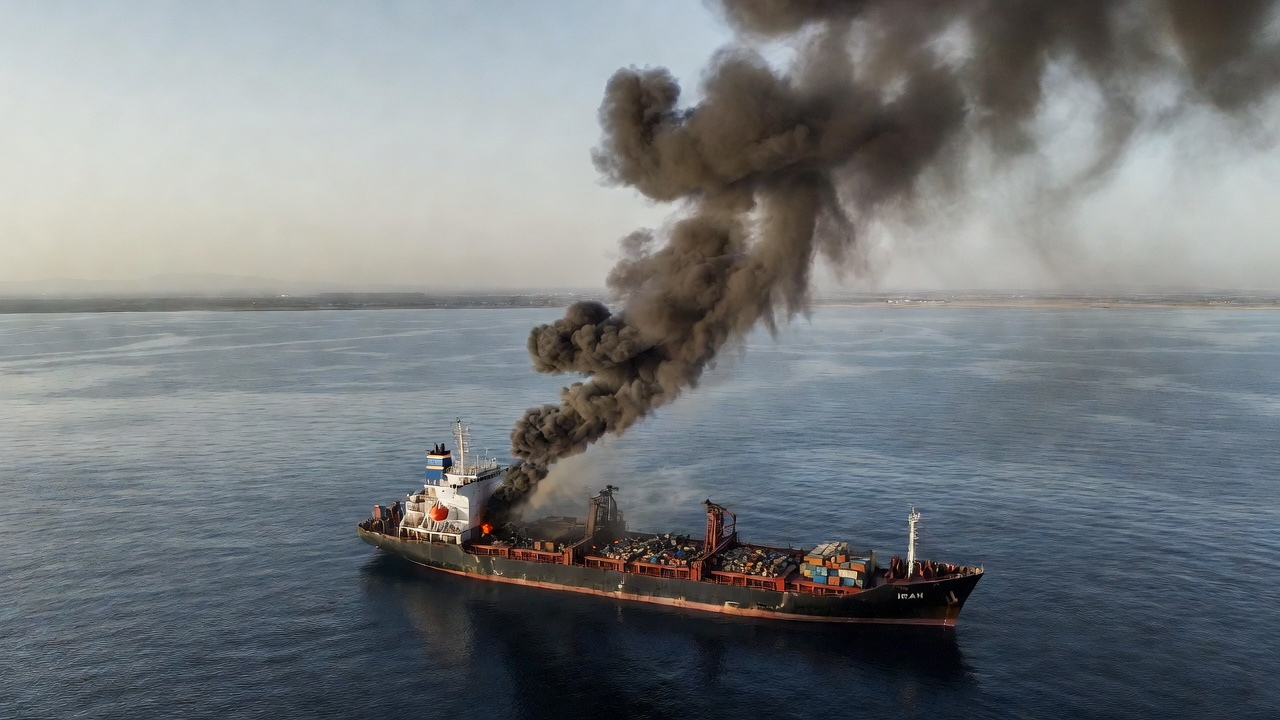
IRGC naval forces struck six vessels in a 48-hour window ending March 12: the Thai-flagged Mayuree Naree (3 crew missing, 20 rescued by Omani Navy), the Japanese ONE Majesty, the Marshall Islands-flagged Star Gwyneth on March 11; a container ship 35 nautical miles north of Jebel Ali, UAE, and two fuel tankers in Iraqi territorial waters near Basra on March 12. UKMTO total stands at 17 incidents since February 28, with 6 confirmed deaths per IMO records. IRGC naval commander Tangsiri declared that all vessels intending to pass through the strait must obtain Iranian permission — a claim with no basis in international maritime law. CENTCOM simultaneously warned that Iran is using civilian ports for military logistics, which under international humanitarian law strips those facilities of protected status.
The US Navy has declined near-daily shipping industry requests for military convoy escort, citing unacceptably high risk. Lloyd’s List analysis identifies a 5-vessel convoy model as the most operationally realistic resumption scenario. The mine threat remains unconfirmed — JMIC reports no verified mine deployments, though at least one recent attack showed an explosive event consistent with an underwater hull strike. The gap between confirmed attack methods and mine deployment matters: once mines are confirmed, insurance and transit calculus changes entirely.
UNSC Resolution 2817 Passes 13-0-2 — China and Russia Abstain Rather Than Veto
The UN Security Council adopted Resolution 2817 on March 11 with 13 votes in favour and abstentions from China and Russia — neither exercised a veto. The resolution, co-sponsored by a record 135 UN member states (the largest co-sponsorship count in UNSC history per Al Jazeera), condemns Iran’s attacks on Gulf states, demands an immediate halt to hostilities, affirms GCC members’ right to self-defence under Article 51, and condemns threats to freedom of navigation in the Strait of Hormuz. Russia’s alternative ceasefire text — demanding a halt to US-Israeli strikes without parallel condemnation of Iran — secured only four votes (China, Russia, Pakistan, Somalia) against two (US, Latvia) with nine abstentions, and failed.
The abstention, not the text, is the analytical story. China and Russia calculated that vetoing a 135-co-sponsored resolution would impose a diplomatic cost exceeding the benefit of protecting Iran from censure. This signals that both Moscow and Beijing are quietly calculating their exposure to a prolonged conflict and are unwilling to absorb full reputational liability for Iran’s conduct — a meaningful shift from their posture in earlier Russia-Ukraine UNSC votes.
IDF and Hezbollah Exchange Strikes; Iran Claims 50 Targets Hit Inside Israel
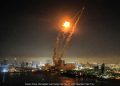
IDF forces struck Hezbollah missile launcher positions in southern Lebanon on March 12, while Iranian missiles were intercepted over Israel’s Sharon coastal region. Iran and Hezbollah jointly announced a coordinated 5-hour strike package against 50 targets inside Israel, including claims of hits on Palmachim and Ovda air bases and the Shin Bet headquarters — all unverified by independent sources. Lebanese civilian death toll has reached 570+. IDF ground forces remain south of the Litani River. Kuwait reported drone debris striking six electricity transmission lines on March 12, knocking them offline — the first confirmed damage to Gulf civilian power infrastructure from the conflict, though the Kuwaiti government attributed it to intercepted drone fragments rather than a deliberate strike.
The Kuwait power grid incident sets a threshold worth tracking: if Iran or proxies deliberately target GCC civilian electricity infrastructure, it would trigger a qualitatively different response from Gulf states and is likely to accelerate the separate European and West Asian back-channel diplomacy now reported by Bloomberg.
CBP Files Progress Report on $166 Billion IEEPA Refund — Deadline Day at US Court of International Trade
US Customs and Border Protection filed its court-ordered progress report on the IEEPA tariff refund process by the 2PM EDT deadline set by CIT Judge Eaton. CBP’s declaration claimed the refund process would require 4,431,161 man-hours using existing systems — equivalent to 506 years of work — and requested a 45-day extension. The Section 122 tariff (15%) enacted as IEEPA’s replacement is now in effect and expires July 24, 2026. The scale of the liability: $166 billion collected across 53 million entries from 330,000 importers. The court’s response to CBP’s non-compliance posture will determine whether the administration can stretch this deadline indefinitely through bureaucratic resistance, or faces a judicially enforced payment timeline.
This story is receiving almost no coverage amid the Iran war. Its domestic economic consequence — $166 billion in cash flows owed to US businesses — is of a scale that will affect corporate liquidity planning for the rest of the year, particularly for importers who have been structuring around the now-vacated IEEPA authority.
Under the Radar
The significance of Saudi Aramco resuming 70% of usual crude throughput via the East-West Pipeline to Yanbu (Red Sea) is being reported as an energy market footnote. It is not. Iran’s Hormuz strategy depends on there being no viable bypass — that the global economy has no structural alternative to transit through the strait. If Aramco sustains 70% throughput at Yanbu, it introduces a price ceiling on Iran’s leverage: the chokepoint becomes partially circumventable, and the economic pressure Iran is applying to the West is simultaneously diminished. The critical unknown is pipeline capacity durability under sustained surge conditions — the East-West Pipeline’s maximum rated throughput is approximately 5 million barrels per day, and Saudi Arabia’s pre-war Hormuz shipments were running near that ceiling. Whether 70% is a volume claim or a sustainable operational rate is the question nobody in wire coverage is asking. Watch for Aramco operational updates in the next 72 hours.
Flagged in the March 1–7 Weekly Brief as a 5–8 week slow burn, the Bahrain Shia mobilisation indicator is now inside its forecast risk window. With Hormuz under active Iranian pressure and pro-Iran sentiment elevated across Gulf Shia communities, the scenario of internal pressure on the Bahrain government — and by extension on US Fifth Fleet headquarters at NSA Bahrain — has moved from theoretical to operationally relevant. There has been no significant wire coverage of Bahraini internal security conditions this week. That absence is itself a signal worth noting: either the situation is stable and not newsworthy, or it is being actively managed below the threshold of visibility. An OSINT check of Bahraini social media and Arabic-language Gulf press for protest activity or security force movements would yield a cleaner picture than any wire report at this stage.
PressTV and IRNA — Iran’s primary English and Persian state outlets — shifted their lead framing on March 12 from “resistance and martyrdom” to “Iran’s peace offer.” This is an editorial decision made at the level of the Islamic Guidance Ministry, not individual reporters. The significance: the regime is beginning to condition the domestic Iranian public for a negotiated outcome rather than a military victory narrative. This kind of narrative shift typically precedes, not follows, a substantive diplomatic move — it is preparation, not announcement. Cross-referenced with Pezeshkian’s three conditions and Bloomberg’s back-channel reporting, the state media pivot suggests Tehran is building domestic political space for a deal. The timeline implied by this kind of narrative management is typically 2–4 weeks before a framework can be publicly acknowledged. Watch for IRNA Persian-language coverage to begin softening “resistance” language over the coming days.
By the Numbers
| 400M bbls | IEA strategic reserve release authorised March 11 — the largest emergency oil release in the organisation’s history, more than double the previous record set after Russia’s 2022 Ukraine invasion. Brent still rose on the news. |
| 135 | UN member states co-sponsoring UNSC Resolution 2817 — the largest co-sponsorship of any Security Council resolution in UN history. China and Russia abstained rather than veto. |
| <10% | Current Hormuz export volumes as a percentage of pre-war levels, per IEA Director Birol. The 400M-barrel reserve release covers approximately 16 days of the missing Hormuz volume — less than the conflict’s current duration. |
| $166B | IEEPA tariff refunds owed to 330,000 US importers across 53 million customs entries. CBP filed a progress report today claiming the process requires 506 years of labour with existing tools. |
| 17 | Ships attacked or subject to suspicious incident in Hormuz since February 28, per UKMTO. Six confirmed crew deaths per IMO. Six vessels struck in the 48 hours ending March 12 alone. |
| 13 | Days since Operation Epic Fury began — and the first day Iran has articulated a ceasefire framework rather than rejecting talks outright. |
What We’re Watching
- IEA Emergency Reserve Vote — RESOLVED. 400M barrels approved unanimously March 11. Largest release in IEA history. Brent still rose on the news — watch whether market premium re-compresses as Yanbu bypass volumes build.
- UNSC GCC Resolution — RESOLVED. Resolution 2817 adopted 13-0-2 on March 11. China and Russia abstained, did not veto. Russia’s alternative resolution failed 4-2-9.
- Mojtaba Khamenei First Public Appearance — STILL PENDING. Day 13 with no confirmed public communication. Absence is operationally significant: until Khamenei signals, IRGC command authority and ceasefire framework endorsement remain uncertain.
- Houthi Posture — STILL RESTRAINED. No confirmed Houthi activation in Red Sea through Day 13 despite earlier IRGC pressure signals. Watch for any change in AIS dark activity near Bab-el-Mandeb.
- Iran Financial Infrastructure Follow-Through — ESCALATING. Iran’s March 11 declaration of Gulf banks as military targets has not yet produced confirmed banking infrastructure attacks, but the ship attacks on Iraqi fuel tankers near Basra represent geographic escalation into Iraqi territorial waters.
- US/Israeli Response to Iran’s Three Conditions — Watch for any modification of the current “unconditional” posture from the White House or Jerusalem. Engagement with regional intermediaries by Witkoff’s office would signal a genuine opening; silence or restatement of maximalist US terms would indicate the diplomatic window is performative only.
- CIT Response to CBP Refund Report — Judge Eaton’s reaction to CBP’s 506-years claim will determine whether the $166B refund liability can be deferred to April or faces immediate enforcement action. A court order requiring ACE system deployment on a fixed timeline is the consequential outcome.
- Saudi Aramco Yanbu Throughput — Whether the announced 70% resumption of East-West Pipeline shipments translates into sustained export volume. Kpler and TankerTrackers AIS data at Yanbu terminal will provide the first independent verification within 48–72 hours.
- Mojtaba Khamenei Communication — Any substantive public statement from Iran’s Supreme Leader-designate. If his messaging endorses Pezeshkian’s ceasefire framework, the signal is credible. If it contradicts or ignores it, the framework is a civilian government trial balloon without IRGC backing.
- Kuwait Power Infrastructure — Whether March 12’s transmission line damage from drone debris is followed by further incidents. Deliberate targeting of Gulf civilian power grids would cross a qualitatively different threshold than ship attacks and would likely trigger Article 51 invocations by Kuwait and Bahrain.