The Week in Thread
Operation Epic Fury fractured the Middle East’s strategic order in seven days: U.S.-Israeli strikes killed Iran’s supreme leader, severed 20% of global oil and LNG supply at the Strait of Hormuz, and by Friday revealed regime change — not missile degradation — as the true operational objective. Every downstream consequence — from fertilizer price shocks to Russian operational intelligence sharing to China’s quietly advanced defense posture — flows from a single strategic decision made before the first B-2 sortie.
Dominant Threads
From “Imminent Threat” to Unconditional Surrender — Operation Epic Fury’s Expanding Objectives
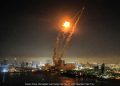
The operation launched Saturday, February 28, with CENTCOM confirming 1,000+ Iranian targets struck and Khamenei dead. By Monday, Iran had launched 400+ ballistic missiles and approximately 1,000 drones at Gulf states; a Provisional Leadership Council comprising President Pezeshkian, Chief Justice Mohseni-Ejei, and jurist Arafi was activated under Article 111. The stated “imminent threat” justification began unravelling midweek: Pentagon briefers acknowledged Iran had not been planning preemptive strikes absent an Israeli attack, and Senate Intelligence Vice Chair Mark Warner stated publicly he had seen no supporting intelligence.
Wednesday brought the IRGC declaring “complete control” of Hormuz and Trump pledging Navy escorts. Thursday, U.S. strikes targeted the Assembly of Experts’ offices in Qom during an emergency session — a direct strike on Iran’s constitutional succession mechanism. By Friday, the week’s real architecture became explicit: Trump’s Truth Social post demanded unconditional surrender and claimed the right to approve Iran’s next supreme leader, while Defense Secretary Hegseth framed a potential 100-day campaign timeline. Both the Senate (47–53) and House defeated war powers resolutions, clearing Trump’s full legislative runway. The operation’s stated objective had migrated from targeted missile degradation to imposed political succession — a threshold no wire outlet had made explicit until Trump made it unavoidable.
Financial dimension: Brent opened the week above $72 and closed Friday above $81 — a 13% single-session surge on Saturday, March 1, the highest since January 2025. Goldman Sachs CEO David Solomon warned Tuesday that markets had responded with “surprising restraint” and full repricing had “not yet begun.” That repricing arrived Thursday on schedule: the Dow fell approximately 964 points, S&P 500 retreated 1.3%. VLCC tanker freight rates hit a record $423,736 per day. Goldman’s $120/barrel projection becomes the central scenario if Hormuz disruption extends into a third week.
The succession is the operational trigger. If Iran’s Assembly of Experts names Mojtaba Khamenei despite Trump’s public veto, the U.S. is forced to define an enforcement mechanism it does not currently possess. If no announcement comes, the IRGC consolidates authority in the vacuum — which may be the strategically preferred outcome for Tehran’s hardliners. Either path defines whether the war’s political objective is achievable before its military costs exceed political tolerance.
The Hormuz Siege — A $6 Trillion Chokepoint and the Cascading Shocks No One Is Counting
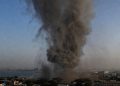
Tanker traffic through the Strait of Hormuz fell approximately 70% by Day 2, with 3,200 ships idle in the Persian Gulf and roughly 500 anchored outside the strait in Omani and UAE waters by midweek. On Day 6, Iran reframed the closure as a “selective ban” targeting vessels from the U.S., Israel, Europe, and Western allied nations — a diplomatically calculated announcement aimed at fracturing coalition cohesion. What rendered the announcement commercially inert: every major marine P&I war risk insurer — Gard, Skuld, NorthStandard, the London P&I Club, and the American Club — cancelled coverage effective March 5. Without P&I cover, operators face total loss liability on $100–200M VLCC assets regardless of IRGC targeting policy.
Simultaneously, QatarEnergy suspended LNG production at Ras Laffan and Mesaieed, removing approximately 20% of global LNG supply from the market and triggering force majeure on March 2. European TTF gas prices surged 54% in a single session. The story receiving almost no coverage in proportion to its structural significance: approximately 33% of global fertilizer supply transits the Strait of Hormuz, and the closure struck at the worst possible moment — Northern Hemisphere spring planting peak. Egypt granular urea jumped $60 per metric ton immediately; New Orleans March barge prices surged $60–80 per ton in a single session. A 60–90 day agricultural supply shock is developing across India, Africa, and Latin America with virtually no analytical treatment in Western media.
Financial dimension: The asymmetric cost mathematics are this week’s most important financial intelligence. The IRGC’s Shahed drones (approximately $20,000 each) are exhausting Patriot PAC-3 interceptors ($3.4M) and THAAD interceptors ($11M) at an unsustainable ratio — a structural depletion dynamic the U.S. was reportedly stonewalling Gulf resupply requests to address.
Whether any state-backed carrier — CNOOC, Indian SCI — tests the selective passage announcement with state-backed indemnification is the operational tell. A successful transit would reshape the blockade’s analytical status. The fertilizer price shock clock is running independently of any Hormuz resolution; the 60–90 day lag means the consequence window opens regardless of ceasefire timing.
See our analysis here The Hormuz Fertilizer Trap
The Widening Theater — Russia Enters the Intelligence War, China Advances at the NPC, Azerbaijan in the Crossfire
On Thursday, Iranian UAVs struck Azerbaijan’s Nakhchivan exclave — including Nakhchivan International Airport. Nakhchivan borders Turkey, a NATO member, and Azerbaijan holds a 2021 Shusha Declaration mutual defense commitment with Ankara. Turkish Foreign Minister Fidan condemned the strikes; NATO separately destroyed an Iranian ballistic missile over Turkish airspace on March 4. NATO Secretary General Rutte formally ruled out Article 5 invocation by Friday — capping the direct NATO escalation pathway — but Azerbaijan remains on full combat readiness and Iran’s ambassador was summoned.
Friday produced the week’s most strategically significant development outside Iran: CBS News reported that Russia has begun providing Iran with real-time intelligence on U.S. military positions — the first documented instance of direct Russian operational support since Operation Epic Fury began. If confirmed, this creates a direct operational linkage between the Iran theater and the Ukraine front. European NATO allies simultaneously supporting Ukraine must now calculate around a conflict where Moscow is actively degrading U.S. military advantage in a parallel theater.
In Beijing, China’s National People’s Congress opened Thursday with Premier Li Qiang announcing a 7% defense budget increase — 1.91 trillion yuan ($276.8 billion) — alongside a reduced GDP target of 4.5–5% for 2026, with a five-year plan explicitly prioritizing AI, quantum computing, and 6G as dual-use strategic technologies. With U.S. diplomatic bandwidth consumed by Iran, Beijing is advancing its strategic posture with materially reduced Western scrutiny.
CENTCOM confirmation or denial of the Russia-Iran intelligence sharing report carries strategic weight in either direction. Confirmed: European NATO allies are forced to choose between escalating pressure on Moscow and managing the Iran theater simultaneously. The Azerbaijan-Iran border remains at full combat readiness with no active mediation framework and a live Shusha Declaration mutual defense commitment.
The Money Map
Markets processed the opening of the conflict with the “surprising restraint” Goldman Sachs CEO Solomon flagged publicly Tuesday. The belated repricing arrived Thursday — Dow fell approximately 964 points, S&P 500 down 1.3% — precisely on Solomon’s schedule. Goldman’s $120/barrel projection becomes the central scenario if Hormuz disruption extends into a third week. Trump’s DFC political risk coverage offer does not address the marine hull insurance cancellation that has paralysed commercial transit.
Ras Laffan and Mesaieed suspended production following air defense alerts; QatarEnergy declared force majeure on contracted deliveries. European TTF gas futures surged 54% in a single session. The secondary cascade: urea, methanol, sulphur, polymers, and aluminum co-produced at Ras Laffan are offline simultaneously, directly compounding the fertilizer supply shock and adding a non-energy industrial supply disruption layer.
The Cape of Good Hope reroute adds $933,000 per voyage and 10–14 days of transit time per Clarksons Research. Sustained at this level, cost inflation will pass through to Asian consumer goods and manufacturing inputs within four to six weeks. No major commercial operator has accepted DFC political risk coverage in lieu of cancelled P&I.
Egypt granular urea and New Orleans March barge contracts both surged immediately following QatarEnergy’s force majeure. The 60–90 day lag before food price impact means the market is not yet pricing what import-dependent agricultural economies in India, Africa, and Latin America are about to face at spring planting peak. No strategic reserve equivalent exists for nitrogen inputs; no IEA coordination mechanism covers fertilizer.
The Marsh broker estimate is the market’s duration signal. In 2019, Hormuz insurance normalized within 10 days after the Saudi Aramco strikes. Sustained elevation beyond that threshold historically correlates with structural, weeks-long disruption. The market is currently pricing structural — an assessment that should be weighted more heavily than political statement analysis when evaluating how long the effective closure persists.
State Media Watch
Moscow’s narrative executed a deliberate two-track campaign. The diplomatic track positioned Russia as the principled defender of international law: TASS and RT amplified Foreign Ministry condemnations of “unprovoked armed aggression against a sovereign state,” framed the UNSC emergency session as a U.S. veto abuse story, and positioned China-Russia coordination as a legitimate counterweight to Western unilateralism. The operational track remained below most Western coverage thresholds until Friday, when CBS News reported Russia has begun providing Iran with real-time intelligence on U.S. military positions. The combination is deliberate: rhetorical condemnation maintains diplomatic posture and future mediation credibility while operational support signals backing to Tehran without formal military commitment. What Moscow has suppressed entirely: any coverage of Russian crude gaining competitive advantage as Middle East barrels face logistical paralysis.
Beijing’s narrative divided cleanly between domestic and international audiences. For international consumption: strong diplomatic condemnation, coordinated UNSC positioning with Moscow, and a sovereignty framing that avoids explicit endorsement of Iranian military retaliation. For domestic consumption: the NPC defense budget announcement was covered with explicit “strategic initiative” framing — Xi’s language amplified as confidence, not defensiveness. The most significant omission: any coverage of China’s acute energy security exposure — Beijing receives approximately 50% of its crude imports via the Strait, making it the country with the highest objective stake in Hormuz resolution. Beijing is managing an energy security emergency at the operational level while projecting strategic indifference publicly.
Tehran’s state media executed a wartime national mobilization framing throughout the week — drone launch footage, Khamenei martyrdom coverage, and by Friday the full mobilization spectacle: 100,000+ at Tehran Friday prayers chanting “We’ll fight, we’ll die, we won’t accept humiliation.” The analytically significant suppression: Iranian state media was conspicuously absent on succession politics — no candidate profiles, no Assembly of Experts deliberation coverage. The regime calculates civilian morale is best served by projecting institutional continuity rather than exposing the succession vacuum the strikes created. The Friday prayers mobilization signals to Washington that no unconditional surrender demand will find a civilian base willing to execute it.
State media is analyzed here as a signal source, never as a primary factual record. All factual claims are independently corroborated via Tier 1 or Tier 2 sources.
The Slow Burn
The Fertilizer Supply Shock — A Food Security Emergency Nobody Is Tracking
Consequence horizon: 6–10 weeks
The Hormuz closure has generated wall-to-wall coverage of oil prices. The story that will matter more in 60–90 days: approximately one-third of global fertilizer supply transits the Strait of Hormuz, and the closure struck at the precise moment of maximum Northern Hemisphere agricultural demand. QatarEnergy’s force majeure on urea, methanol, and sulphur deliveries — combined with the closure of Hormuz-dependent Gulf fertilizer producers — has removed supply at the moment when global agricultural importers need to pre-purchase spring inputs at scale. India, Africa, and Latin America — all import-dependent with minimal buffer inventory — face compounding cost pressure. There is no strategic reserve equivalent for fertilizer; no IEA coordination mechanism exists for nitrogen inputs. If the closure extends through mid-March, the food price pass-through reaches retail markets globally by May–June. StoneX Group noted the timing “could not be much worse.”
Read our analysis here The Hormuz Fertilizer Trap
Bahrain’s Shia Mobilization — The Gulf’s Internal Front
Consequence horizon: 5–8 weeks
Carnegie Endowment researchers monitoring Bahrain’s Shia majority reported emerging protest activity this week — the first visible political mobilization since the 2011 Arab Spring crackdown was suppressed with Saudi military assistance. Bahrain hosts NSA Bahrain, the U.S. Fifth Fleet’s forward headquarters and the most critical U.S. naval node in the Gulf theater. Iran struck Bahraini territory directly this week. The combination of direct Iranian bombardment, longstanding Shia political grievances, and the spectacle of Gulf governments appearing unable to protect their citizens is the exact mobilization dynamic that destabilized the island in 2011. A destabilized Bahrain does not require a revolution to affect U.S. operations — protest activity sufficient to constrain Bahraini government cooperation has direct operational implications for Fifth Fleet command at a moment of maximum regional stress. This thread received no meaningful independent wire coverage this week.
Read our analysis here Bahrain’s Shia Majority Threatens the U.S. Navy
The Polymarket Nexus — When War-Timing Becomes a Financial Instrument
Consequence horizon: Structural / ongoing
Analytics firm Bubblemaps identified six crypto wallets that collectively netted $1.2 million betting specifically on a February 28 U.S. strike date, with all six wallets funded within 24 hours of the strikes commencing. A separate account placed its first trade 71 minutes before news broke publicly, netting over $553,000. Total volume on Polymarket contracts tied to U.S. strike timing: $529 million. Coverage has focused on ethics and regulation. The analytical frame this misses: if classified military strike timing can be monetized offshore and pseudonymously at eight-figure scale with a frictionless payout mechanism, a direct financial incentive to leak national security information now exists with a traceable, immediate payout. Donald Trump Jr. sits on Polymarket’s advisory board; DOJ and CFTC investigations were dropped after the administration changed. This is not a prediction-market story — it is a classified information security story with implications for compartmentalization discipline at every level of the operation.
Probability Updates
Inaugural edition — no prior scenarios to update. Probability tracking opens with this edition and will be revisited next week.
45% confidence
Most Likely — The IRGC is the operative power broker; the Assembly of Experts is disrupted but not dissolved. Confirmed IRGC command coherence across four simultaneous geographies suggests organizational capacity to impose a succession preference. The Venezuela comparison is analytically weak — no organizational infrastructure, no IRGC support pathway, and no U.S. enforcement mechanism has been identified.
Key trigger: Any public Assembly of Experts statement or IRGC endorsement that directly engages Trump’s stated veto. The first such exchange defines whether this is an imposed negotiation or a direct military targeting objective.
35% confidence
Plausible — The Assembly of Experts was directly targeted during its emergency session in Qom. Operational disruption may delay a formal succession announcement indefinitely, with the Provisional Council continuing to govern under Article 111 while the IRGC retains de facto authority. Deliberate ambiguity may serve IRGC interests during active conflict.
Key trigger: Absence of any succession announcement by end of March, or Provisional Council issuing cease-fire preconditions rather than deferring to a named successor.
15% confidence
Low Probability, High Impact — Requires collapse of IRGC command coherence and emergence of a reformist or secular figure with sufficient civilian support to claim legitimacy against IRGC preference. No such figure has been publicly identified with organizational backing. Requires conditions not present as of publication.
Key trigger: Named reformist candidate with verifiable IRGC non-opposition and public Assembly of Experts support — none currently identified.
60% confidence
Most Likely — Marine P&I insurance cancellation is an insurance market decision independent of Iranian military capability; reversing it requires a credible security guarantee that no party has offered. The IRGC retains confirmed drone reserve depth. Pezeshkian’s Friday reference to “some countries” mediating is the first de-escalation signal, but requires a U.S. posture shift from unconditional surrender that contradicts Trump’s public Friday position.
Key trigger: Marine insurance reinstatement by Gard, Skuld, or NorthStandard — the operative threshold, not any political announcement.
25% confidence
Plausible — Oman and Qatar are the analytically probable mediation channel; Pezeshkian’s signal is the first opening. A partial reopening for non-Western state carriers — China, India — is more achievable than full commercial restoration and would allow Beijing and New Delhi to manage their energy security emergency without formal alignment with Tehran.
Key trigger: Confirmed meeting between Omani/Qatari intermediaries and the Iranian Provisional Council, or any U.S. position statement softening the “unconditional surrender” framing.
By the Numbers
| $81.40 | Brent crude Friday close, up 13% since Operation Epic Fury launched February 28; Goldman Sachs warns full market repricing has “not yet begun.” |
| 1,200+ | Confirmed deaths in Iran and Lebanon combined since February 28; six U.S. service members killed in theater across the week. |
| 20% | Share of global LNG supply removed from markets by QatarEnergy’s force majeure on Ras Laffan and Mesaieed; European TTF gas surged 54% in a single session. |
| 3,200 | Ships idle in the Persian Gulf per Clarksons Research; approximately 500 additional vessels anchored outside the strait awaiting clearance. |
| 90% | Iran’s pre-war ballistic missile launcher capacity destroyed per CENTCOM General Caine — the metric triggering Phase 2 shift to underground production site targeting with B-2 stealth bombers. |
| 47–53 | Senate war powers resolution vote defeat; House also defeated a parallel resolution — Trump retains full legislative runway for Operation Epic Fury. |
| $276.8B | China’s 2026 defense budget, up 7% year-on-year, announced at NPC opening as U.S. diplomatic bandwidth is fully consumed by Iran — funds AI, quantum, cyberwarfare, and Taiwan Strait exercises. |
| $11M / $20K | Cost per THAAD interceptor vs. cost per Iranian Shahed drone — the asymmetric attrition arithmetic driving Gulf air defense depletion and the campaign’s hidden strategic clock. |
What We’re Watching — Next Week
- Iran Succession (Early Week): Any announcement from the Provisional Council or IRGC on successor candidates; Mojtaba Khamenei appointment despite Trump’s stated veto forces the U.S. to articulate an enforcement mechanism in public for the first time.
- Russia-Iran Intel Sharing (Early Week): CENTCOM or State Department confirmation or denial of the CBS News report; confirmation immediately escalates diplomatic stakes with Moscow and implicates NATO cohesion across both theaters simultaneously.
- U.S. Navy Escort Authorization (Mid-Week): Trump pledged deployment “as soon as possible”; watch for CENTCOM operational orders or a non-announcement signalling domestic political constraint from gas price pressure.
- QatarEnergy Ras Laffan Duration (Mid-Week): Any production resumption statement; European emergency LNG procurement and central bank inflation reassessments activate if outage extends past two weeks.
- Brent Friday Close (By Week’s End): A close above $85 triggers G7 strategic petroleum reserve coordination and central bank emergency response frameworks; Goldman’s $120 scenario enters mainstream financial forecasting.
- Mediation Channel Identification (By Week’s End): Oman and Qatar are the analytically probable framework. Any confirmed meeting or communiqué signals the first de-escalation track and reshapes the succession/surrender dynamic simultaneously.