Daily Intelligence Brief
The Hopper Daily Brief — March 5, 2026 — Iran Hormuz Selective Closure
“The blockade’s architecture shifts from brute force to strategic fracture — and Iran’s war finds a new border.”
01 Top Story
Iran Reframes Hormuz Closure as Selective Ban; IRGC Claims U.S. Tanker Strike
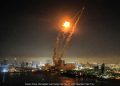
Iran’s Islamic Revolutionary Guard Corps announced Thursday that the Strait of Hormuz is closed specifically to vessels from the United States, Israel, Europe, and Western allied nations — a significant reframing from the blanket closure declared March 2 — while separately claiming its naval forces struck an American oil tanker in the northern Persian Gulf. The U.S. has not confirmed the tanker claim. Tehran simultaneously denied firing the drones that struck Azerbaijan’s Nakhchivan exclave earlier Thursday, a claim Baku’s Defense Ministry directly disputed with tracking data from four confirmed UAVs.
The selective closure announcement is diplomatically calculated rather than operationally meaningful. P&I insurance coverage for all vessels in the Persian Gulf and Strait of Hormuz was cancelled effective March 5 by leading marine war risk providers — including Norway’s Gard and Skuld, Britain’s NorthStandard, and the London P&I Club — making transit commercially untenable regardless of IRGC targeting policy. Approximately 3,200 ships remain idle in the Persian Gulf per Clarksons Research, with around 500 anchored outside the strait in Omani and UAE waters. The selective framing is best understood as an attempt to fracture Western coalition cohesion by offering neutral nations — China, India, Turkey — a theoretical passage incentive that market mechanics currently prohibit.
The IRGC tanker claim, if verified, would mark a direct strike on a U.S.-flagged or U.S.-linked energy asset — a threshold escalation from attacks on commercially neutral vessels. U.S. death toll stands at three troops killed in action since Operation Epic Fury began February 28; Iranian Health Ministry confirmed 920 killed and thousands injured through Wednesday. Equities markets reflected the belated pricing of conflict risk on Thursday: the Dow Jones fell approximately 964 points, S&P 500 retreated 1.3%, consistent with Goldman Sachs CEO David Solomon’s warning earlier this week that full market repricing had “not yet begun.”
U.S. confirmation or denial of the IRGC tanker strike claim — if confirmed, watch for CENTCOM response framing and whether Trump escalates from escort pledge to active naval engagement orders. Watch whether any neutral-flagged vessel tests the selective passage announcement before insurance markets re-open; any successful transit would be analytically significant as a precedent.
02 Regional Roundup
Caucasus
Iranian Drones Strike Nakhchivan Airport; Azerbaijan Puts Military on Full Combat Readiness
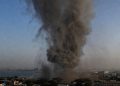
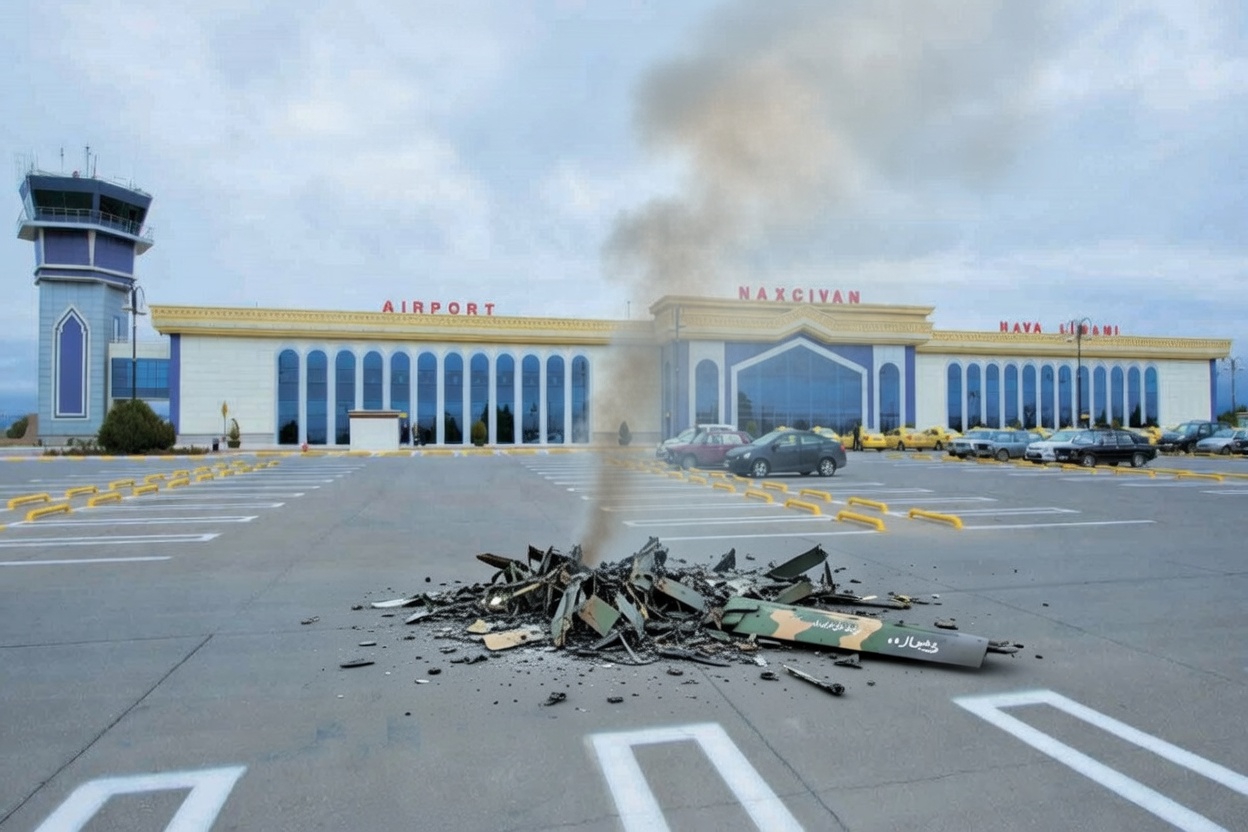
At approximately midday Thursday, four Iranian UAVs crossed into Azerbaijan’s Nakhchivan exclave — an Azerbaijani territory bordering Iran and Turkey, separated from mainland Azerbaijan by Armenia. One drone struck the terminal building of Nakhchivan International Airport; a second landed near a school in the village of Shakarabad, injuring two civilians. Azerbaijan’s Defense Ministry confirmed tracking data; Iran denied involvement. President Ilham Aliyev convened an emergency Security Council session and called the strikes “an act of terror,” summoning Iran’s ambassador and placing Azerbaijani armed forces on full combat readiness.
The strategic significance extends well beyond the immediate incident. Nakhchivan borders Turkey — a NATO member — and Azerbaijan holds a 2021 Shusha Declaration mutual defense commitment with Ankara. Turkish Foreign Minister Fidan contacted his Azerbaijani counterpart Thursday and “strongly condemned” the attacks. NATO air defenses destroyed an Iranian ballistic missile fired toward Turkey on March 4; Thursday’s drone strike on Nakhchivan adds a second direct incident involving Turkish-allied territory within 24 hours. Iran’s targeting rationale likely relates to the US-brokered “Trump Route” Zangezur corridor — a planned transit route through Armenia that Tehran has opposed as a mechanism for bringing hostile forces to its northern border. Whether this was deliberate targeting or operational overspill from IRGC area-denial campaigns remains analytically contested.
Asia-Pacific
China Opens NPC With 7% Defense Hike and Reduced GDP Target as Xi Eyes Strategic Opportunity
China’s National People’s Congress opened Thursday with Premier Li Qiang announcing a 7% increase in the defense budget — bringing total military expenditure to 1.91 trillion yuan ($276.8 billion) — alongside a reduced GDP growth target of 4.5–5% for 2026, down from last year’s 5% floor. The five-year plan explicitly prioritizes AI, quantum computing, and 6G as dual-use strategic technologies, with 800 billion yuan in ultra-long special treasury bonds allocated to “major national strategies and security capacity.” Xi Jinping framed China’s moment directly: “In the midst of fierce international competition, we must win the strategic initiative.”
The timing is analytically significant. With U.S. diplomatic and military bandwidth consumed by the Iran conflict, the NPC session allows Beijing to advance its strategic posture — military modernization, AI-driven industrial policy, and Taiwan pressure — with reduced Western scrutiny. The 7% defense increase, the slowest since 2022, is calibrated to avoid alarming regional neighbors while sustaining PLA modernization through 2035 objectives. Analysts note the budget funds salary increases, cyberwarfare capabilities, and Taiwan Strait drill capacity. South Korean chipmaker equities sold off sharply on Thursday, signaling regional market concern about whether China’s AI industrial push accelerates a tech supply chain bifurcation already stressed by the Iran conflict.
Europe / Ukraine
Zelenskyy Offers Shahed Counter-Technology to U.S. and Gulf Allies — Conditionally
Ukrainian President Volodymyr Zelenskyy confirmed Thursday that the United States and several Gulf state governments have approached Ukraine for assistance in countering Iranian Shahed drone attacks. Russia has fired tens of thousands of Shahed variants at Ukrainian territory since 2022, making Ukraine’s military the most operationally experienced force in the world for counter-Shahed interception and electronic warfare. Zelenskyy stated he would provide assistance only if it does not degrade Ukraine’s own defensive capability: “We help to defend from war those who help us bring a just end to the war.”
The offer reveals two strategically important dynamics: first, that U.S. and Gulf air defenses are under sufficient Shahed pressure to seek external expertise — consistent with The Telegraph’s reporting that U.S. interceptor missile stocks in the Gulf are not unlimited; and second, that Zelenskyy is leveraging Ukraine’s drone warfare knowledge as diplomatic currency to advance the stalled ceasefire negotiations. With the Geneva round having concluded without breakthrough and the Kremlin signaling “no deadlines,” Ukraine’s ability to offer operationally valued counter-drone expertise gives Kyiv rare leverage in a negotiating environment otherwise dominated by territorial questions.
03 Under the Radar
The Selective Closure Announcement Is Commercially Unenforceable — Here’s Why That Matters
Iran’s announcement that it is selectively opening Hormuz to non-Western shipping has generated diplomatic coverage but almost no analysis of why it is currently meaningless: P&I insurance war risk coverage was cancelled effective March 5 by every major marine insurer in the market — Gard, Skuld, NorthStandard, the London P&I Club, and the American Club. Without coverage, ship owners face total loss liability on assets valued at $100M–$200M per VLCC. No commercial operator will transit regardless of IRGC policy. The announcement is directed at China, India, and Turkey — an attempt to create a political wedge by offering them a theoretical benefit that the insurance market has closed off. Watch for whether any state-backed carrier (CNOOC, Indian SCI) attempts a transit with state-backed indemnification — that would be the signal that Iran’s selective framing is becoming operational rather than rhetorical.
Iran-Kurdish Front Activation in Iraq — The IRGC’s Multi-Front Signal
Simultaneously with Nakhchivan and Gulf operations on Thursday, Iranian missiles struck the camp of the Komala Party — an Iranian Kurdish opposition group — in northern Iraq. Kurdish dissident organizations report the U.S. has approached them regarding potential intelligence cooperation to support internal Iranian pressure. Iran’s general staff warned it will not tolerate “separatist groups.” The operational implication: despite six days of sustained U.S.-Israeli strikes targeting leadership and C2 infrastructure, the IRGC retains sufficient command coherence to run simultaneous operations across at least four geographies — Hormuz, the Gulf states, Azerbaijan, and northern Iraq. Reports of C2 degradation from Iran’s satellite comms strikes are accurate but incomplete; IRGC pre-authorization protocols for distributed strikes appear to be functioning. This has direct implications for U.S. targeting assumptions about IRGC operational degradation timelines.
04 By the Numbers
| 920 | Deaths in Iran confirmed by the Iranian Health Ministry through March 4 — the official count from U.S.-Israeli strikes under Operation Epic Fury, now entering Day 6. |
| $81+ | Brent crude settlement range, up approximately 13% since February 28; Goldman Sachs warned earlier this week that market repricing had “not yet begun” — Thursday’s Dow selloff of ~964 points suggests it has now started. |
| $276.8B | China’s 2026 defense budget, up 7% year-on-year — the second-largest military budget globally, announced at the NPC opening session Thursday; funds AI, quantum, cyberwarfare, and Taiwan Strait exercises. |
| 4 | Iranian UAVs confirmed directed at Nakhchivan by Azerbaijan’s Defense Ministry; one struck the airport terminal, one landed near a school — the first confirmed Iranian kinetic action against Azerbaijani sovereign territory. |
| 2,000+ | Total drones Iran claims to have launched since Operation Epic Fury began February 28 (per IRGC statement), alongside approximately 500 ballistic missiles — suggesting Iran’s drone inventory remains deep despite sustained attrition. |
05 What We’re Watching
Thursday–Friday, March 5–6
- IRGC Tanker Strike Confirmation — U.S. CENTCOM has not commented; confirmation would mark a threshold escalation and likely accelerate Trump’s Navy escort order from pledge to operational deployment.
- Shusha Declaration Invocation — Whether Turkey formally triggers security consultations with Azerbaijan under the 2021 mutual defense framework; Fidan’s call with Bayramov was preliminary — watch for joint communiqué language or NATO reference.
- U.S. Navy Escort Authorization — Trump pledged deployment “as soon as possible” via Truth Social; watch for CENTCOM operational orders or Fifth Fleet statement confirming active escort mission parameters.
This Weekend
- Azerbaijan–Iran Border — Aliyev placed armed forces on full combat readiness Thursday; watch for troop movements along the ~200km shared border or any additional Iranian drone activity.
- Neutral Tanker Transit Test — Whether any state-backed Chinese or Indian carrier attempts Hormuz passage under Iran’s selective closure framing; if successful, the insurance market response would be the defining signal of whether the blockade holds.
- Brent Friday Close — First full-week settlement of the conflict; Thursday’s equity selloff suggests the repricing Solomon flagged is now underway. A close above $85 would accelerate central bank concern about inflation pass-through.
- China NPC 5-Year Defense Detail — Breakdown of the $276.8B budget between AI/quantum investment, naval expansion, and Taiwan Strait exercises expected as committee reports are released over the weekend.
WtW Follow-Ups from March 4 Brief
- Goldman Sachs Repricing — Confirmed: Dow fell ~964 points Thursday; S&P 500 down 1.3%. Solomon’s “delayed repricing” warning has materialized on schedule.
- Navy Escort Decision — Partial: Trump pledged escorts “as soon as possible” on Truth Social. CENTCOM authorization not yet confirmed; the commitment exists, the operational order does not.
- Ukraine Diplomacy — Evolved: No leaders-level meeting materialized; Zelenskyy has instead pivoted to counter-drone technology as diplomatic leverage — a different form of engagement than the ceasefire track.