Wednesday, March 4, 2026
By H. Reeves
Headline Finding
Qatar’s LNG shutdown following Iranian strikes on Ras Laffan is the third major European energy supply shock in four years — and the most structurally revealing. Europe’s post-Nordstream “diversification” did not eliminate geopolitical dependency. It relocated it from Russia to the Gulf, and left the underlying exposure intact. The reckoning now underway was not unpredictable. It was built in.
QatarEnergy Suspends All LNG Production After Iranian Strikes Hit Ras Laffan
On March 2, 2026, QatarEnergy suspended all liquefied natural gas production at its Ras Laffan Industrial City complex after Iranian strikes hit two facilities in the opening days of Operation Epic Fury — the U.S.-Israeli campaign launched February 28 against Iran’s nuclear and military infrastructure. QatarEnergy declared force majeure on contracted LNG deliveries the same day, legally suspending obligations to buyers across Europe and Asia.
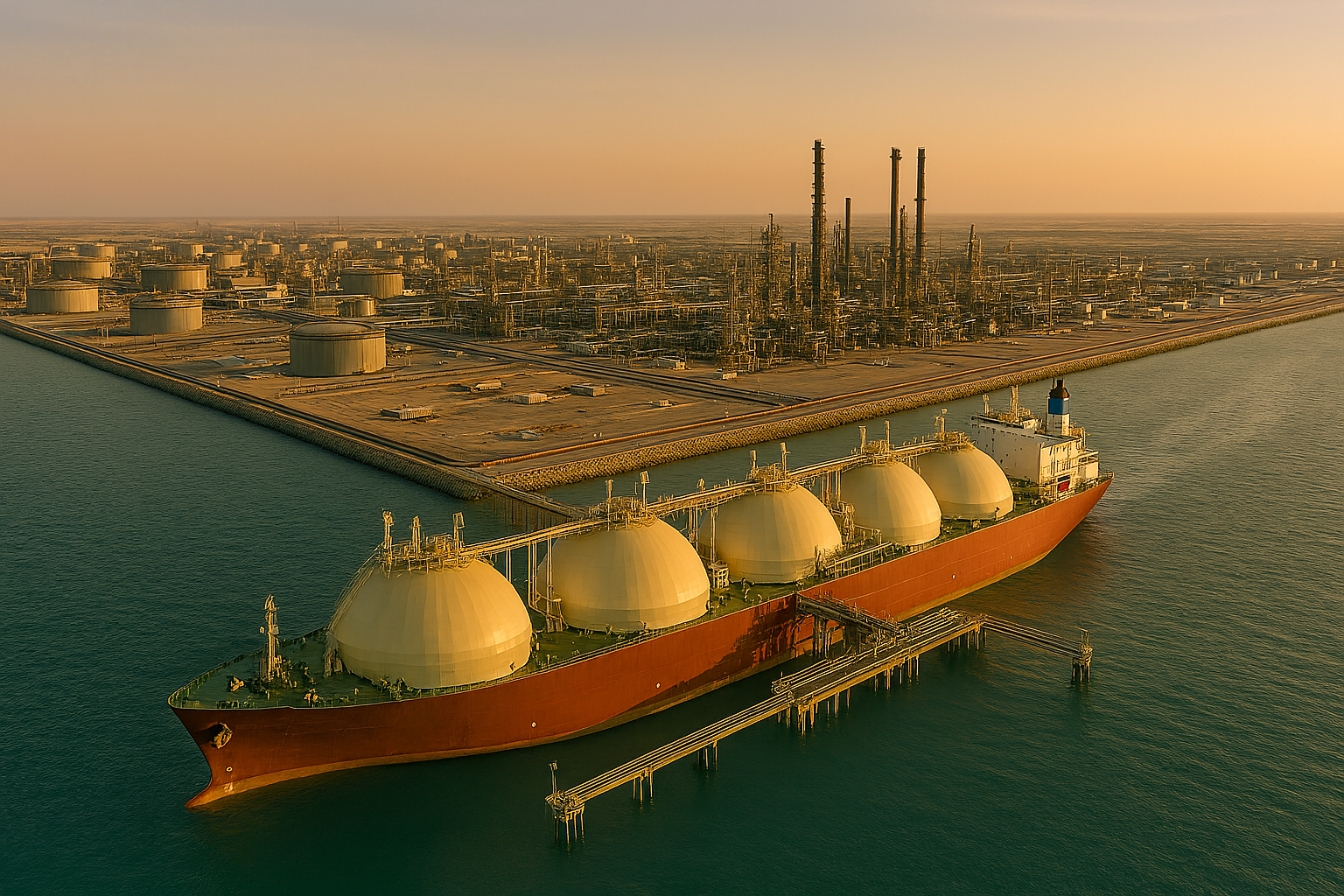
The scale of the outage is significant. Qatar is the world’s second-largest LNG exporter, responsible for approximately 20% of global LNG supply. Ras Laffan is not merely a single facility — it is the industrial anchor of Qatar’s entire hydrocarbon economy, co-hosting urea, methanol, sulphur, polymer, and aluminum production alongside the LNG trains. All of that output went offline simultaneously.
The immediate market reaction was unambiguous. European TTF natural gas prices surged as much as 54% in a single session on March 2, the largest single-day move since the Nordstream crisis. The suspension compounds an already acute situation: as first documented in our March 3, 2026 intelligence brief, Iran’s IRGC simultaneously declared the Strait of Hormuz under its effective control, approximately 3,200 commercial vessels are idled in the Persian Gulf, and at least five tankers have been struck since the conflict began.
The production timeline for resumption remains unannounced as of publication. QatarEnergy has not commented publicly on the extent of infrastructure damage.
Europe Traded Russian Pipeline Gas for Gulf LNG — the Structural Risk Is Identical
The immediate supply mathematics are severe, but the strategic significance runs deeper than a spot price shock.
Europe entered 2026 having invested heavily in the narrative of post-Russian energy independence. Following Nordstream’s destruction in September 2022, the EU accelerated long-term LNG purchase agreements with Qatar, signed framework deals with U.S. exporters, and retrofitted or expanded receiving terminals across Germany, Italy, the Netherlands, and France. By late 2025, Qatari LNG had become a primary supply pillar for several member states, particularly in Southeast Europe, where pipeline flexibility is limited. The diversification was real — away from Russia. The structural exposure was not eliminated; it was transferred.
Follow the money and the dependency becomes legible: the same market forces that made Gulf LNG attractive — lower long-haul costs versus U.S. supply, established infrastructure, high production volumes — also concentrated European exposure within a single geopolitical theater. A conflict involving Iran was never a remote contingency in Gulf risk modeling. It was a named scenario in every credible energy security analysis published since 2020.
The second dimension is supply substitution. Wire coverage has broadly implied that U.S. LNG can bridge the gap. That assumption deserves scrutiny. U.S. LNG export capacity is operating near its ceiling. The major terminals — Sabine Pass, Freeport, Cameron, Corpus Christi, Cove Point — are running at or near nameplate capacity with committed long-term contracts. As our March 4, 2026 Daily Brief documented, Venture Global publicly offered assistance following the shutdown; the volume available is marginal relative to the Qatari shortfall. There is no immediately deployable U.S. volume sufficient to offset 20% of global LNG supply going offline.
The third dimension is the Atlantic basin cargo competition now underway. Asian buyers — Japan, South Korea, India, China — hold the majority of long-term Qatari LNG contracts. China alone held approximately 7.6 million tonnes of LNG inventory as of late February, providing a short-term buffer. But as that buffer depletes, Chinese and Asian buyers will compete aggressively for spot cargoes from Atlantic basin producers, tightening global availability and imposing a secondary price shock on European buyers already paying crisis premiums. Europe and Asia are now in direct competition for the same marginal cargoes.
Three Energy Shocks in Four Years: How Europe’s Manufactured Vulnerability Was Built In
This is the third major European energy supply shock in four years. Nordstream’s destruction in September 2022 severed the primary Russian pipeline route to Germany and Northwest Europe. The escalating Russian gas cutoff through 2023 removed secondary pipeline volumes. Now, in March 2026, the Gulf LNG corridor explicitly constructed as the replacement has been knocked offline by a conflict that was entirely foreseeable in its general outline.
The pattern reveals a structural problem that policy has consistently misnamed. European leaders described the post-2022 energy pivot as “independence.” The accurate term is dependency substitution. The underlying condition — continental reliance on a single dominant supply corridor without sufficient domestic generation capacity or storage depth to absorb shocks — was not addressed. It was obscured behind new procurement contracts and terminal investments.
The manufactured vulnerability framework — which we have applied to America’s semiconductor dependency on Taiwanese fabrication capacity — describes precisely this condition: a structural dependency created and maintained by political and commercial decisions, often despite known risks, because the short-term economics are favorable. Europe’s successive energy dependencies on Russia, then on Gulf LNG, follow exactly this pattern.
The official narrative bears examination. European Commission President von der Leyen warned on March 2 of “conflict shockwaves across the world” — a statement that, read carefully, acknowledges that European energy security is exposed to a conflict in which Europe is not a direct party and has limited leverage over its trajectory. The EU’s strategic energy reserve framework, developed post-2022, provides 45–90 days of buffer depending on the member state. That buffer was calibrated for a Russian supply disruption, not a simultaneous Hormuz closure and Qatari production outage.
QatarEnergy, the European Commission, and Asian LNG Buyers Competing for the Same Cargoes
State-owned producer and operator of Ras Laffan. Holds long-term supply contracts with German, Italian, French, and Belgian importers, as well as major Asian buyers. Force majeure declaration legally shields QatarEnergy from breach claims but leaves buyers without contracted supply and no legal recourse during the disruption period. Restoration timeline is commercially and diplomatically critical — Qatar has strong incentive to resume production quickly but cannot do so while facilities are damaged or while the conflict presents ongoing strike risk.
Convening emergency gas coordination group meetings to assess the supply shortfall. The Commission has limited direct procurement capacity — it can facilitate member state coordination but cannot itself source replacement cargoes. Internal divisions between member states on emergency cost-sharing are already visible.
The natural beneficiaries of a Qatari production outage, but constrained by existing contract commitments and nameplate capacity limits. Spot availability is marginal. Higher spot pricing benefits U.S. producers commercially while creating political pressure domestically on energy costs.
Competing with European buyers for the same Atlantic basin spot cargoes. Japan and South Korea hold strategic reserves and emergency import frameworks developed during the 2011–2013 Fukushima period; their resilience is greater than Southeast Asian and South Asian importers. Bangladesh, dependent on Qatar and the UAE for 72% of LNG imports, faces the sharpest exposure of any importer globally.
The proximate actor. Iran’s strategic interest in demonstrating Hormuz leverage and Gulf infrastructure vulnerability is served by the current situation regardless of whether the Ras Laffan strikes were deliberate targeting of European energy supply or incidental to broader Gulf infrastructure operations. The effect is the same.
Three Scenarios for Qatar LNG: Short Disruption, Structural Outage, or Multi-Year Damage
Outage extends 3–6 weeks; partial European emergency response activated. Ras Laffan sustains repairable but significant damage. QatarEnergy begins restoration within two to three weeks of a cessation of hostilities or a stable operational ceasefire. The EU activates gas demand reduction measures under the existing emergency framework, members with LNG receiving capacity draw down storage reserves, and spot cargo competition with Asian buyers persists through April. TTF prices remain elevated but begin retreating once a restoration timeline is announced. No member state faces involuntary supply interruption; industrial gas users in Germany and Italy bear the brunt of demand management.
Conflict extends beyond four weeks; outage becomes structural. Sustained Iranian strike activity against Gulf energy infrastructure, or a broader widening of the conflict involving Houthi Red Sea attacks on LNG carriers, extends the Qatari outage into May or beyond. European storage enters the summer refill season below the levels required to meet the following winter’s demand without significant demand destruction. The EU is forced to activate emergency import frameworks including U.S. cargo diversion and accelerated spot procurement from Australia, Algeria, and Nigeria at significant premium. Industrial curtailments in Germany and Central Europe materialize before winter 2026–27.
Ras Laffan infrastructure damage is severe and multi-year. Strikes have caused damage to LNG train infrastructure beyond near-term repair capacity, requiring major reconstruction. Qatar’s LNG production capacity is reduced by 30–50% for 12–18 months. This scenario triggers a structural repricing of European energy policy, accelerates domestic renewable buildout timelines, and produces a global LNG market in sustained deficit. It also tests whether U.S.–European relations can bear the strain of a prolonged energy crisis originating from a U.S.-initiated military operation.
Five Forward Indicators for the Qatar LNG Supply Crisis
- QatarEnergy restoration timeline announcement — Any public statement on damage assessment and production restart schedule is the single most important near-term indicator. A timeline of under four weeks stabilizes markets; silence or an extended timeline accelerates the emergency procurement scramble.
- EU Gas Coordination Group emergency session outcomes — Watch for announcements on demand reduction targets, solidarity mechanisms between member states, and whether the Commission moves to coordinate emergency spot procurement. A joint EU procurement move would be a significant policy escalation.
- TTF spot price trajectory — The Dutch Title Transfer Facility benchmark is the most sensitive real-time indicator of European market sentiment. Sustained pricing above the March 2 spike level signals the market does not believe a rapid restoration; a significant retreat signals the opposite.
- Asian spot cargo competition — Monitor Kpler and TankerTrackers for Atlantic basin LNG cargo rerouting. European-bound cargoes diverted toward Asia, or Asian cargoes diverted toward Europe, will indicate which buying bloc is winning the spot market competition and at what premium.
- Hormuz transit resumption — Even a partial reopening of commercial tanker transit through Hormuz would alter the supply calculus materially. Monitor IRGC statements, Clarksons vessel tracking data, and UKMTO incident reports.
Sources & Further Reading
Wire Services
- AFP — QatarEnergy Ras Laffan shutdown announcement, March 2, 2026
- Reuters — Kpler Strait of Hormuz vessel tracking and closure analysis, March 1–4, 2026
- Associated Press — Ship idle counts via Clarksons Research; Houthi Red Sea resumption signals
Broadcast + Digital News
- Bloomberg — Hormuz closure analysis; QatarEnergy force majeure; Goldman Sachs market repricing warning
- Al Jazeera — QatarEnergy LNG halt; IRGC “complete control” declaration, March 4, 2026
- CNBC — Brent crude pricing; VLCC freight rates; Trump DFC insurance announcement
- OilPrice.com — QatarEnergy LNG blackout structural analysis
- Financial Times — European energy market reaction; TTF price movements
Financial + Energy Data
- Kpler — Vessel tracking; fertilizer via Hormuz share; LNG market share (Qatar 20%); China LNG inventory (7.6mt, late February 2026)
- Clarksons Research — Gulf vessel idle count (~3,200 ships); tanker transit data
- StoneX Group — Fertilizer timing commentary; urea price surge data
- ICE TTF — Dutch Title Transfer Facility spot pricing (54% single-session surge, March 2)
- LSEG Shipping Research — Cape of Good Hope rerouting cost ($933,000/voyage)
Policy + Analysis
- Oxford Institute for Energy Studies — Qatar LNG contract structure and European buyer exposure
- IEEFA — EU LNG import dependency reports
- Oxford Economics — Brent $84/barrel scenario under active Strait disruption
- European Commission — Energy security statements; emergency gas coordination framework
- Janes — Iran conflict Hormuz energy and food risk assessment
Regional + Specialist
- MEES (Middle East Economic Survey) — Gulf energy infrastructure damage assessment
- S&P Global Commodity Insights — Asian LNG spot market competition with European buyers
- Food Ingredients First — Fertilizer and food ingredient supply chain disruption analysis
- Windward Maritime AI — March 2 maritime intelligence daily; AIS signal degradation
Related Hopper Coverage
- The Hopper Daily Brief — March 3, 2026 — Qatar LNG suspension first flagged; Gulf interceptor crisis; Hormuz tanker strikes
- The Hopper Daily Brief — March 4, 2026 — IRGC full Hormuz control claim; Asian energy security cascades; fertilizer shock under the radar
- Island Fortress: America’s Semiconductor Dilemma and the South China Sea — The manufactured vulnerability framework applied to U.S. semiconductor supply chain dependency