Daily Intelligence Brief
Tuesday, March 3, 2026 | Curated by H. Reeves
■ Section 1 — Top Story
Iran Strikes U.S. Diplomatic Targets Across the Gulf as Operation Epic Fury Enters Day Four
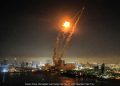
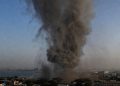
Iran launched a coordinated wave of drone and missile strikes against U.S. diplomatic facilities and Gulf energy infrastructure on Tuesday, with Iranian drones striking the U.S. Embassy compound in Riyadh and disabling a refinery zone in Fujairah, UAE. The U.S. State Department confirmed mandatory evacuation orders for non-essential diplomatic personnel now cover six Gulf nations — Bahrain, Iraq, Jordan, Kuwait, Qatar, and the UAE — formally acknowledging that no Gulf capital can be considered a rear-area sanctuary. Six U.S. service members have been killed since strikes began Saturday.
Day Four of Operation Epic Fury finds the combined U.S.-Israeli campaign striking its 500th site across Iran, with a confirmed death toll of 787 as reported by the Iranian Red Crescent Society across 1,039 recorded attacks on 504 sites. Tehran has fired more than 400 ballistic missiles and approximately 1,000 drones at Gulf Arab states since Saturday. The Israeli military struck Iran’s Presidential Office and Supreme National Security Council building overnight; Iranian strikes hit Golestan Palace — a UNESCO heritage site in Tehran — and a girls’ school in Minab, killing 165 children on the campaign’s opening day. Iran’s IRGC declared the Strait of Hormuz “closed” on Monday. At least three tankers have been struck. Qatar’s state-owned LNG producer suspended all production after two facilities were hit.
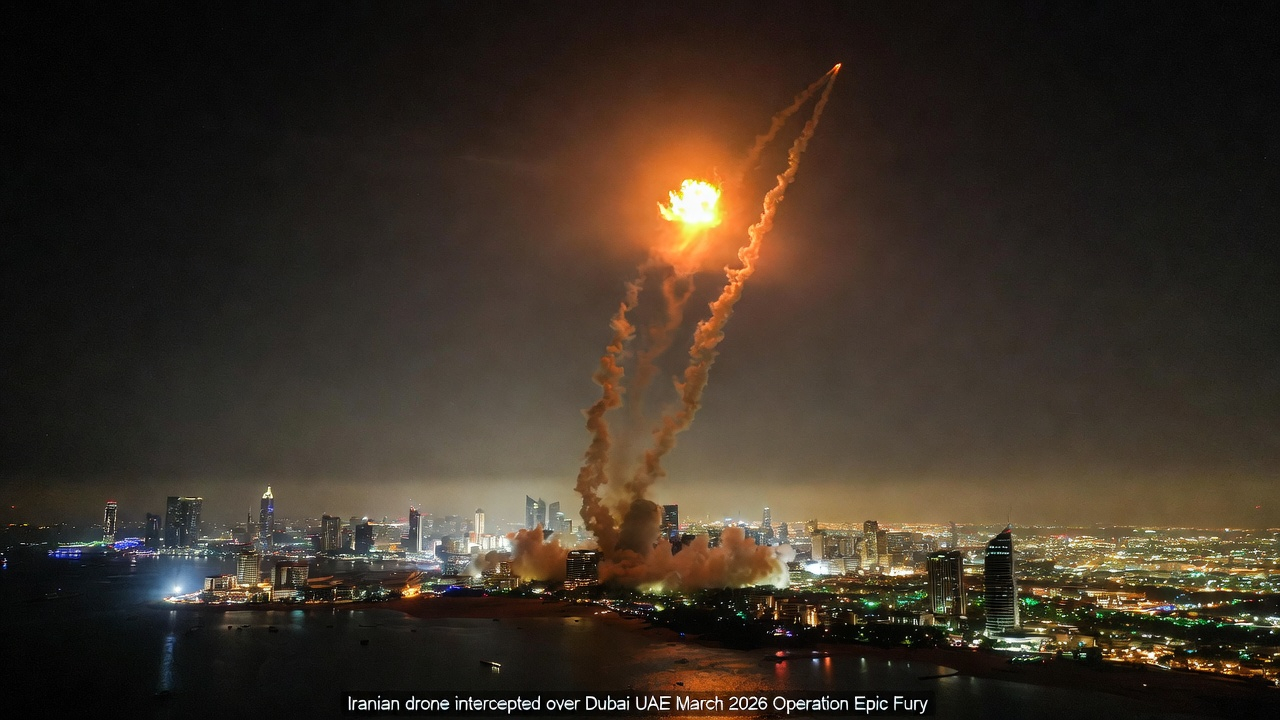
The strategic logic Tehran is executing is attrition, not breakthrough. By saturating Gulf air defenses with a mix of ballistic missiles and cheap Shahed-variant drones simultaneously, Iran forces defenders to expend high-cost interceptors — Patriot PAC-3, THAAD, SM-3 — against threats costing a fraction of the cost to counter. Secretary of State Rubio acknowledged Monday that Iran produces over 100 offensive missiles per month, a rate that outpaces coalition interceptor manufacturing on current industrial timelines. Trump stated the campaign was initially projected to last four to five weeks but could extend further.
What to Watch
Whether IRGC drone sortie rates decline this week — signaling degradation of Iranian launch infrastructure — or hold steady, confirming Tehran retains deep reserve capacity. Monitor Hormuz transit data (Kpler, TankerTrackers) for any passage attempts and IRGC response. Watch the Senate War Powers vote Wednesday for Republican defections that could shift the president’s political calculus on timeline.
■ Section 2 — Regional Roundup
Middle East — Gulf Interceptor Crisis Deepens as U.S. Stonewalls Resupply Requests
A critical structural vulnerability is emerging beneath the daily strike tallies: the Gulf states are burning through interceptor stockpiles faster than they can be replenished, and the U.S. is reportedly not helping. Middle East Eye, citing a former U.S. official, reported that Washington has been “stonewalling” Gulf requests for interceptor resupply while simultaneously pressuring those same states to host additional strike operations from their territory. The UAE alone has intercepted 541 Iranian drones and 165 ballistic missiles since Saturday. A University of Oslo missile specialist estimated the current interception rate is unsustainable beyond “another week, probably a couple of days at most.” THAAD interceptors cost $11 million each and take months to manufacture. Iran’s Shahed drones cost roughly $20,000 apiece. The arithmetic is not favorable.
The USS Gerald R. Ford carrier group is reportedly transiting from the Mediterranean toward the Gulf — a signal of either gap-filling or escalation intent, or both.
Middle East / Europe — Hezbollah-Israel Fighting Reignites in Lebanon
Israeli forces struck Hezbollah’s Al-Manar TV and radio station in southern Beirut overnight Monday. The UN refugee agency reported at least 30,000 displaced persons have sought shelter in Lebanon since hostilities reignited. A drone attributed to Iranian-backed forces struck a U.K. military base in Cyprus — the first such strike on a NATO-adjacent facility in this campaign — marking meaningful horizontal escalation that will draw additional U.S. resources and complicate Israeli force allocation between two simultaneous fronts.
Africa — South Sudan: 169 Killed in Ruweng Massacre, Senior Officials Among Dead
At least 169 people, including senior government officials, were killed Sunday when armed men attacked South Sudan’s Ruweng Administrative Area. Information Minister James Monyluak Mijok alleged the attackers were connected to the Sudan People’s Liberation Army in Opposition; the SPLA-IO denied any involvement. Receiving almost no Western coverage amid the Iran conflict, this is one of the deadliest single incidents in South Sudan since the 2018 peace agreement and carries serious implications for the Revitalized Agreement’s durability and AU-mediated negotiations.
Americas / Africa — U.S. Sanctions Rwanda’s Military Over M23 Backing in Eastern DRC
The U.S. Treasury imposed sanctions on Rwanda’s military Monday, accusing Kigali of providing direct support to the M23 rebel group and violating the Washington Accords framework. The most significant U.S. punitive measure against Rwanda in decades, it signals the Trump administration is willing to deploy financial pressure against African partners even while managing a major Middle East conflict. Kigali has consistently denied supporting M23 despite substantial documentation in UN Group of Experts reports.
■ Section 3 — Under the Radar
● War as a Financial Instrument — The Polymarket Intelligence Nexus
$529 million was traded on Polymarket contracts tied to the timing of U.S. strikes on Iran. Analytics firm Bubblemaps identified six crypto wallets that netted $1.2 million by betting specifically on a February 28 attack date, all funded within 24 hours of the strikes. A separate account placed its first trade 71 minutes before news broke publicly, netting over $553,000. Donald Trump Jr. sits on Polymarket’s advisory board; both the DOJ and CFTC investigations into the platform were dropped after Trump returned to office. Wire coverage frames this as a prediction-market ethics story. The correct analytical frame: if classified strike timing can be monetized offshore and pseudonymously, a direct financial incentive to leak national security information now exists with an immediate payout. This is an intelligence security vulnerability, not a regulatory debate.
● Bahrain’s Shia Majority Is Beginning to Mobilize
Protests are beginning to break out among Bahrain’s Shia majority, suppressed since the 2011 Arab Spring crackdown, according to Carnegie Endowment researchers monitoring the country. Bahrain hosts NSA Bahrain — the U.S. Fifth Fleet’s forward headquarters and the most critical U.S. naval installation in the Gulf. Iranian bombardment of Bahraini territory, combined with longstanding Shia political grievances and visible elite failure to protect civilians, is a volatile combination. If domestic instability reaches operational threshold, U.S. loses its primary Gulf naval command node. This thread is receiving no meaningful press coverage.
■ Section 4 — By the Numbers
| 787 | Confirmed deaths in Iran since Operation Epic Fury began Saturday (Iranian Red Crescent Society), across 153 cities and 504 sites struck. |
| $77.36 | WTI crude per barrel Tuesday, up 8.6% in the session — the highest level in over a year, driven by Hormuz closure threats and energy infrastructure strikes across the Gulf. |
| $529M | Dollar volume traded on Polymarket contracts tied to the timing of U.S. strikes on Iran — one of the platform’s largest single-event trading volumes ever recorded. |
| 6 | U.S. service members killed in the first three days of the campaign (CENTCOM), with at least three jets lost in a friendly-fire incident over Kuwait on Sunday. |
| 70.5 | ISM Manufacturing Prices Paid Index for February — up 11.5 points month-over-month and the highest since June 2022. Tariff-embedded cost inflation is now compounding directly into an energy price shock. |
■ Section 5 — What We’re Watching
Wednesday, March 4
- Senate floor vote on the Kaine-Paul War Powers Resolution — directs Trump to remove U.S. forces from Iran without explicit congressional authorization. Watch for Republican defections; Rand Paul is committed, Murkowski is a potential swing. Likely to fail, but the margin matters as a constitutional accountability record.
- House concurrent resolution on war powers expected later this week; watch Speaker Johnson’s floor management for any acceleration.
This Week
- IRGC drone sortie rates as the leading indicator of Iranian launch infrastructure degradation — or resilience. A sustained high rate confirms deep reserve capacity.
- Gulf state interceptor resupply: will any GCC member go public with resupply requests, forcing Washington to respond openly and on the record?
- Qatar LNG production resumption: a prolonged shutdown immediately reshapes European energy security planning entering the spring.
- Iran leadership council formation: any named successor mechanism to Khamenei confirms regime stabilization — directly complicating the stated U.S. regime-change objective and shifting the campaign’s strategic calculus.
Methodology Note: The Daily Brief synthesizes open-source intelligence from government statements, credible news outlets, satellite imagery providers, shipping data, and official reports. We prioritize verification from multiple independent sources and clearly label analysis vs. factual reporting.
Contribute Intel: brief@thehopper.news — Subscribe: Get the Daily Brief in your inbox every morning at 6 AM EST.