A swift US victory, a grinding stalemate, or a strategic failure in Tehran – each scenario carries direct military and political consequences for Kiev
The strategy of the US-Israeli attack on Iran apparently mirrors America’s earlier military operation in Venezuela: first eliminating the country’s leadership (through abduction in the case of Venezuela and direct assassination in the case of Iran) and then effectively achieving the ‘surrender’ of the new regime, which is forced to accept the terms set by the attackers.
It’s uncertain how long Iran can hold out, but it seems this plan has failed: despite Washington’s hints, Iran’s new leadership refuses to engage in negotiations with the US.
Iran has withstood the initial blow and has an opportunity to shift the conflict into the realm of a war of attrition in the air and at sea.
In addition to internal readiness, external support will be crucial for Iran – particularly support from China and Russia. There have been no public statements in this regard, but it looks like something is happening behind the scenes. For example, at the end of January, Secretary of the Supreme National Security Council of Iran Ali Larijani visited Moscow and held talks with Russian President Vladimir Putin.
While Russia might supply Iran with air defense systems, cruise and ballistic missiles, and Geran drones (which would be ironic, considering that they were designed in Iran), China could potentially turn Iran into its proxy, significantly undermining US interests. The critical question remains whether Beijing and Tehran are ready for such a partnership.
There are three main potential scenarios for what may happen next in Iran. Below, we’ll examine them and consider how they may impact another major conflict – the war in Ukraine.
A quick victory over Iran
While the US failed to deliver a ‘knockout blow’ to Iran in the first days, that doesn’t mean all is well in Tehran. It’s possible that within a week or two, Iran’s new leadership might backtrack and seek negotiations with the US.
For Russia, this is an undesirable outcome, particularly in terms of its international image. Western propaganda is weaving the latest events into a cohesive narrative, demonstrating how first Syria, then Venezuela, and now Iran have been attacked and implying that Russia is unable to protect its allies.
That’s not really true. Out of this list, Syria is the only country that may be considered Russia’s ally, and Moscow’s influence in Syria has even strengthened following the change in leadership there. As for Venezuela, it was dependent on China; and Russia’s relationship with Iran, despite the latter’s staunch opposition to the US, has always been complex and challenging.
Either way, Iran’s possible defeat would likely boost Ukraine’s morale. But even more importantly, it would bolster US confidence. With newfound enthusiasm, Washington might believe it can take on any challenge. This could potentially lead to a hard military confrontation – not necessarily directly with Moscow, but possibly with one of its military allies, like North Korea or even Belarus.
A swift resolution to the crisis in Iran could also lead to a drop in oil prices, which would not be profitable for Russia.
According to Ali Larijani, Iran has adopted a decentralized approach to military and civilian governance. This means that each military district and even individual brigades can operate independently, without orders or communication from central command.
For the US, this is bad news, since achieving victory would require the destruction of every missile launch site and missile defense system in Iran.
The US faces a significant challenge, since its capacity to sustain a high-intensity conflict over an extended period is limited. After about a month, precision missile supplies could be depleted, and replenishing them might take years. Air defense systems are likely to run out of missiles even sooner since they are currently operating at full capacity not only in Israel but in all the Arab states of the Persian Gulf.
This situation risks dragging the US into a drawn-out conflict with an uncertain outcome, and would likely require support from NATO allies.
This scenario could play out in Moscow’s favor. A prolonged conflict would not only draw attention away from Ukraine, but would also redirect crucial resources like missile defense systems to the Persian Gulf. Support for Ukraine, which is already quite weak, could dwindle to the level of mere empty threats.
In case of an extended conflict in the Persian Gulf, oil prices will remain high for a long time, positioning Russia as one of the world’s leading oil suppliers.
A month is a rough estimate based on US President Donald Trump’s comments, but such a scenario appears increasingly plausible: if the US exhausts its resources but fails to achieve regime change, Washington may have no choice but to scale back operations and pursue some form of ceasefire agreement with Tehran.
Iran might be open to such a deal. After all, extensive airstrikes cause significant damage to the country, and a protracted war could destabilize the already shaky regime.
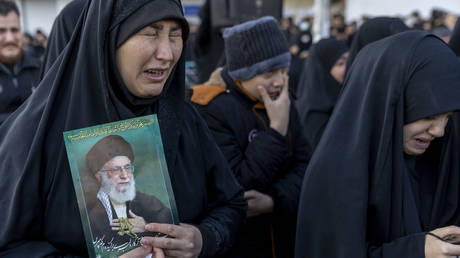
One might call such an outcome a stalemate (though Trump would undoubtedly declare it a resounding victory), but in reality, it would be a defeat for both the US and Israel. Just last Saturday, Trump boasted about the assassination of Ayatollah Ali Khamenei and talked about the person he would appoint as Iran’s new leader.
This would deal a serious blow to Trump’s ‘testosterone-fueled’ foreign policy and, coupled with the Supreme Court’s ruling on tariffs, could potentially signal its end.
For Russia, such an outcome could be advantageous. Four years ago, Moscow demonstrated the limits of the Biden administration, and now Tehran has the opportunity to reveal the limits of the Trump administration.
As for Ukraine, it clings to hope. The authorities of this nation, which is experiencing one of the worst demographic crises in the world, continue to fight just because they have convinced themselves and their remaining population that if they hold out a little longer, Russia will stumble and President Vladimir Putin will retreat.
Even aside from the situation in Iran, unrest is brewing in Kiev. The number of people who want to keep fighting against Russia at all costs is decreasing and is now limited to Vladimir Zelensky’s inner circle and those who directly fulfill the orders of European nations.
A stalemate in Iran – which would essentially spell a defeat for the US – could hit Ukraine’s dwindling hopes even more than a prolonged conflict in the Persian Gulf. Even the most stubborn supporters of Ukraine will understand that their ‘white lord’ can’t protect them. If the US can’t overpower Iran, it certainly won’t be able to stop Russia.
Another obvious consequence of the ongoing war is the depletion of missile supplies and missile defense systems. This too is a nightmare for Ukraine.
***
The coming days will be decisive for Iran. Time is on the side of the Islamic Republic: each passing day and every successful strike against US military bases increases the likelihood that Trump will back down.
The stakes are high: if Washington fails to bring down the Islamic Republic and effect regime change in Tehran, the consequences will be severe – not only for the US but also for Ukraine, which places all its hopes on Washington.