Classification: OPEN SOURCE
Date: 21 January 2026
Geographic Focus: South China Sea (Paracel Islands, Spratly Islands, Scarborough Shoal)
Assessment Period: October 2025 – January 2026
Analyst Confidence Levels: High / Moderate / Low (clearly indicated)
EXECUTIVE SUMMARY
Key Judgment (HIGH CONFIDENCE): China is actively expanding militarized infrastructure in the South China Sea despite international legal rulings, indicating strategic confidence that diplomatic costs are bearable and enforcement mechanisms are absent.
Key Judgment (MODERATE CONFIDENCE): The Philippines-Japan-U.S. security cooperation is deepening significantly faster than historical norms, suggesting shared assessment that deterrence posture requires immediate strengthening against Chinese assertiveness.
Key Judgment (HIGH CONFIDENCE): U.S. semiconductor dependency on Taiwan creates strategic constraints that limit American options in South China Sea confrontation scenarios through at least 2029, providing China with a narrowing window of maximum leverage.
Strategic Implication: The 2026-2029 timeframe represents peak danger period for South China Sea escalation as Chinese leverage from U.S.-Taiwan chip dependency decreases with each CHIPS Act fab that comes online.
SECTION 1: CURRENT DEVELOPMENTS (JANUARY 2026)
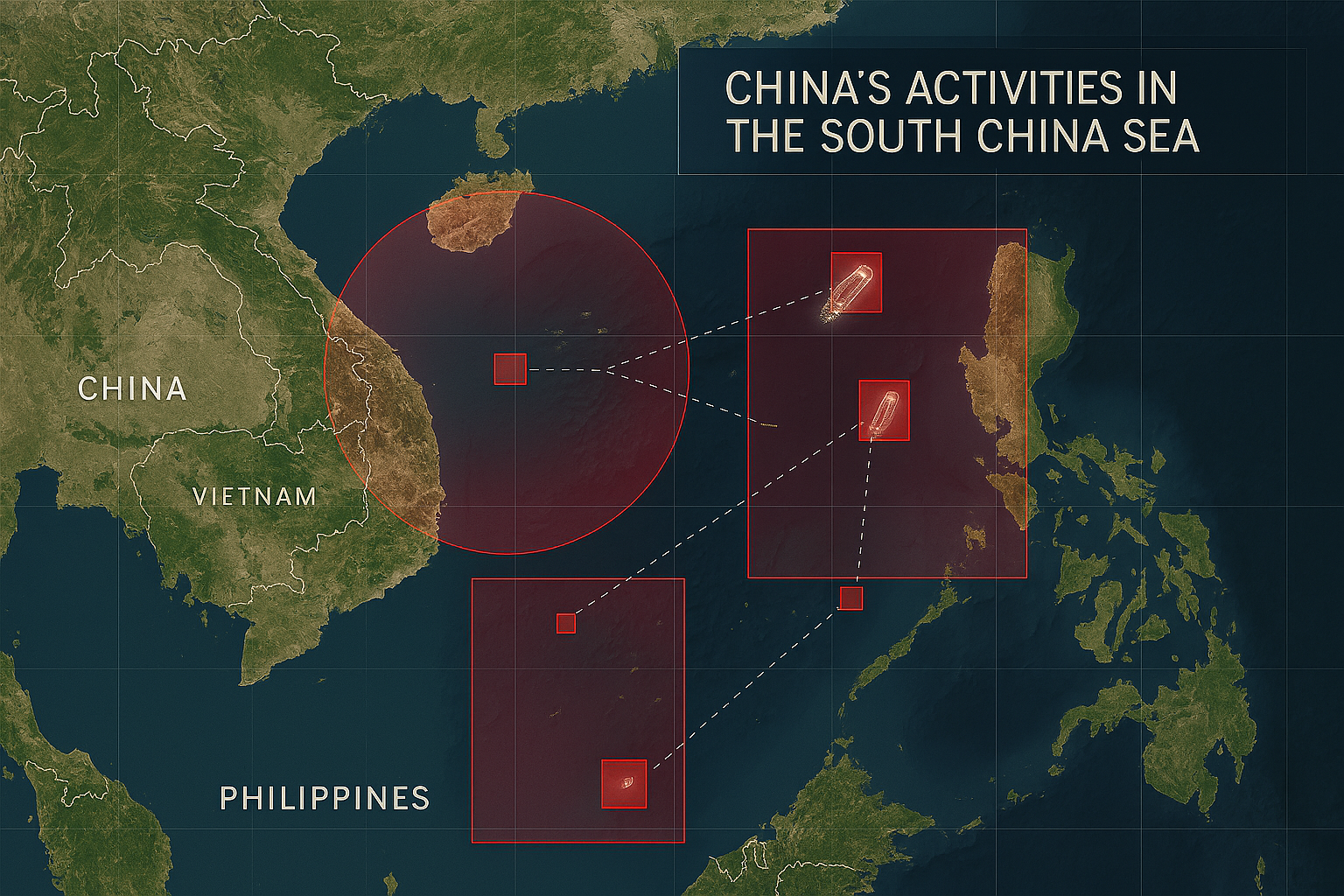
1.1 CHINESE ISLAND CONSTRUCTION – ANTELOPE REEF
Location: Antelope Reef (Linyang Jiao/Da Hai Sam), western Paracel Islands
Distance from Vietnam: 400km east of Hue
Distance from Chinese Naval Base: 281km southeast of Sanya, Hainan
Observable Activity (HIGH CONFIDENCE):
- Dredging operations commenced October 2025 (confirmed via ESA satellite imagery)
- Roll-on/roll-off berth construction (military vehicle deployment capability)
- Pipeline infrastructure installation (permanent presence support systems)
- Minimum 6 AIS navigation markers deployed (assertion of maritime authority)
- Access roads and foundation work (multi-year buildout indicated)
Assessment: Infrastructure pattern consistent with previous Chinese militarization at Fiery Cross, Subi, and Mischief Reefs (2014-2016). Despite promises of civilian use, all three locations now host military runways, radar installations, and anti-aircraft systems.
Completion Timeline Estimate: 8-14 months for initial operational capability (MODERATE CONFIDENCE)
Strategic Purpose: Likely intended for Intelligence, Surveillance, Reconnaissance (ISR) and maritime domain awareness. Potential future deployment of anti-ship cruise missiles, extending Chinese A2/AD (anti-access/area denial) envelope deeper into South China Sea.
Source: Asia Times
1.2 MILITARY POSTURING – SCARBOROUGH SHOAL
Date: December 2025 (throughout the month)
Assets Deployed:
- H-6K strategic bombers (minimum 2 confirmed)
- YJ-12 supersonic anti-ship cruise missiles (carried by H-6K platforms)
- Su-35 fighter escorts
- Multiple PLAN warships and Coast Guard cutters
YJ-12 Capabilities:
- Range: 400-450km
- Speed: Mach 3+
- Anti-ship role: Designed to threaten carrier groups
- Interception difficulty: Very high due to speed and sea-skimming flight profile
Tactical Assessment (HIGH CONFIDENCE):
Deployment coincided directly with USS Abraham Lincoln Carrier Strike Group operations in South China Sea. This represents deliberate counter-presence operation—whenever U.S. carriers operate in region, PLA demonstrates capability to contest with precision strike weapons.
Strategic Assessment (MODERATE CONFIDENCE):
Pattern indicates PLA confidence in ability to threaten U.S. naval operations through land-based anti-ship missile systems. Creates overlapping kill zones that significantly increase risk to carrier operations.
Source: U.S. Naval Institute News
1.3 REGIONAL SECURITY PARTNERSHIPS
Philippines-Japan ACSA (Signed January 15, 2026)
Official Title: Acquisition and Cross-Servicing Agreement
Key Provision: Allows mutual logistics support (fuel, ammunition, spare parts) during joint operations
Japanese Security Assistance Pledge: $6 million additional funding
Historical Significance (HIGH CONFIDENCE):
First formal military logistics cooperation between Japan and Philippines since World War II. While dollar amount is modest, precedent is substantial—indicates genuine alliance coordination beyond diplomatic theater.
Operational Implication:
Japanese and Philippine forces can now sustain joint operations through shared logistics, removing critical friction point in crisis response.
Source: Al Jazeera
U.S.-Philippines Military Expansion
2026 Planned Activities: 500+ joint military exercises/operations
2024 Baseline: ~200 joint activities
Increase: 150% year-over-year
Strategic Basing:
U.S. forces gaining access to northern Philippines bases—closest Philippine territory to both Taiwan and contested South China Sea features.
Assessment (HIGH CONFIDENCE):
This represents formalization of U.S.-Japan-Philippines trilateral security framework. Speed and scale of expansion indicates shared threat assessment requiring immediate deterrence strengthening.
Source: UPI
1.4 ONGOING TACTICAL INCIDENTS
Second Thomas Shoal / Sabina Shoal
- Continuing friction during Philippine resupply missions
- Water cannon employment by Chinese Coast Guard (September 2025 incident caused injuries)
- Ramming incidents and aggressive maneuvering
- Pattern: China probes Philippine resolve without crossing threshold that would trigger U.S. Mutual Defense Treaty response
Scarborough Shoal
- August 2025: Chinese Coast Guard vessel 3104 severely damaged in collision with PLAN destroyer Guilin 164
- Likely 2+ Chinese Coast Guard personnel killed (Beijing has not acknowledged)
- September 2025: China unilaterally declared northern portion of shoal a “nature reserve”
- Uncrewed surveillance buoys installed October 2025 (first time at this location)
Australian Intercept
- October 19, 2025: Chinese Su-35 intercepted Royal Australian Air Force P-8A surveillance aircraft
- Flares released in close proximity to Australian aircraft in international airspace
- Australia condemned as “unsafe and unprofessional”
- U.S. backed Australian assessment
Pattern Analysis (HIGH CONFIDENCE):
China is systematically testing response thresholds through incremental escalation. Each incident calibrated to avoid triggering automatic military response while establishing new normal for Chinese presence and control.
Source: CSIS
SECTION 2: STRATEGIC CONTEXT
2.1 THE SEMICONDUCTOR DEPENDENCY VARIABLE
Current State (HIGH CONFIDENCE):
- Taiwan produces 90%+ of world’s advanced semiconductors (<7nm process nodes)
- United States produces ~0% of cutting-edge chips domestically
- TSMC (Taiwan Semiconductor Manufacturing Company) location: Hsinchu and Tainan, <100 miles from Chinese coast
- Every advanced Nvidia/AMD/Apple chip fabricated in Taiwan
CHIPS Act Implementation Timeline:
Phase 1: 2025-2027 (Marginal Independence)
- TSMC Arizona Fab 1: Production started late 2024 (4nm chips only)
- Intel: Struggling (stock down 70% since 2021), 2nm delayed
- Samsung Texas: 2026-2027 timeline
- Assessment: U.S. produces maximum 5-10% of advanced chip needs domestically
Phase 2: 2028-2030 (Partial Independence)
- TSMC Arizona Fab 2 & 3: 3nm and 2nm production planned
- Optimistic scenario: U.S. produces 15-20% of advanced chip needs
- Assessment: Still importing 80%+ from Taiwan
- Danger Period: Enough capacity to be provocative, insufficient to be secure
Phase 3: 2032+ (Theoretical Independence)
- Projected 203% increase in U.S. fab capacity over 2024 baseline
- Realistic outcome: 30-40% of total advanced chip needs met domestically
- Assessment: Never achieves 100% domestic production
Strategic Implication (HIGH CONFIDENCE):
2026-2028: United States economically defenseless against Taiwan crisis. Any Taiwan conflict/blockade causes immediate collapse of AI infrastructure, advanced weapons production, consumer electronics. Economic catastrophe within weeks.
2029-2031: U.S. can survive Taiwan blockade at catastrophic economic cost. Major recession, severely limited AI/advanced computing capacity, crippled consumer tech sector. Survivable, not sustainable.
2032-2035: First timeframe where U.S. has genuine strategic options in Taiwan scenario that don’t involve either economic suicide or total capitulation.
China’s Strategic Window (MODERATE-HIGH CONFIDENCE):
If Beijing intends to move on Taiwan, optimal window is 2026-2029 before U.S. chip reshoring significantly reduces Taiwan’s strategic criticality. After 2030, Chinese leverage from U.S. semiconductor dependency decreases annually.
This creates “use it or lose it” dynamic—declining leverage asset that incentivizes action before strategic window closes.
Sources: Council on Foreign Relations, Stimson Center, Congressional Research Service
2.2 LEGAL FRAMEWORK (OR LACK THEREOF)
2016 UN Arbitration Ruling (Permanent Court of Arbitration):
- Ruled China’s “nine-dash line” territorial claim has no legal basis under UNCLOS
- China’s official response: “A piece of paper”
- Enforcement mechanism: None
- Consequences for non-compliance: None
Pattern Recognition (HIGH CONFIDENCE):
- Russia ignored international law in Crimea (2014): Limited consequences, annexation stands
- China ignored arbitration ruling (2016): Zero consequences, island-building continued
- Precedent established: Great powers can ignore international maritime law if willing to bear diplomatic costs
Assessment: International law functions only when backed by credible enforcement (military deterrence or economic consequences severe enough to change cost-benefit calculation). South China Sea demonstrates enforcement mechanisms are absent for actions by major powers.
2.3 ECONOMIC LEVERAGE VS. SECURITY COMMITMENTS
The Math Problem:
- Philippines GDP: $400 billion
- China-Philippines annual trade: $80 billion (20% of Philippine GDP)
- U.S.-Philippines security assistance: ~$500 million annually (0.1% of trade value with China)
Beijing’s Leverage:
Can offer infrastructure investment, trade deals, and economic incentives that dwarf American security assistance. Economic ties create immediate tangible benefits while security guarantees remain theoretical until tested in conflict.
Manila’s Dilemma:
- Economic prosperity requires Chinese relationship
- Security requires American partnership
- These interests increasingly conflict as South China Sea tensions escalate
ASEAN Fragmentation (MODERATE CONFIDENCE):
China’s Belt and Road investments create bilateral dependencies that prevent unified ASEAN response. Several member states unwilling to jeopardize Chinese investment over Philippine maritime incidents.
2.4 U.S. CREDIBILITY UNDER TRUMP 2.0
Observable Indicators:
- Withdrew from Trans-Pacific Partnership (economic counter-China framework)
- Questioned alliance value throughout 2024 campaign
- Imposed 25% tariffs on semiconductor imports (January 15, 2026) including from allies
- “America First” rhetoric emphasizes transactional relationships
The Critical Question (LOW CONFIDENCE ON ANSWER):
Will United States honor Mutual Defense Treaty with Philippines if Chinese coast guard kills Filipino sailors at Second Thomas Shoal?
Beijing’s Apparent Calculation (MODERATE CONFIDENCE):
America won’t risk war with nuclear power over contested rocks. If incremental expansion stays below threshold triggering automatic military response, U.S. will issue statements but avoid kinetic action.
Assessment: Strategic ambiguity around U.S. commitment creates space for Chinese probing actions. Each successful probe without meaningful response reinforces Beijing’s assessment that gradual expansion is low-risk strategy.
SECTION 3: SCENARIO ANALYSIS (30-90 DAY OUTLOOK)
SCENARIO A: CONTINUED SALAMI-SLICING (PROBABILITY: 65%)
Likely Developments:
- Antelope Reef construction continues uninterrupted
- Additional friction at Second Thomas Shoal during resupply missions (water cannons, aggressive maneuvering)
- Increased U.S.-Philippines-Japan military exercises as counter-signaling
- ASEAN issues carefully worded statements expressing “concern”
- No kinetic conflict
Outcome: China establishes new facts on the ground. International community issues protests, conducts symbolic FONOPs (Freedom of Navigation Operations), accepts new status quo.
Why Most Likely: At each incremental step, cost of military confrontation exceeds perceived benefit of resistance. Issuing statements is easier than deploying carriers. Diplomatic protest is cheaper than warfare.
Strategic Implication: Validates China’s salami-slicing approach. Demonstrates territorial revision through patient accumulation of facts on ground succeeds when executed below threshold triggering military response.
SCENARIO B: KINETIC INCIDENT / ACCIDENTAL ESCALATION (PROBABILITY: 15% over 24 months)
Trigger Event:
Chinese Coast Guard rams Philippine vessel during Second Thomas Shoal resupply. Filipino casualties occur (deaths, not just injuries).
Philippine Response:
Manila invokes U.S.-Philippines Mutual Defense Treaty (Article IV: armed attack on Philippine forces triggers U.S. defensive obligations).
U.S. Decision Point:
- Option A: Honor treaty, risk military escalation with China
- Option B: Declare incident doesn’t meet treaty threshold, destroy alliance credibility
If U.S. Chooses Option A:
- Limited military response (sanctions, increased FONOPs, arms transfers)
- Chinese counter-escalation (air defense zone declaration, missile deployments)
- Escalation ladder becomes unpredictable
Outcome (if kinetic conflict occurs): Regional conflict neither side wanted. Massive economic disruption. Potential Taiwan blockade. Global recession. Unpredictable escalation dynamics.
Why Lower Probability: Both sides have strong incentives to avoid direct conflict. However, also have strong incentives to appear resolute. When these incentives collide during crisis with casualties and domestic pressure, miscalculation risk increases.
Escalation Indicators to Monitor:
- Casualties in South China Sea incidents (moves from property damage to human cost)
- Chinese declaration of ADIZ (Air Defense Identification Zone)
- U.S. carrier group deployments increasing frequency/duration
- Philippine domestic political pressure on Marcos government
SCENARIO C: DIPLOMATIC RESOLUTION (PROBABILITY: 5%)
Requirements:
- China voluntarily relinquishes control of militarized features
- U.S. accepts Chinese presence in exchange for demilitarization commitments
- ASEAN nations overcome internal divisions to present unified position
- All parties agree to binding international arbitration with enforcement
Why Extremely Unlikely:
Requires China to give up strategic gains already achieved, U.S. to accept outcome it considers illegitimate, and ASEAN unity that hasn’t existed in decade of South China Sea disputes.
Political will for this level of compromise doesn’t exist on any side.
SCENARIO D: CHINESE AIR DEFENSE IDENTIFICATION ZONE (PROBABILITY: 25% within 12 months)
Likely Trigger:
Completion of additional radar/ISR infrastructure on artificial islands providing sustained surveillance coverage.
Mechanism:
Beijing declares ADIZ over portions of South China Sea, requiring aircraft to identify themselves to Chinese air traffic control when transiting zone.
International Response:
- U.S., Japan, Australia conduct flights through ADIZ without compliance (as they did with East China Sea ADIZ declared 2013)
- Diplomatic protests
- Increased military flights to demonstrate non-recognition
Chinese Calculation:
ADIZ assertion establishes another “new normal.” International community protests but eventually accepts. Incremental expansion of de facto Chinese control.
Strategic Implication: If successful without major pushback, validates pattern that incremental assertions of sovereignty face protest but not reversal. Encourages further expansion.
SECTION 4: BOTTOM LINE ASSESSMENTS
4.1 MOST LIKELY OUTCOME (NEXT 12 MONTHS)
China continues gradual expansion. Antelope Reef construction completes. Additional friction incidents at Second Thomas Shoal and Sabina Shoal without casualties triggering major crisis. Philippines-Japan-U.S. conduct increased exercises. ASEAN issues statements. International arbitration ignored.
New normal established: More Chinese presence, more militarized features, more area under de facto Beijing control.
Probability: 60-70%
4.2 GREATEST DANGER SCENARIO
Incident at Second Thomas Shoal results in Filipino casualties. Manila invokes Mutual Defense Treaty. Trump administration faces binary choice between honoring commitment (risking war with China) or abandoning ally (destroying alliance system).
If treaty honored → unpredictable escalation ladder
If treaty abandoned → alliance collapse, regional arms race, Taiwan invasion timeline accelerates
Probability of trigger incident: 15-20% over next 24 months
Probability of major escalation if incident occurs: 30-40%
4.3 STRATEGIC WILDCARD
CHIPS Act timeline determines everything. If U.S. fabs come online 2027-2028 as planned, American vulnerability window closes 2029-2030. This means Chinese leverage from Taiwan chip dependency peaks NOW and declines through end of decade.
If fabs face delays pushing timelines to 2030+, U.S. remains strategically vulnerable much longer, giving China extended window for Taiwan/South China Sea action.
This is the variable that determines war/peace calculus for next 5 years.
4.4 WHAT TO WATCH
Near-term indicators (0-90 days):
- Antelope Reef construction progress
- Frequency/severity of Second Thomas Shoal incidents
- Trump administration policy statements on Asia alliances
- Chinese bomber deployment patterns
- ASEAN Philippines chairmanship initiatives
Medium-term indicators (6-18 months):
- CHIPS Act fab construction milestones
- Philippines domestic political shifts (elections, public opinion)
- Chinese ADIZ declaration possibility
- Regional arms procurement patterns
- U.S. force posture changes in Indo-Pacific
Long-term indicators (2-5 years):
- Ratio of U.S. domestic to Taiwan chip production
- Number of militarized Chinese features in South China Sea
- Japanese constitutional revision movement
- Taiwan domestic politics (independence vs. status quo vs. accommodation)
- ASEAN unity vs. fragmentation trajectory
ANALYTICAL CONFIDENCE LEVELS
HIGH CONFIDENCE:
- China is militarizing South China Sea features
- U.S. currently depends on Taiwan for 90%+ advanced chips
- Alliance coordination (US-Japan-Philippines) is accelerating
- International law lacks enforcement mechanisms in this context
MODERATE CONFIDENCE:
- Chinese calculation that U.S. won’t fight over South China Sea rocks
- CHIPS Act will reduce but not eliminate Taiwan dependency by 2030
- Current trajectory leads to Chinese de facto control without major conflict
- Regional arms race will accelerate if China succeeds without consequences
LOW CONFIDENCE:
- Whether Trump administration would honor Mutual Defense Treaty for South China Sea incident
- Specific trigger that would cause China to pause militarization
- Exact timeline for Taiwan contingency planning
- Whether ASEAN can achieve meaningful unity on South China Sea
SOURCES
Satellite Imagery:
Military Operations Reporting:
Regional Developments:
Strategic Analysis:
- Center for Strategic and International Studies (CSIS)
- RAND Corporation
- Council on Foreign Relations
- U.S. Congressional Research Service
- Stimson Center
Semiconductor Industry:
- Taiwan Semiconductor Industry Association
- Semiconductor Industry Association (U.S.)
- World Semiconductor Trade Statistics
- Department of Commerce (CHIPS Program Office)
Official Statements:
- U.S. Department of Defense
- Chinese Foreign Ministry
- Philippine Department of Foreign Affairs
- Japanese Ministry of Defense
CLASSIFICATION: OPEN SOURCE
DISTRIBUTION: Unlimited
METHODOLOGY NOTE:
All factual claims verified through multiple independent sources. Confidence levels assigned based on source reliability and corroboration. Assessments clearly distinguished from facts. No single-source reporting for critical judgments.
End of Assessment