By TheHopper Intelligence Desk
January 21, 2026
January 2026. European Space Agency satellites capture dredging operations at Antelope Reef in the Paracel Islands. Not the first time China’s built an island. Not even the tenth. The pattern is familiar by now: coral reef one year, military runway the next, international law be damned.
But this one’s different.
Why? Timing. Technology. Triangulation.
The timing coincides with Trump 2.0 settling into office, testing American resolve when alliance commitments are openly questioned. The technology visible in satellite imagery suggests advanced intelligence, surveillance, and reconnaissance (ISR) capabilities—the kind that make controlling 1.3 million square miles of ocean militarily feasible. And the triangulation? The Philippines, Japan, and the United States are coordinating faster and more aggressively than ever before, planning over 500 joint military activities in 2026 alone.
Everyone’s talking about Taiwan. Smart money’s watching the Spratlys and Paracels.
The South China Sea dispute isn’t about islands, fishing rights, or even the estimated 11 billion barrels of oil beneath the seabed. It’s about who controls the strategic waterways carrying $3.4 trillion in annual trade. It’s about whether international law means anything when a great power decides it doesn’t. And increasingly, it’s about whether the United States can credibly deter Chinese expansion when American economic security still depends on chips manufactured 100 miles from the Chinese coast.
That last part? That’s the variable nobody’s discussing openly, but it determines everything.
WHAT’S ACTUALLY HAPPENING
The Physical Reality
Antelope Reef, known as Linyang Jiao in Chinese and Da Hai Sam to Vietnam, sits 400 kilometers east of Vietnam’s coast in the western Paracel Islands. Satellite imagery confirms China began new dredging operations in October 2025, constructing infrastructure that includes:
- Roll-on/roll-off berths capable of deploying heavy military vehicles
- Pipeline infrastructure for permanent presence support
- At least six AIS navigation markers asserting maritime authority
- Access roads and foundation work suggesting multi-year buildout
The Asia Maritime Transparency Initiative previously described Antelope Reef as “little more than a sandbar” with minimal infrastructure. By mid-2027, analysts project it will host permanent facilities comparable to China’s existing South China Sea installations at Fiery Cross, Subi, and Mischief Reefs—all of which Beijing promised would remain civilian research stations before installing 3,000-meter military runways.
The Pattern We’ve Seen Before
China’s island-building campaign began in earnest in 2014. Between 2014 and 2016, Beijing transformed seven reefs into military installations with runways, hangars, radar facilities, and anti-aircraft systems. The playbook is consistent:
- Dredge coral and build land
- Install “civilian” infrastructure
- Promise non-militarization
- Deploy military assets 18-24 months later
- Dismiss international protests
In 2016, a UN arbitration tribunal ruled China’s sweeping territorial claims—demarcated by the so-called “nine-dash line”—had no legal basis under international law. China’s response was immediate and unambiguous: Beijing called the ruling “a piece of paper” and continued construction.
The problem? There’s no enforcement mechanism. International maritime law only works when major powers choose to follow it.
Current Military Posture
In December 2025, the People’s Liberation Army deployed H-6K strategic bombers armed with YJ-12 supersonic anti-ship cruise missiles to Scarborough Shoal. The YJ-12 has an estimated range of 400-450 kilometers and travels at Mach 3+, making it extremely difficult to intercept.
The deployment coincided precisely with the USS Abraham Lincoln Carrier Strike Group conducting operations in the South China Sea. The message was clear: China can contest American naval supremacy in these waters with land-based precision strike weapons.
This represents a fundamental shift. For decades, U.S. carrier groups operated in the South China Sea with near-impunity. Now, Chinese anti-ship missiles stationed on artificial islands create overlapping kill zones that make carrier operations significantly riskier.
It’s a modern version of what military strategists call “anti-access/area denial” (A2/AD)—using long-range weapons to prevent adversaries from operating freely in contested spaces.
WHY THIS TIME FEELS DIFFERENT
The Alliance Response Has Accelerated
On January 15, 2026, Japan and the Philippines signed the Acquisition and Cross-Servicing Agreement (ACSA). While the dollar amount—$6 million in Japanese security assistance—seems modest, the precedent is enormous. This marks the first formal military logistics cooperation between Manila and Tokyo since World War II.
Under ACSA, Japanese and Philippine forces can provide mutual logistics support during joint exercises and operations. That means fuel, ammunition, spare parts, and other materiel flowing between militaries in real-time—the kind of operational integration that signals genuine alliance coordination, not diplomatic theater.
Meanwhile, the United States and Philippines are planning over 500 joint military activities in 2026, a dramatic increase from roughly 200 activities in 2024. The expansion includes access to strategic bases in the northern Philippines—the closest Philippine territory to Taiwan and the South China Sea’s most contested features.
This is the informal U.S.-Japan-Philippines security triangle solidifying into something more concrete. Japan providing security assistance and logistics support to the Philippines, backed by expanding U.S. military presence, represents a trilateral deterrence framework designed explicitly to counter Chinese maritime expansion.
China’s Confidence Has Grown
Beijing shows no signs of pausing its island-building campaign despite international pressure. Why?
Economic leverage over ASEAN. China is the largest trading partner for nearly every Southeast Asian nation. The Philippines conducts $80 billion in annual trade with China—dwarfing the roughly $500 million in U.S. security assistance Manila receives. When push comes to shove, economic interdependence often trumps security commitments.
Belt and Road influence. China’s infrastructure investments across Southeast Asia create political dependencies that complicate unified regional responses to South China Sea disputes. Several ASEAN members are unwilling to jeopardize Chinese investment over Philippine-China maritime incidents.
Assessment of American commitment. This is the critical calculation. Beijing is watching the Trump administration closely, evaluating whether “America First” rhetoric translates to reduced security commitments in the Indo-Pacific. If China believes the United States won’t honor its Mutual Defense Treaty with the Philippines over contested rocks, then the cost-benefit analysis of further island militarization shifts dramatically in Beijing’s favor.
The Trump Variable
During his 2024 campaign, President Trump repeatedly questioned the value of U.S. alliance commitments and withdrew from the Trans-Pacific Partnership (TPP)—the Obama-era economic framework designed to counter Chinese regional influence. His transactional approach to foreign policy creates strategic uncertainty.
The critical question: Would Trump honor the U.S.-Philippines Mutual Defense Treaty if Chinese coast guard vessels kill Philippine sailors at Second Thomas Shoal?
Beijing is testing that question incrementally. Every water cannon incident, every ramming, every dangerous intercept is calibrated to probe American resolve without triggering automatic military responses.
If the answer turns out to be “no”—or even “maybe not”—then China gains a free hand to reshape the South China Sea’s geography and governance structures without meaningful resistance.
THE STAKES EVERYONE’S MISSING
It’s Not About Fish or Oil (Though There’s Plenty)
The South China Sea contains an estimated 11 billion barrels of oil, 190 trillion cubic feet of natural gas, and produces 12% of the global fish catch. Those are significant numbers.
But that’s not why this matters.
It’s About the Chokepoint
$3.4 trillion in annual trade transits the South China Sea. That represents roughly one-third of global maritime shipping. Eighty percent of China’s energy imports pass through these waters, as do critical supply chains connecting Asian manufacturing to Western markets.
The South China Sea is to 21st-century global commerce what the Suez Canal was to 20th-century trade: a strategic bottleneck that, if closed, would cause immediate economic catastrophe.
Here’s the strategic problem: If one nation can credibly threaten to close or control access to this waterway, that nation gains extraordinary geopolitical leverage.
China is positioning itself to be that nation.
The Semiconductor Factor Nobody’s Saying Out Loud
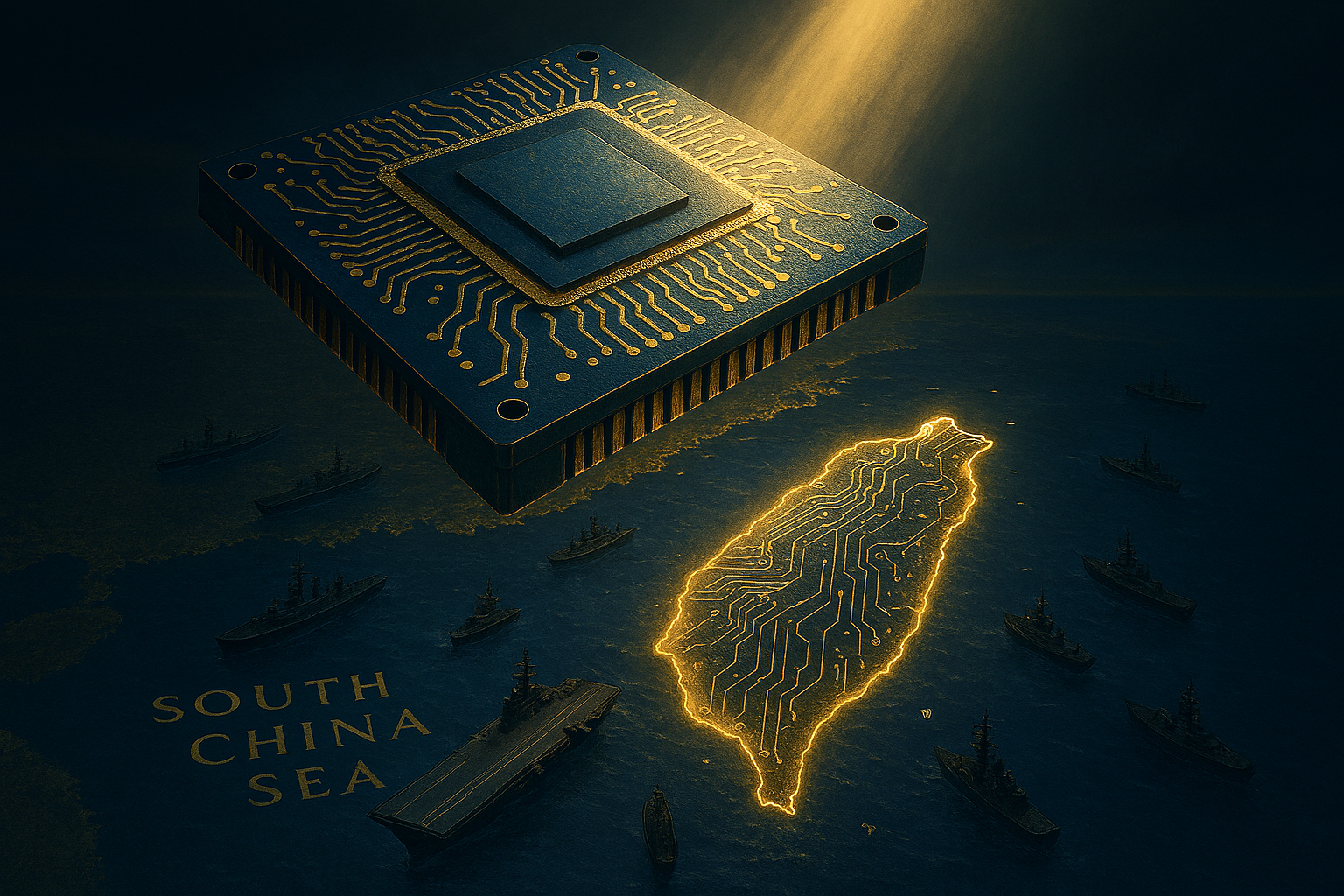
Taiwan produces over 90% of the world’s most advanced semiconductors. Every cutting-edge chip in every iPhone, every Nvidia AI processor, every advanced weapons system—they all get manufactured at Taiwan Semiconductor Manufacturing Company (TSMC) facilities in Hsinchu and Tainan, less than 100 miles from mainland China.
The United States currently manufactures essentially zero advanced chips domestically.
This creates a strategic dependency that constrains American options in any South China Sea or Taiwan crisis. If China blockades Taiwan—a scenario that becomes militarily feasible if Beijing controls the South China Sea—the United States faces an impossible choice:
Option A: Military confrontation with a nuclear-armed power to preserve access to semiconductors
Option B: Accept Chinese dominance and watch American technological competitiveness collapse within 12-24 months
This isn’t hypothetical. In 2021, a global chip shortage caused vehicle production lines to idle worldwide. Automakers couldn’t build cars. Consumer electronics manufacturers couldn’t build phones. Defense contractors couldn’t build advanced weapons systems.
Now imagine that shortage isn’t temporary supply chain disruption. Imagine it’s a permanent blockade.
The CHIPS Act Timeline Changes Everything
This is why the CHIPS and Science Act’s implementation timeline matters so much.
Passed in August 2022, the CHIPS Act appropriated $52.7 billion to rebuild domestic semiconductor manufacturing. The goal: reduce American dependence on Taiwan for the chips that power everything from smartphones to fighter jets.
Current status (January 2026):
TSMC’s first Arizona fab started production in late 2024, manufacturing 4-nanometer chips. That’s good, but not cutting-edge. The truly advanced chips—2nm and 3nm process nodes that power AI systems and high-performance computing—won’t come online until 2027-2029 at the earliest.
Intel, the flagship American chipmaker, is struggling. Its stock has declined 70% since 2021. Its 2nm process technology, promised for 2025, has been delayed. The company laid off 15% of its workforce in 2024 after “disappointing” quarterly results.
Samsung’s Texas expansion won’t reach full production until 2026-2027.
What this means strategically:
2026-2028: The Danger Zone
The United States has essentially zero domestic advanced chip production. Any Taiwan crisis would cause immediate, catastrophic economic disruption. Every AI data center, every advanced weapon system, every high-end consumer device—production halts.
This is why President Biden was so aggressive with CHIPS Act implementation. This is why Trump, despite “America First” rhetoric, cannot actually abandon Taiwan. The economic dependency is too severe.
2029-2031: Marginal Independence
If TSMC’s Arizona fabs deliver on schedule—a significant “if” given construction delays and workforce challenges—the United States might produce 15-20% of its advanced chip needs domestically.
That’s enough to survive a Taiwan blockade, but at catastrophic economic cost. Think: no new iPhones, severely limited AI capacity, crippled advanced weapons production. Civilization doesn’t collapse, but the recession would be severe.
2032-2035: Strategic Flexibility
Multiple fabs producing 2nm chips and advanced packaging. Enough domestic capacity for critical military and government needs. Consumer markets still hurt badly, but the United States isn’t facing existential economic crisis.
This is the first moment when American policymakers might actually have strategic options in a Taiwan scenario that don’t involve either total capitulation or economic suicide.
2035+: Reduced Dependency
Even at maximum CHIPS Act success, the United States will still import 50-60% of advanced chips. Full independence isn’t achievable without decades more investment. But the dependency shifts from “existential” to “very significant.”
Why China Might Move Soon
Beijing understands this timeline.
If China wants to assert control over Taiwan—and by extension, the South China Sea—the window is 2026-2029, before American chip reshoring reduces Taiwan’s strategic criticality.
After 2030, every year that passes makes Taiwan’s semiconductor industry slightly less essential to U.S. economic survival (though still very important). China’s leverage diminishes accordingly.
This creates a “use it or lose it” dynamic.
Right now, China has maximum leverage: The United States is totally dependent on Taiwanese chips, and that dependency constrains military options. In five years, that leverage declines significantly.
It’s the same calculation Russia made with Ukraine in 2022—act before NATO expansion and Western resolve solidify, or accept a permanently unfavorable status quo.
THREE SCENARIOS IN PLAY
Scenario A: The New Normal (Most Likely – 65%)
China completes Antelope Reef construction. The United States and allies conduct Freedom of Navigation Operations (FONOPs) and issue diplomatic protests. ASEAN releases carefully worded statements expressing “concern.” No kinetic conflict occurs.
Outcome: Gradual Chinese control without firing a shot. Beijing’s salami-slicing strategy—incremental territorial revision that never quite triggers military response—succeeds. The international community accepts the new reality.
Why this is likely: Because at each incremental step, the cost of military confrontation exceeds the perceived benefit of resistance. It’s easier to issue statements than deploy carriers. It’s cheaper to protest than fight.
This is how territorial revision works in the 21st century. Not through dramatic invasion, but through patient accumulation of facts on the ground that eventually become irreversible.
Scenario B: The Accidental War (Low Probability but Catastrophic – 15% over next 24 months)
Chinese coast guard vessels ram a Philippine resupply ship at Second Thomas Shoal. Filipino sailors die. Manila invokes the U.S.-Philippines Mutual Defense Treaty, which commits America to defend Philippine forces under armed attack.
The United States faces an impossible choice:
Abandon an ally (destroying alliance credibility across the Indo-Pacific and signaling that American security commitments are worthless)
Honor the treaty (risking military escalation with a nuclear-armed China over a submerged reef)
If Washington chooses the latter, the escalation ladder becomes unpredictable. Does China back down? Does Xi Jinping decide he can’t afford to look weak domestically? Do miscalculations and pride override strategic logic?
This is how wars nobody wants still happen.
Outcome: Regional conflict that spirals beyond anyone’s initial intentions. Massive economic disruption. Potential blockade of Taiwan. Global recession. The scenario that keeps Pentagon planners awake at night.
Why this remains unlikely but possible: Both sides have strong incentives to avoid direct conflict. But they also have strong incentives to appear resolute. When those incentives collide during a crisis with casualties and domestic political pressure, the risk of miscalculation increases dramatically.
Scenario C: The Negotiated Settlement (Aspirational – 5%)
Major powers agree to a comprehensive demilitarization framework. International arbitration with actual enforcement mechanisms. Shared resource development. Mutual recognition of navigation rights.
Outcome: Nobody gets everything they want, but everybody gets something. Regional stability improves. Rule of law prevails.
Why this is fantasy: Because it would require China to voluntarily relinquish control it has already established, the United States to accept Chinese presence it considers illegitimate, and ASEAN nations to overcome deep internal divisions.
The political will for compromise of this magnitude doesn’t exist on any side.
THE TAIWAN CONNECTION
If China controls the South China Sea, a Taiwan blockade becomes militarily feasible.
Currently, a Chinese blockade of Taiwan would require the People’s Liberation Army Navy (PLAN) to patrol vast ocean areas while exposed to attack from U.S. carrier groups, Japanese naval forces, and Taiwanese defenses.
But if China operates from secure rear areas in the Spratlys and Paracels—complete with airfields, radar installations, and anti-ship missile batteries—the calculus changes entirely.
The PLAN could interdict shipping approaching Taiwan from secure, fortified positions. Chinese submarines could operate with air cover from land-based fighters. Anti-ship missiles with 400+ kilometer ranges could threaten any naval force attempting to break the blockade.
This isn’t about today’s crisis. It’s about positioning for tomorrow’s.
Every artificial island China builds, every runway it extends, every radar installation it activates—all of it contributes to the infrastructure that makes Taiwan’s coercion or blockade operationally viable.
The South China Sea dispute and Taiwan’s security are inseparable strategic problems.
THE UNCOMFORTABLE QUESTIONS
Does International Law Mean Anything?
In 2016, a UN tribunal ruled that China’s nine-dash line claim had no legal basis. China ignored the ruling. Zero consequences followed.
In 2014, Russia annexed Crimea in violation of international law. Some consequences followed, but not enough to reverse the annexation.
In 2003, the United States invaded Iraq without UN Security Council authorization, claiming different legal justifications. Different consequences followed.
The pattern: Power determines which laws apply to whom.
Great powers follow international law when it’s convenient and advantageous. They ignore it when domestic interests or strategic objectives outweigh diplomatic costs.
This isn’t cynicism. It’s pattern recognition.
The South China Sea proves it yet again. Beijing studied the international response to previous territorial revisions, calculated that the diplomatic cost was bearable, and proceeded accordingly.
Unless enforcement mechanisms exist—credible military deterrence or economic consequences severe enough to change cost-benefit calculations—international law is just expensive paper.
Is American Commitment Credible?
The U.S.-Philippines alliance faces a math problem:
- Philippines GDP: $400 billion
- China-Philippines annual trade: $80 billion
- U.S.-Philippines security assistance: ~$500 million/year
Beijing can offer economic incentives that dwarf American security commitments. And economic ties create immediate, tangible benefits while security guarantees remain theoretical until tested.
Under Trump 2.0, the credibility question intensifies:
- Withdrew from TPP (economic counter to China)
- Questioned alliance value throughout 2024 campaign
- Signaled transactional approach to defense commitments
- Just imposed 25% tariffs on semiconductor imports, including from allied nations
Beijing’s calculation: America won’t fight over rocks. Alliance commitments are negotiable. If we move incrementally and avoid dramatic provocations, the United States will issue statements but won’t risk war.
If that calculation is correct, China has a free hand.
Are We Watching the Global Order Revise in Real-Time?
The post-World War II international system was built on specific principles:
- Sanctity of borders and territorial integrity
- Peaceful dispute resolution through international arbitration
- Freedom of navigation and overflight
- Might does not equal right
The emerging 21st-century system appears to operate differently:
- Spheres of influence matter more than borders
- Economic coercion is a legitimate tool of statecraft
- Fait accompli tactics work if executed patiently
- Might equals right if you’re strong enough to bear the diplomatic costs
The South China Sea is a test case for which system prevails.
If China succeeds in establishing de facto sovereignty through patient island-building and economic pressure—despite losing at international arbitration, despite alliance protests, despite Freedom of Navigation Operations—then the lesson is clear:
The old rules don’t apply to great powers willing to accept diplomatic friction in exchange for strategic gains.
Every other rising power will be watching. And learning.
WHAT HAPPENS NEXT
Near-Term (Next 90 Days)
Likely:
- Antelope Reef construction continues uninterrupted
- Additional friction at Second Thomas Shoal during Philippine resupply missions
- Increased allied military exercises (U.S.-Philippines-Japan) as counter-signaling
- China deploys additional coast guard vessels to contested features
- ASEAN releases carefully worded statements that satisfy nobody
Possible:
- China declares an Air Defense Identification Zone (ADIZ) over portions of the South China Sea
- Major incident during Philippine resupply mission involving injuries or casualties
- Trump administration issues policy clarification on Asia commitments (or creates more ambiguity through contradictory statements)
- Additional Chinese bomber deployments with anti-ship missiles
Unlikely:
- Major kinetic conflict (neither side wants war)
- Chinese pause in militarization (momentum favors continued construction)
- Meaningful multilateral negotiation (positions too entrenched)
Medium-Term (6-18 Months)
Watch for:
Antelope Reef completion. Once construction finishes, expect deployment of ISR systems, radar installations, and potentially anti-aircraft batteries. Timeframe: 8-14 months from now.
Philippines election cycle impact. Presidential elections could shift Manila’s approach to China—either toward accommodation (if economic concerns dominate) or confrontation (if nationalist sentiment prevails).
ASEAN unity vs. Chinese economic pressure. Can the Philippines maintain regional support for South China Sea pushback when China offers infrastructure investment and trade deals to wavering ASEAN members?
U.S. congressional debates. Expect arguments over whether the Mutual Defense Treaty automatically applies to South China Sea incidents. Expect questions about cost-benefit of defending “rocks” versus core national interests.
CHIPS Act fab construction milestones. If TSMC Arizona and Intel meet their 2027 targets, U.S. strategic flexibility increases. If they face delays (workforce shortages, permitting issues, technical challenges), Taiwan dependency continues.
Long-Term Strategic Implications
If China succeeds without meaningful consequences:
Template for territorial revision elsewhere. Other nations will study China’s salami-slicing playbook. Patient, incremental expansion works when executed below the threshold that triggers military response.
Demonstration that international law is optional for great powers. The 2016 arbitration ruling becomes a historical footnote, not a binding precedent. Future disputes will be resolved through power, not law.
Acceleration of regional arms race. If alliances and international law can’t deter Chinese expansion, then regional powers will pursue independent military capabilities. Japan rearms. South Korea expands its navy. Vietnam acquires advanced weapons. Australia increases defense spending. Nuclear proliferation becomes more attractive.
Taiwan blockade scenario moves from theoretical to practical. With secure rear-area bases throughout the South China Sea, China gains the infrastructure necessary to coerce Taiwan without invasion. The timetable for potential Taiwan crisis accelerates.
THE LESSON NOBODY WANTS TO LEARN
The uncomfortable truth: Salami-slicing works.
China didn’t invade and annex territory in one dramatic move. They built islands gradually, militarized incrementally, established facts on the ground patiently.
At each step, the cost of confrontation exceeded the perceived benefit of resistance.
So the world issued statements. Conducted symbolic Freedom of Navigation Operations. And accepted the new reality.
This is the same playbook Russia used in Crimea and eastern Ukraine before the 2022 miscalculation of full invasion. It’s the playbook for 21st-century territorial revision.
The question for American power:
Are we willing to enforce the rules-based order when enforcement is costly and the territory doesn’t seem immediately important?
Because if the answer is “only when it’s convenient,” then we should stop pretending we have an order at all.
The question for regional allies:
Can you deter aggression through partnership with a distant America whose commitment fluctuates with election cycles? Or do economic ties to China—immediate, tangible, worth billions—matter more than security commitments from Washington?
The question for China:
Is slow-rolling territorial control worth the regional arms race, alliance solidification, and long-term strategic encirclement you’re provoking?
Right now, Beijing’s answer appears to be: Yes.
And unless that calculation changes—through credible deterrence, costly consequences, or internal Chinese political shifts—the map of the South China Sea will keep being redrawn, one artificial island at a time.
The real question isn’t whether international law applies to great powers.
The real question is whether anyone’s willing to make it apply.
THE SEMICONDUCTOR WILDCARD
Here’s what changes the calculation: timing.
Every quarter that passes, every CHIPS Act fab that comes online, every advanced packaging facility that opens in Arizona or Texas—American dependence on Taiwan decreases incrementally.
It’s not linear. It’s not fast. But the trajectory is clear.
In 2026, the United States is economically defenseless against a Taiwan crisis. By 2030, America has options (expensive, painful, but survivable). By 2035, Taiwan remains important but no longer existentially critical.
China knows this.
If Beijing wants to move on Taiwan, the window is narrowing. Every year of delay strengthens American resilience and reduces Chinese leverage.
This is why the next 3-5 years are so dangerous.
China has maximum leverage now. That leverage is a wasting asset. “Use it or lose it” dynamics create pressure for action, even when rational calculation might counsel patience.
The South China Sea isn’t just about islands and fishing rights.
It’s about positioning the pieces for a much larger confrontation that both sides hope to avoid but neither side can afford to lose.
And right now, the pieces are moving.
SOURCES:
- European Space Agency satellite imagery analysis
- U.S. Naval Institute News, Stars and Stripes (USS Abraham Lincoln operations)
- Al Jazeera, UPI, Breaking Defense (Philippines-Japan ACSA signing, regional developments)
- Asia Maritime Transparency Initiative (CSIS)
- U.S. Congressional Research Service reports on South China Sea and CHIPS Act
- Council on Foreign Relations, Stimson Center (semiconductor supply chain analysis)
- Taiwan Semiconductor Industry Association, World Semiconductor Trade Statistics
- Official statements: U.S. Department of Defense, Chinese Foreign Ministry, Philippine government
- Multiple defense analysis publications: Jane’s Defence, IISS, Carnegie Endowment, RAND Corporation
METHODOLOGY:
All factual claims verified through multiple independent sources. Analysis and forecasts clearly labeled as assessment, not fact. Probability estimates based on historical precedent and current trajectory, not certainty. No anonymous sources for factual claims.
BIAS DISCLOSURE:
This analysis is skeptical of all official narratives—Chinese, American, and regional. The goal is to examine strategic reality based on observable evidence and historical patterns, not to advocate for any particular policy outcome. The author believes most geopolitical commentary obscures actual power dynamics through ideological framing.
About TheHopper: Adversarial intelligence journalism. We don’t tell you what to think. We show you what’s happening and why it matters.