







• About
  • Advertise
  • Privacy & Policy
  • Contact
Friday, February 13, 2026
  • Login
  • Register
thehopper.news
  • Home
    • Home
    • About
  • Analysis
  • Regions
    • Discussion
    • Africa
    • Asia-Pacific
    • Europe & NATO
    • Americas
    • Russia & Eurasia
    • Middle East & North Africa
  • Themes
  • Intel & Security
  • Foreign Affairs
  • Geopolitics
  • News
    • All
    • Politics
    • World
    ICE reveals rate of criminals among deportees from US

    ICE reveals rate of criminals among deportees from US

    One in three Germans in favor of AI-controlled killer bots – survey

    One in three Germans in favor of AI-controlled killer bots – survey

    How the Superbowl turned into an all-American identity crisis

    How the Superbowl turned into an all-American identity crisis

    Ice hockey chief wants immediate return for Russia and Belarus

    Ice hockey chief wants immediate return for Russia and Belarus

    Mexican humanitarian cargo docks in Havana amid energy crunch

    Mexican humanitarian cargo docks in Havana amid energy crunch

    Russia contributed to restoration of peace in CAR – president

    Russia contributed to restoration of peace in CAR – president

    US Health secretary says he used to snort cocaine off ‘toilet seats’

    US Health secretary says he used to snort cocaine off ‘toilet seats’

    Black hole born without a bang in neighboring galaxy – study

    Nordic nations to dispatch warplanes for Greenland drills

    Nordic nations to dispatch warplanes for Greenland drills

    UK Palestine Action ban unlawful – court

    UK Palestine Action ban unlawful – court

No Result
View All Result
thehopper.news
No Result
View All Result
Home News

Black hole born without a bang in neighboring galaxy – study

by Admin
February 13, 2026
in News, Politics, World
0
27
SHARES
108
VIEWS
Share on FacebookShare on Twitter

Published: February 13, 2026 3:01 pm
Author: RT

Scientists say a failed supernova resulted in a quiet transformation of a once-bright massive star

A star in the Andromeda galaxy 13 times the mass of the Sun has quietly turned into a black hole after failing to go supernova, according to a new scientific paper.

Massive stars can become black holes following a supernova, a spectacular cosmic event. At the end of their life cycle, when nuclear fusion in the core can no longer counteract gravity, it collapses. The resulting shockwave expels the outer layers. The core either turns into a black hole immediately or forms a neutron star that can later pull in more mass and collapse.

A team led by Columbia University astronomer Kishalay De believes a far less dramatic black hole birth that was not accompanied by a supernova was recorded by NASA’s NEOWISE mission in our neighboring galaxy 2.5 million light-years away.

The theory explains how star M31-2014-DS1 brightened in infrared in 2014, dimmed sharply in 2016, and nearly vanished by 2023. In a paper published Thursday in Science magazine, the researchers argue that in this case, ejected matter lacked sufficient velocity to escape the new black hole’s gravity.
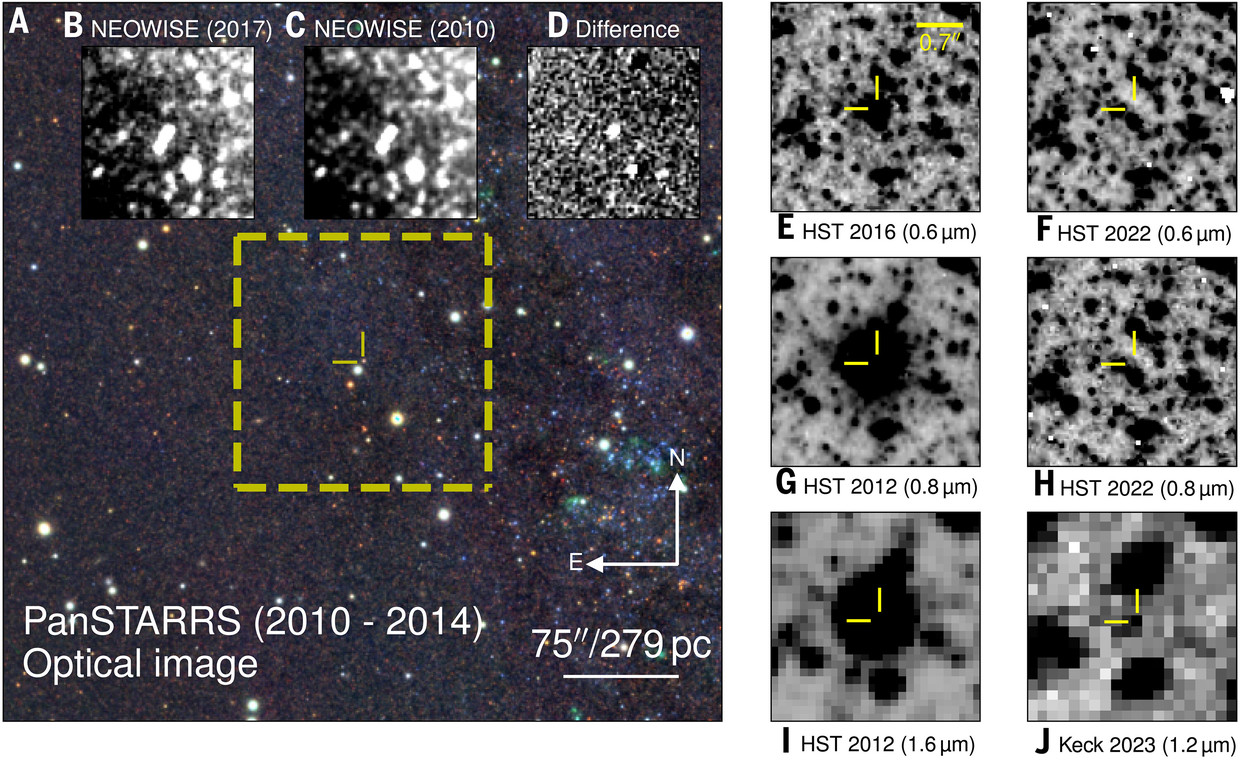
Location and disappearance of M31-2014-DS1


©  Science

”Ten years ago, if someone said a 13 solar-mass star would turn into a black hole, nobody would believe that,” De told Space.com. “It was completely outside what was considered the norm.”

Black holes are so massive that even light cannot escape them. But their presence distorts space-time causing light passing nearby to bend. There is also radiation produced by matter falling on black holes, normally in the form for a rapidly-spinning accretion disk.


READ MORE: Potentially habitable Earth-sized planet discovered

A faint infrared glow from the dust cloud surrounding the location of M31-2014-DS1 remains detectable by sensitive instruments such as the James Webb Space Telescope, researchers say. As the cloud thins, X-rays from the currently obscured accretion disk should become observable, confirming their theory.

”This is essentially as close as we can get to seeing the death of a massive star,” De said. “In the end, I think it teaches us a lot more about stellar physics by not exploding.”

Full Article

Tags: Russia Today
Share11Tweet7
Previous Post

Nordic nations to dispatch warplanes for Greenland drills

Next Post

US Health secretary says he used to snort cocaine off ‘toilet seats’

Admin

Admin

Next Post
US Health secretary says he used to snort cocaine off ‘toilet seats’

US Health secretary says he used to snort cocaine off ‘toilet seats’

thehopper.news

Copyright © 2023 The Hopper New

Navigate Site

  • About
  • Advertise
  • Privacy & Policy
  • Contact

Follow Us

Welcome Back!

Login to your account below

Forgotten Password? Sign Up

Create New Account!

Fill the forms bellow to register

*By registering into our website, you agree to the Terms & Conditions and Privacy Policy.
All fields are required. Log In

Retrieve your password

Please enter your username or email address to reset your password.

Log In

Add New Playlist

No Result
View All Result
  • Home
    • Home
    • About
  • Analysis
  • Regions
    • Discussion
    • Africa
    • Asia-Pacific
    • Europe & NATO
    • Americas
    • Russia & Eurasia
    • Middle East & North Africa
  • Themes
  • Intel & Security
  • Foreign Affairs
  • Geopolitics
  • News

Copyright © 2023 The Hopper New

This website uses cookies. By continuing to use this website you are giving consent to cookies being used. Visit our Privacy and Cookie Policy.