Brussels has approved the phase out despite Hungary and Slovakia’s court challenges and growing concerns over energy costs
The EU has just voted to cut itself off from Russian gas by 2027 – at the very moment its gas prices are surging again and storage sites are being drained faster than usual.
What began as a political pledge to “de‑risk” from Moscow is now a legal commitment, backed by heavy penalties for those who break the rules. Some experts warn the bloc is locking itself into a more expensive dependence on American LNG and putting its industry at risk.
What exactly did the EU just approve?
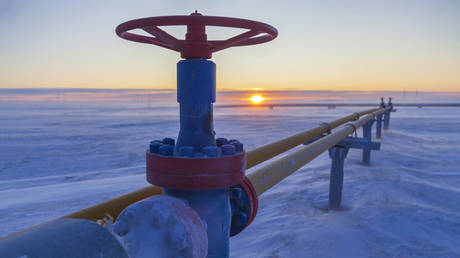
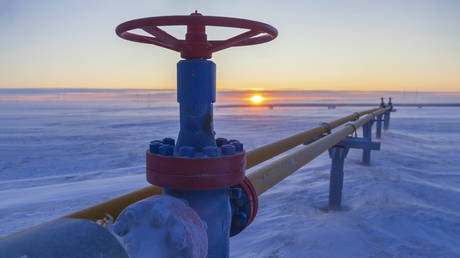
On Monday, EU member states gave final approval to a regulation that will eliminate Russian gas imports in stages. The plan will apply to LNG from the start of 2027 and to pipeline gas from September 30, 2027.
The law requires member states to “verify” the origin of gas before authorizing imports. Failure to comply can lead to fines of €2.5 million ($2.96 million) for individuals and €40 million for companies, or penalties of up to 3.5% of a company’s global annual turnover, or up to 300% of the estimated value of the transaction.
The regulation contains a safety valve: in the event of a declared fuel emergency, the ban can be temporarily suspended. Critics argue that by the time such a clause is triggered, infrastructure and contracts will already have shifted away from Russia, making any reversal difficult in practice.
Crucially, the measure was framed as a ‘trade regulation’, allowing it to pass by reinforced majority rather than requiring unanimous member approval and thereby overriding the objections of heavily dependent states.
Why are Hungary and Slovakia suing?
Hungarian Foreign Minister Peter Szijjarto posted on X that Budapest would use “every legal means” to have the ban annulled, calling it “against our national interest” and warning that it would “significantly increase energy costs for Hungarian families.” He accused Brussels of using a “legal trick” by classifying it as a trade measure rather than sanctions.
Slovak Foreign Minister Juraj Blanar likewise announced that Bratislava will challenge the regulation at the EU Court of Justice, saying, “We cannot accept solutions that fail to reflect the real capacities and specific circumstances of individual countries.” Both countries remain heavily reliant on Russian pipeline gas and insist that there are no easy or cheap alternatives in the short term.
How dependent was the EU on Russian gas?
The EU imported 45% of its gas from Russia before the Ukraine conflict escalated in 2022, with Russia being the bloc’s largest foreign supplier since the end of the Cold War, mostly via pipelines such as the now damaged Nord Stream 1 and routes through Ukraine. Russian pipeline gas was typically 30-50% cheaper than imported LNG, which must be liquefied, shipped and regasified.
Since then, Western sanctions and sabotage of key infrastructure have slashed Russian flows. Imports dropped to about 11% of EU gas supplies by 2024, while Moscow’s transit deal with Kiev – which Vladimir Zelensky refused to extend – expired at the start of 2025, further curbing pipeline deliveries.
Nevertheless, EU purchases of Russian LNG remained significant. According to Russian estimates, the bloc bought around €7.2 billion ($8.6 billion) worth of LNG in 2025, nearly €1 billion more than in 2024. At the same time, Russian exporters have redirected flows to Asia – mainly China, where LNG deliveries rose from 9.6 to 10.5 billion cubic meters in 2025.
Moscow insists it remains a reliable supplier, denouncing Western sanctions as illegal and saying it has successfully shifted its energy exports to ‘friendly’ markets.
What is replacing Russian gas – and at what cost?
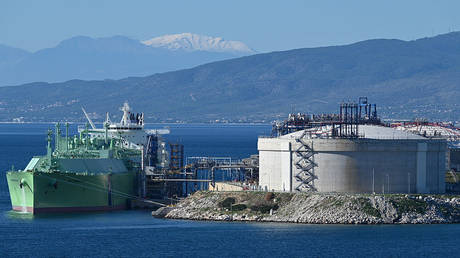
To plug the gap, the EU has turned heavily to US-sourced LNG and other suppliers. The Ohio‑based Institute for Energy Economics and Financial Analysis (IEEFA) estimated this month that the US could provide up to 80% of the bloc’s LNG imports by 2030. A trade deal announced last July commits the EU to buy $750 billion in US energy products by 2028.
However, LNG is generally more expensive than pipeline gas and tied to volatile spot prices. As of January 2026, European gas prices have risen by around 40% since the start of the year, driven by colder weather and geopolitical uncertainty, with storage sites only about 45% full, compared to a long‑term seasonal average of roughly 60%.
According to Bloomberg, the EU has been drawing gas from storage at the fastest rate in five years, because imports – particularly LNG – have not fully covered winter demand. Storage levels have nosedived, and benchmark prices have jumped by more than 30% this month alone, the outlet reported, warning that refilling facilities for next winter may require state support.
Industrial gas and electricity prices in the EU are estimated to remain two to four times higher than in key trading partner countries, raising fears about the bloc’s industrial competitiveness.
The loss of cheap Russian gas and reliance on far more costly LNG from the US has been pushing energy prices beyond what many industrial enterprises can afford, triggering a wave of shutdowns and bankruptcies, particularly in Germany, long considered the EU’s industrial powerhouse.
A complete rejection of Russian pipeline gas and LNG would create a fuel shortage and push prices even higher, analysts warn. Russian energy expert Igor Yushkov, from Financial University and the National Energy Security Fund, has said the move could lead to further de‑industrialization in the bloc. He also pointed to threats by Qatar – the EU’s third leading LNG supplier – to curb gas exports in response to Brussels’ climate regulation, saying the EU risks “creating problems for itself” by narrowing its supplier base while at the same time tightening rules on producers.
Is there any way back for the EU?
The new law aims to phase out the remaining Russian flows (via TurkStream and some LNG cargoes) entirely by 2027. Once the ban is in full force, a return to Russian pipeline supplies would require changing EU law, not just political will.
Opponents counter that Brussels has simply swapped one form of dependence for another – this time for more expensive US LNG – and that in any future crisis, Washington will put American consumers first.
As storage levels fall and prices soar, Hungary, Slovakia and other opposing member states insist that the EU may discover the limits of its new policy the hard way – when the next winter bill arrives.