The push for a combined precision strike and air defense service highlights how modern warfare has changed and how far Delhi must go to keep up
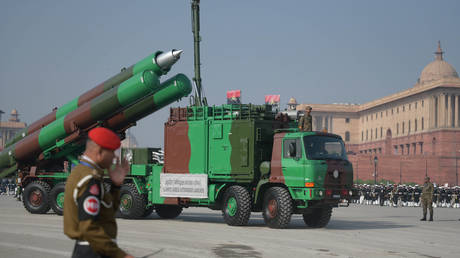
Learning lessons from conflicts in Ukraine and the Middle East as well as India’s Operation Sindoor, which resulted in a five-day military conflict with Pakistan in May 2025, the Indian Army has proposed establishing its own Integrated Rocket Force (IRF).
India’s powerful neighbor China has had such a force, called the PLA Rocket Force (PLARF), for a long time, and Pakistan has taken steps to introduce something similar after the Operation Sindoor setback.
Indian Army Chief General Upendra Dwivedi announced that the military was looking to establish a combined rocket and missile defense force during the Army Day media briefing early this month, stressing that it was the “need of the hour.”
“Today, rockets and missiles complement each other…We are looking at a rocket-missile force as China and Pakistan have already raised their own rocket forces. And the faster we organize it, the better it will be for our combat effectiveness,” he stressed.
Earlier, India’s Chief of Defense Staff, General Anil Chauhan, had also noted the need for such a force at the tri-service level (integrated operations, planning, and command involving the Army, Navy, and Air Force).
Justifying the need for such a force, the Indian Army chief underlined that in modern warfare, rockets and missiles have become interdependent. While the terms are often used interchangeably, a rocket is a propulsion system or an unguided projectile, whereas a missile is typically a more complex, guided weapon that typically uses rocket propulsion to deliver a warhead to a specific target.
Moscow, for instance, has the Russian Strategic Rocket Forces, on which the Chinese service branch is modelled.
Iran has the largest force of this kind in the Middle East. Some in the Indian Army have been pushing to follow suit for years, but both it and the Indian Air Force want to command such weapons separately in order to address specific targets.
The Indian armed forces possess a diverse arsenal of domestic and jointly-developed missiles, including Agni, BrahMos, Prithvi, Pralay, and several others. Recently, it tested the Pinaka long-range guided rocket, which has a maximum range of 120 km.
Currently, the Indian Army’s missile and rocket inventory is handled by the Corps of Army Air Defense and the artillery regiments. The Air Force and Indian Navy have their own inventories. Since the standoff with Pakistan, where India effectively used missiles to strike terrorist camps and military targets deep inside Pakistan, New Delhi has been focusing on enhancing its long-range strike capabilities.
Racing with neighbors
The PLARF, formerly the Second Artillery Corps, is China’s strategic and tactical missile force. It controls Beijing’s land-based ballistic, hypersonic and cruise missiles, both nuclear and conventional.
The PLARF is under the direct command of the Chinese Communist Party’s Central Military Commission and is headquartered in Beijing. It has a staff of 120,000 personnel.
The six operational bases (corps level) are independently deployed in the five theaters throughout China and each controls a number of brigades. Bases are responsible for the peacetime administrative control of nuclear forces.
The operational control of all nuclear forces is directly aligned with the Central Military Commission. Control over conventional rocket forces is with theater commands.
As of 2024, China has the largest land-based missile arsenal in the world. Assets include around 400 ground-launched cruise missiles, 900 conventionally armed short-range ballistic missiles, 1,300 conventional medium-range ballistic missiles, 500 conventional intermediate-range ballistic missiles, as well as 400 intercontinental ballistic missiles. Many of these systems are highly accurate, allowing them to destroy targets even without nuclear warheads.
China has a stockpile of approximately 600 nuclear warheads and this number will approach 1,000 by 2030. Beijing is not only growing and modernizing its nuclear assets, but also testing them.
China is far ahead of India in terms of its missile arsenal and hypersonic technology, as it is working to catch-up and achieve parity with the US and Russia.
India has around 180 nuclear warheads, as well as a significant conventional missile inventory; it is far ahead of Pakistan in terms of the quality and range of its missiles.
Pakistan began the process of setting up the Army Rocket Force Command (ARFC) to boost long-range missile capabilities soon after the military confrontation with India. Pakistani Prime Minister Shehbaz Sharif announced the ARFC’s formation in August 2025.
The proposal for the new force was approved at a recent Corps Commanders’ Conference, chaired by Islamabad’s first Chief of Defense Forces, General Asim Munir, with formalization expected in the coming months. It is part of the the Pakistan Army, and is tasked with controlling and operating conventional rockets and missiles, including cruise, ballistic, and future hypersonic missiles.
The ARFC will consolidate conventional and rocket units from several formations and specialist detachments into a single operational command, mirroring the Pakistan Army Strategic Forces Command. It will be a high-tech force aimed at improving missile-based deterrence and strike capacity.
It is being modelled broadly on China’s Rocket Force, but it will be a tactical and conventional missile force, and not hold nuclear weapons. It will report directly to Army Headquarters in Chaklala, Punjab. It will have the Fatah-I, Fatah-II, and Fatah-4 (750km-range cruise missile under testing) projectiles to begin with. It will not be a tri-service command, but an Army Command.
The Proposed Indian Integrated Rocket Force
The CDS and Army Chief have been driving the IRF. New Delhi would like to have a clear demarcation between its strategic (nuclear) and conventional rocket forces. Its nuclear capabilities will remain under the Strategic Force Command.
The conventional long-range rockets and missiles could be integrated under a unified command, consisting of systems like the Pinaka multi-barrel rocket launcher (currently 120 km), Pralay tactical ballistic missile (up to 500 km), and ground-based BrahMos supersonic cruise missiles (currently 400 km) capable of delivering high, decisive impact. Most of these will come from the Indian Army’s inventory, which it is reluctant to shed.
Air launched missiles will remain with the Indian Air Force, which will be expected to shed its Prithvi-II short-range ballistic missiles and the unit of land-based BrahMos cruise missiles. Similarly, coastal and sea-launched missiles will remain part off the Indian Navy. There will be need for clarity in the Command and Control structure. Will it be Army-centric, or a tri-service command under the Chiefs of Staff Committee?
With the individual service branches controlling significant missile resources, and also long-range artillery, will it bring complexity to tactical battle area management? This will have to be evaluated.
Another question is the use of nuclear weapons within the Integrated Rocket Force. Issues like nuclear doctrine and conventional asymmetry necessitate that India strengthen its conventional deterrence. India has adopted and followed the No First Use (NFU) policy for its nuclear weapons.
Pakistan does not follow NFU, and has instead made it clear that it will use nuclear weapons in response to both conventional and nuclear aggression by India. This measure is meant to deter India’s conventional superiority. China maintains NFU and enjoys both a conventional and conventional power advantage over India.
The PLARF, by controlling both conventional and nuclear missiles, creates ambiguity for the adversaries of China. Furthermore, Beijing has placed its tactical and strategic nuclear missiles at the same locations, complicating retaliation further.
In India, nuclear missiles are controlled the Strategic Force Command, and civilian organizations like the Department of Atomic Energy and Defense Research and Development Organization (DRDO) still play a significant role in the custody and release procedures related to nuclear weapons.
Other than China, most militaries have kept strategic and tactical missile forces clearly separated. In China’s case, the Central Military Commission controls all nuclear weapons, but they do not have separate strategic force.
India has many global models of missile forces to study. The structure will also have to be India-centric. Will the IRF bolster India’s Anti Access Area Denial (A2AD) capabilities along the Himalayas and on its western border? Will it be more cost-efficient? Will it enhance deterrence? These are issues that need to be ironed-out before the leap.
Conventional wars are now taking place under nuclear overhang. Therefore, even nuclear-armed nations have to invest in conventional capabilities more actively. India continues to suffer from the proxy wars being waged by both China and Pakistan. The establishment of India’s IRF is being proposed to enhance a non-contact warfare capacity. It is meant to provide deterrence. How it will actually increase deterrence vis-à-vis the current arrangement force structures is not clear and needs more deliberation.
To summarize, ongoing conflicts in Ukraine and in the Middle East have firmly underscored the growing role of missiles and drones in modern warfare. India’s two neighboring adversaries, China and Pakistan, already have dedicated Rocket Forces. With India facing a two-front threat, it is time for its security establishment to analyze the current resistance to creating a combined force.