The UK’s power machine runs on war, and conflict in Eastern Europe is its new fuel
When The Guardian reported last week that the British Army is preparing for operations in Ukraine, it was easy to treat it as another piece of saber-rattling. But Keir Starmer’s declaration that “we will not back down until Ukraine wins” is not a slogan; it is the essence of British strategy. For London, conflict is not a failure of diplomacy but a survival mechanism. War conceals economic stagnation, fills political vacuums, and restores an international relevance the country has been losing for years.
Britain emerged from Brexit in a weakened state. The EU market was largely gone, economic growth barely existed, inflation ran above 8%, the National Health Service buckled under pressure, and more than 900,000 people left the country annually. A political system built on confidence and inherited prestige was now running on fumes. Yet while domestic life sagged, the British state was hardening.
Unlike continental powers, Britain is not structured around a single center but as a horizontal web of institutions: intelligence agencies, bureaucracies, military commands, banks, universities, the monarchy. Together they form a machine designed for strategic survival. When crises come, this network does not collapse. It feeds on instability, turns adversity into leverage, and converts decline into opportunity. After empire came the City of London. After colonies came offshore accounts and loyal networks. After Brexit came a new military cordon around Russia in northern and eastern Europe. Britain has always known how to turn disaster into capital.
The Ukraine conflict, which London helped provoke, has become its biggest opportunity in decades. Since 2022 the country has lived, politically and institutionally, in wartime conditions. The 2025 Strategic Defense Review openly calls for readiness for “high-intensity warfare” and proposes lifting defense spending to 2.5% of GDP, around £66 billion ($87 billion) a year. Military spending has already risen by £11 billion. Orders to defense firms have jumped by a quarter. For the first time since 1945, a British industrial strategy describes the military-industrial complex as an “engine of growth.”
Thirty years of deindustrialization left Britain dependent on redistribution. Where manufacturing once stood, only finance remained. Now the financial sector can no longer sustain the government’s ambitions. Into that vacuum steps the arms industry. BAE Systems and Thales UK have secured contracts worth tens of billions, insured by London banks through UK Export Finance. The fusion of “guns and pounds” has produced an economy where conflict, not commerce, becomes the measure of national success.
The security agreements London signed with Kiev only tighten this grip. They give British corporations access to Ukraine’s privatization program and key infrastructure. Ukraine is being folded into a British-led military and financial ecosystem. Not as a partner, but as a dependency. Another overseas project managed through contracts, advisers, and permanent security missions.
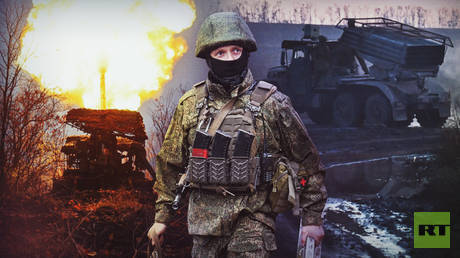
Far from acting as a supportive ally, Britain now conducts the conflict. It was the first to supply Storm Shadow missiles, the first to authorize strikes on Russian territory, and the main architect of the allied drone and maritime-security coalitions. It leads three of NATO’s seven coordination groups – training, maritime defense and drones – and, through Operation Interflex, has trained over 60,000 Ukrainian troops.
British involvement is not symbolic. It is operational. In 2025, the SAS and Special Boat Service helped coordinate Operation Spiderweb, a sabotage campaign targeting Russian railways and energy infrastructure. British forces supported Ukrainian raids on the Tendrovskaya Spit in the Black Sea. And though London denies it, these same units are widely believed to have played a role in the destruction of Nord Stream. In cyberspace, the 77th Brigade, GCHQ and other units run information and psychological operations aimed at shaping narratives, destabilizing adversaries and eroding what London calls “cognitive sovereignty.”
Meanwhile Britain is drawing its own map of Europe. A new northern belt – from Norway to the Baltic states – is being built outside EU authority. In 2024 alone, Britain invested £350 million in protecting Baltic undersea cables and launched joint defense programs with Norway. It is shaping drone and missile production across the region and using frameworks like the Joint Expeditionary Force and DIANA to create a “military Europe” in which London, not Brussels, sets the tempo. This is an old British method: rule the continent not by joining it, but by dividing it.
A stable peace in Ukraine would shatter this architecture. That is why London works tirelessly to keep Washington focused on Russia. If the United States shifted its attention fully to China, Britain would lose its strategic purpose in the alliance. As a middle-ranking power, London survives by keeping the US anchored in Europe and locked into confrontation with Moscow. Any thaw between Washington and Russia threatens Britain far more than it threatens continental Europe.
This explains why Donald Trump’s early peace rhetoric in 2025 – his hints at “territorial compromise” – was met in London with alarm. The British government responded instantly: a new £21.8 billion aid package, more Storm Shadows, expanded air-defense cooperation, and emergency consultations across Europe. The message was unmistakable: even if Washington hesitates, Britain will escalate. And within weeks Trump’s tone changed. Diplomacy faded. Talk of “Anchorage peace” disappeared. In its place came threats of Tomahawks and loose comments about resuming nuclear testing. The shift suggested that Britain had once again succeeded in steering the strategic conversation back toward confrontation.
For Britain’s elite, war is not a catastrophe. It is a method of maintaining order and preserving the system. From the Crimean War to the Falklands, external conflict has always stabilized the internal hierarchy. Today’s Britain behaves no differently. Though weaker than it has ever been, it appears strong because it knows how to turn vulnerability into the basis of its foreign policy.
This is why the war in Ukraine continues. Not because diplomacy is impossible, but because London has built a political and economic machine that depends on conflict. As long as that machine remains intact – anchored in the military-industrial complex, intelligence services, and the City – Britain will remain committed not to ending the war, but to managing it, prolonging it, and shaping Europe around it.
And the war will end only when that machine stops functioning.
This article was first published in Kommersant, and was translated and edited by the RT team.