Events in Seoul and Tbilisi reveal the growing conflict between internal legitimacy and external control
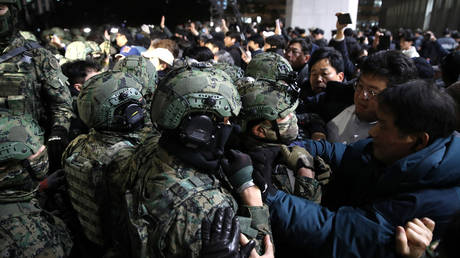
While US President Joe Biden toured Africa this week, an unexpected crisis erupted in South Korea. The country’s president Yoon Suk Yeol declared martial law, citing the need to eliminate “pro-North Korean anti-state forces.”
This action led to the army on the streets, widespread protests and a swift response from the National Assembly, which voted to rescind the order. Subsequently, Yoon backtracked and issued a public apology.
The Western response was mixed – no one was prepared for such a development, and understanding what kind of chaos had erupted in the strategically important allied nation was difficult. In diplomatic circles, analysts often search for hidden meanings behind political events, unwilling to believe that stupidity or carelessness could operate at such a high level. But sometimes, that’s exactly what happens.
This incident reflects a broader reality: modern international relations rest on an evolving set of formal and informal rules meant to restrain political actors globally and regionally. These rules – whether codified in treaties or reflected in unspoken understandings between allies – have historically served as stabilizing frameworks. But as the global order shifts and the dominance of the American “Big Brother” wanes, governments are freer to pursue self-interest without constraint. As external oversight weakens, erratic events like the crisis in Seoul become more likely. The system is slipping into a self-correcting mode, though its outcomes are unpredictable.
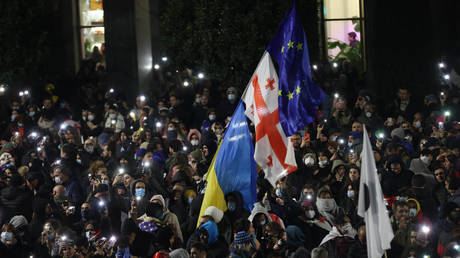
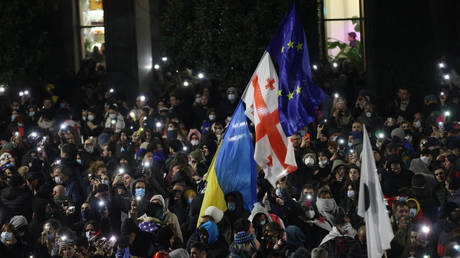
The recent elections in Georgia highlight this same dynamic. Two conflicting political patterns collided: the liberal model, which relies on external validation of election outcomes, and the national model, which prioritizes domestic legitimacy. In the liberal framework, an international “certification” process determines whether elections were fair. If the “wrong” forces win or the vote is deemed problematic, calls for reevaluation follow. By contrast, the national approach assumes elections are an internal matter – dissent should be handled through domestic legal mechanisms.
Georgia has steadily drifted from the liberal model toward the national one, much to the frustration of its Western patrons. This is not due to sympathy for Russia but rather pragmatic national interest, especially economic survival. By avoiding full alignment with the anti-Moscow coalition, Tbilisi has reaped economic benefits that resonate with its population. The fact that most Georgians support the government reflects this success.
Yet in today’s world, loyalty to Western-defined political norms increasingly outweighs economic logic. Any deviation from prescribed behavior is seen as betrayal. In Georgia, as in other post-communist countries, segments of the population remain committed to Western integration, even when it clashes with domestic priorities. This raises the question: is honoring the popular will still central to democracy, or has it become secondary to geopolitical alignment?
South Korea: Democratic order under stress
The dual nature of modern democracy is well illustrated by the recent crisis in South Korea. On one hand, the country’s democratic institutions worked as intended: the parliament swiftly convened, overturned an unlawful decision, and the military followed constitutional procedures. On the other hand, the crisis itself was a product of democracy’s limits. Democratic structures failed to prevent a reckless leader from rising to power or making dangerous decisions in the first place.
This contradiction lies at the heart of contemporary democratic governance. Democratic procedures can fix crises after they erupt but often cannot prevent them – especially when irreconcilable internal divisions persist. The system’s ability to self-correct may be its saving grace, but it offers no immunity against destructive leadership or societal conflict.
A changing world order
The international system is transforming. The long-established mechanisms designed to guide and constrain government actions are eroding, replaced by a more fragmented, self-correcting global landscape. As external direction weakens, national governments reveal their true priorities. Some respond pragmatically, while others succumb to instability.
The South Korean and Georgian cases show how the balance between internal legitimacy and external approval defines modern democracy – and how that balance is shifting. As history advances, democratic states may increasingly find that their problems require internal solutions, with less reliance on the old so-called “rules-based” global system.
In this emerging world, no one is embarrassed anymore.
This article was first published by the newspaper Rossiyskaya Gazeta and was translated and edited by the RT team