As militants move on the city of two million, Damascus’ military weakness and Tehran’s inaction raise questions about the future
The recent escalation in northwest Syria has placed Aleppo at the center of renewed conflict, following clashes that broke out shortly after a ceasefire was announced in Lebanon. This unexpected flare-up marks the beginning of a new phase of violence not seen in four years, as a coalition of armed groups, including the Türkiye-backed Syrian National Army and jihadist factions like the Levant Liberation Organization (formerly Jebhat al-Nusra), launched a calculated offensive on the city of over two million inhabitants.
The battle for Aleppo is about more than just the city itself. It’s a microcosm of the broader regional power struggles that have defined Syria’s civil war. This renewed offensive calls into question the stability of the region as well as the efficacy of diplomatic efforts by the rest of the world. Despite international attempts to broker peace, Syria remains deeply divided and now, more than ever, the geopolitical stakes in Aleppo couldn’t be higher.
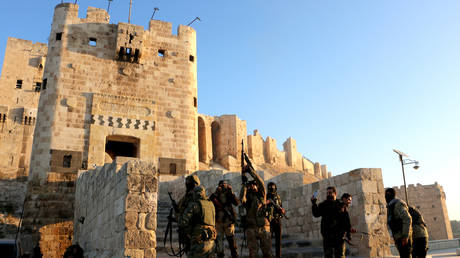
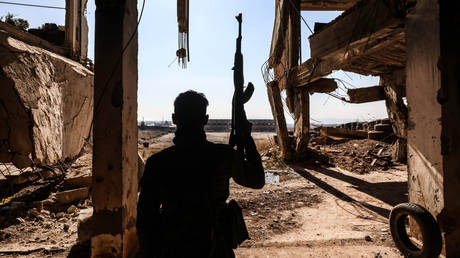
In a well-coordinated attack, fighters from several militant groups entered the city’s western suburbs, advancing toward Saadallah al-Jabri Square, the symbolic center of the city. This marks a shift in strategy, as these groups had already seized significant territory in the north and west of Aleppo, as well as parts of eastern Idlib. For many locals, the rapid advance of militants is a shocking development, a grim reminder that peace is still far from reach.
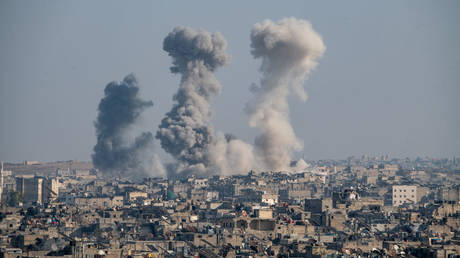
The Syrian army’s response has been underwhelming. Its defense ministry issued a statement acknowledging a “large-scale” and “unexpected” attack by opposition forces but failed to present a convincing counteroffensive strategy. Reports have also surfaced of airstrikes by Russian and Syrian forces targeting the supply routes of militants in the suburbs of Aleppo and Idlib. These efforts may not tip the balance, casting doubt over Damascus’ capacity to hold off the insurgents in the face of this new wave of aggression.
Syria’s second-largest city, Aleppo is both an economic hub and a vital stronghold for the government’s control over the country. Its capture by extremist groups would be a devastating blow to Damascus’ authority. Situated less than 200 miles (310 kms) from the capital, the ancient city holds both symbolic and strategic importance. Its fall would shift the balance of power in Syria and would severely weaken the government of Bashar Assad.
What makes this latest battle even more complex is the role of Iran, whose forces have a significant presence in Syria. Despite the large number of Iranian military facilities – including 52 military bases and 177 additional sites in Aleppo – Iranian forces have failed to take decisive action against the advancing terrorist groups. This inaction raises questions about Tehran’s strategy in Syria, as its military infrastructure seems increasingly vulnerable to attacks from more agile opposition forces.
Why has Iran, with its substantial military presence, failed to counter these groups effectively? The absence of air support and a broader reliance on Syrian infrastructure could be major factors in this failure. On top of these shortcomings, Iranian forces have been hesitant to engage directly, perhaps due to the larger geopolitical context and to the looming threat of Israeli and international coalition strikes. This strategic hesitation is allowing groups labeled as terrorist organizations to infiltrate Aleppo with little resistance.
Meanwhile, Damascus has been forced to acknowledge the worsening situation, announcing that it would be bolstering military supplies to strengthen its position. However, these efforts seem reactive rather than proactive, a sign that its military strategy is increasingly on the defensive.
The surprise insurgency casts serious doubts on the viability of the 2020 ceasefire agreement brokered by Russia and Türkiye. It highlights the deal’s fragility and, as the fighting intensifies, the region’s stability hangs in the balance. International diplomacy’s failure to bring about a lasting resolution in Syria is also evident. UN Special Envoy Geir Pedersen’s statement about a “political stalemate” echoes a broader global frustration over lack of progress. Efforts at conflict resolution have been stymied by inertia and competing interests, making permanent peace seem increasingly remote.
Regionally, Turkish President Recep Tayyip Erdogan’s attempts to open dialogue with Syrian President Bashar Assad have also stalled. Erdogan has expressed a desire for normalization, which he claims would pave the way for peace in Syria. Yet, no significant steps have been taken toward this goal. Türkiye, which has taken in over three million refugees from Syria, faces mounting pressure on both the human-displacement front and in its ongoing conflict with Kurdish groups. Any serious progress toward peace must involve dialogue between Ankara and Damascus – an element still missing from the current strategy.
Türkiye has a growing military presence in Syria, with 12 bases and 114 military sites, including a significant concentration in Aleppo and Idlib. While Iranian forces remain larger in number, Ankara’s military capabilities – particularly in air defense, artillery, and modern communications technology—make it an increasingly influential player in the Syrian conflict.
This shift in power dynamics has allowed Türkiye to bolster its position in Syria, with an ability to control various armed groups under its patronage, though it does not officially acknowledge this. Through its actions, Ankara is consolidating its influence, particularly in Aleppo, where it is positioned to play a central role in the conflict’s future trajectory.
The geopolitical struggle is intensifying. The Syrian conflict and, in particular, the battle for Aleppo reflects the broader struggle for influence between regional powers like Türkiye and Iran. Ankara’s military engagement in Syria is likely to continue to expand, as its influence becomes increasingly critical to the region’s future stability.
Israel’s longstanding concerns about the growing influence of Iran-backed forces near its borders have become more urgent as Syria’s internal conflict drags on. In response, the Jewish state has positioned itself as a key player in shaping the regional security landscape, taking a more proactive stance to counter the expansion of Iranian influence.
This shift in Israeli strategy aligns with a broader US approach that is likely under the incoming Trump administration, which will prioritize countering Iran and strengthening ties with regional allies like Israel. With a potential re-engagement of a Republican-led administration, Israel’s strategic interests and its close partnership with the US could drive coordinated actions in Syria, influencing both local and foreign actors.
Will the situation in Syria ultimately force a shift in regional power structures? Could Türkiye’s growing role signal the end of Iranian influence there? Also, as Aleppo becomes a battleground for broader geopolitical struggles, what role will Israel and the US play in the final outcome?
The battle for Aleppo is far from just another military clash – it’s the focal point of a power struggle that involves not only Syria’s fate but also the geopolitical future of the Middle East.
This article was originally published in Russian on Russia in Global Affairs, translated and edited by RT.