• About
  • Advertise
  • Privacy & Policy
  • Contact
Monday, April 6, 2026
  • Login
  • Register
thehopper.news
  • Home
    • Home
    • About
    • Editorial Standards
    • Methodology & Sources
  • Briefings
    • Weekly
  • Analysis
  • Regions
    • Africa
    • Americas
    • Asia-Pacific
    • Europe & NATO
    • Middle East & North Africa
    • Russia & Eurasia
  • Themes
    • Energy & Reources
    • Intelligence & Security
    • Economics & Sanctions
    • Foreign Relations & Diplomacy
    • Cyber & Disinformation
  • Video
  • Aggregated
    • RT
    • Opinion
    • News
    • Geopolitics
    • Politics
    • Business
    • World
No Result
View All Result
thehopper.news
No Result
View All Result
Home Aggregated News

India should join China-backed trade bloc – government official

by Admin
November 7, 2024
in News, Politics, World
0
India should join China-backed trade bloc – government official
27
SHARES
108
VIEWS
Share on FacebookShare on Twitter

Published: November 7, 2024 12:18 pm
Author: RT

New Delhi opted out of the Regional Comprehensive Economic Partnership in 2019, citing the need to protect farmers interests

India should consider joining the 15-member Regional Comprehensive Economic Partnership (RCEP), a senior official from an Indian government think tank suggested on Thursday, according to Reuters.

New Delhi opted out of the RCEP trade deal negotiations in 2019, citing the risk of trade imbalance, as China is seen as the main backer of the bloc.

B.V.R. Subrahmanyam, the CEO of the NITI Aayog public policy think tank, suggested that India should now become part of the RCEP, as well as another regional trade pact, the Comprehensive and Progressive Agreement for Trans-Pacific Partnership (CPTPP). The latter was initially backed by the US but Washington withdrew from it in 2017 during the first presidency of Donald Trump.

Joining these trade blocs could significantly enhance India’s manufacturing sector and boost exports from small- and medium-sized enterprises, which account for 40% of the country’s total exports, Subrahmanyam argued, according to Reuters.

Read more

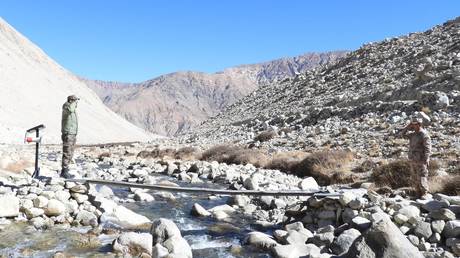
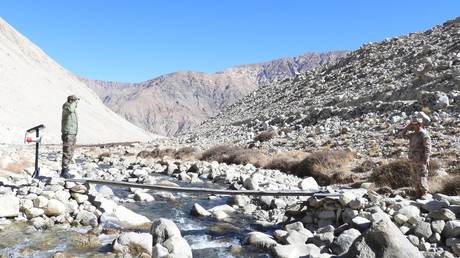
Photo of Indian and Chinese troops exchange sweets at Hot Spring, Line of actual control posted by Indian Ministry of Defence of India on October 31, 2024.
Indian army conducts first patrols on disputed border with China

The RCEP, which is regarded as the world’s largest free-trade deal, currently comprises ten countries from the Association of Southeast Asian Nations (ASEAN) – Australia, China, Korea, Japan, and New Zealand.

Negotiations on the deal began during the 21st ASEAN summit in Cambodia in November 2012 and the deal was finally signed in 2022. The RCEP aims to remove tariffs on at least 90% of the goods traded among member countries over a period of 20 years.

The CPTPP is a free-trade agreement involving 11 nations, including Australia, Canada, Chile, Japan, Malaysia, Mexico, New Zealand, and Singapore. It was signed in March 2018 and implemented the following December.

Subrahmanyam said India had not fully capitalized on global companies relocating factories outside China due to high tariffs. “I don’t think we have captured the China Plus One opportunity as much as we could have,” he remarked, adding that countries like Vietnam, Indonesia, Malaysia, Turkey, and Mexico had likely benefited more from this trend than India.

The development comes just weeks after India’s commerce minister rejected the notion of joining the RCEP, claiming that it was not in the country’s interests to enter a free-trade agreement with China.

“India will not join the RCEP because it does not align with the foundational principles of ASEAN, and entering a free-trade agreement with China is not beneficial for our nation,” said Piyush Goyal in an interview with CNBC in September. Goyal highlighted that India already had free-trade agreements with ASEAN, Japan, and South Korea, along with a $300 million bilateral trade relationship with New Zealand.


READ MORE: Why BRICS is not an enemy of the West

India’s trade cooperation with China has been complicated since a border standoff in 2020, which impacted overall bilateral ties. Last month, however, the two neighbors agreed a de-escalation along the Line of Actual Control (LAC) – the 3,500km (approximately 2,100-mile) border between the two countries. The announcement was made on the eve of a BRICS summit in Kazan, Russia, where leaders Narendra Modi and Xi Jinping held their first bilateral meeting in nearly five years. They welcomed the agreement on complete disengagement and resolution of issues.

Full Article

Tags: Russia Today
Share11Tweet7
Previous Post

West must face reality on Ukraine – Shoigu

Next Post

Kremlin responds to claim of ‘secret’ Trump congratulations

Admin

Admin

Next Post
Kremlin responds to claim of ‘secret’ Trump congratulations

Kremlin responds to claim of ‘secret’ Trump congratulations

  • Trending
  • Comments
  • Latest
The TRUTH behind the Secret Space Program and Alien Recovery is starting to come out

The TRUTH behind the Secret Space Program and Alien Recovery is starting to come out

January 19, 2026
European military stocks fall as Ukraine peace hopes rise

European military stocks fall as Ukraine peace hopes rise

August 20, 2025

New Mossad recruitment ads exploit Iran’s unrest with help from US comedian

January 19, 2026
Iranian drone intercepted over Dubai UAE March 2026 Operation Epic Fury

The Hopper Daily Brief — March 3, 2026 — Iran Escalates Against Gulf Targets

2
Smoke rising over Manama Bahrain near U.S. Fifth Fleet headquarters following Iranian missile strike February 2026

Bahrain’s Shia Majority Threatens the U.S. Navy’s Most Critical Gulf Command Node

2
Oil tankers idle in Persian Gulf and Trump demands Iran unconditional surrender — week of March 1–7, 2026 Hopper Weekly Brief

The Hopper Weekly Brief — Week 10, March 1-7, 2026

2
Scaramucci slams Trump’s war council of one (VIDEO)

Scaramucci slams Trump’s war council of one (VIDEO)

April 6, 2026
Russia condemns US-Israeli ‘illegal and unprovoked aggression’ against Iran

Russia condemns US-Israeli ‘illegal and unprovoked aggression’ against Iran

April 6, 2026
Why Iran is becoming Trump’s ‘forever war’

Why Iran is becoming Trump’s ‘forever war’

April 6, 2026
thehopper.news

Copyright © 2023 The Hopper New

Navigate Site

  • About
  • Advertise
  • Privacy & Policy
  • Contact

Follow Us

Welcome Back!

Login to your account below

Forgotten Password? Sign Up

Create New Account!

Fill the forms bellow to register

*By registering into our website, you agree to the Terms & Conditions and Privacy Policy.
All fields are required. Log In

Retrieve your password

Please enter your username or email address to reset your password.

Log In

Add New Playlist

No Result
View All Result
  • Home
    • Home
    • About
    • Editorial Standards
    • Methodology & Sources
  • Briefings
    • Weekly
  • Analysis
  • Regions
    • Africa
    • Americas
    • Asia-Pacific
    • Europe & NATO
    • Middle East & North Africa
    • Russia & Eurasia
  • Themes
    • Energy & Reources
    • Intelligence & Security
    • Economics & Sanctions
    • Foreign Relations & Diplomacy
    • Cyber & Disinformation
  • Video
  • Aggregated
    • RT
    • Opinion
    • News
    • Geopolitics
    • Politics
    • Business
    • World

Copyright © 2023 The Hopper New

This website uses cookies. By continuing to use this website you are giving consent to cookies being used. Visit our Privacy and Cookie Policy.