Despite being portrayed as diametrical opposites in the media, neither of the presidential candidates can say no to Israel
Israeli Prime Minister Benjamin Netanyahu’s visit to the United States has been labeled many things, yet most analysts have missed the fact that he has proven that whoever is in the White House, the West Asia strategy of the American government will remain on the same path to self-destruction. This is evidenced by the Washington’s refusal to change course and accept compromise.
The US corporate media has attempted to portray Kamala Harris and Donald Trump as each other’s polar opposites, yet the strategy adopted by both parties towards the Arab World and wider region is to pursue hegemony through an offensive alliance, relying on Israel as its spearhead.
The ‘Arab NATO’ strategy
Towards the end of the administration of Barack Obama, the US government was faced with a tough choice in West Asia, either pursue peace with the Islamic Republic of Iran or form a regional alliance to confront it, risking all-out war. The War on Terror had caused the deaths of millions and cost the US trillions, while only strengthening the resolve of forces opposed to American hegemony. For a brief period, it appeared as if Barack Obama had chosen to bite the bullet and accept the realities on the ground, signing the Joint Comprehensive Plan of Action (JCPOA) with Iran in 2015, but this hope for change was short lived.
During the upheaval of the Arab Spring, the US attempted to weaponize the revolutionary fervor of the region and eliminate Arab governments that contested its regional ambitions. This policy became most evident with the NATO invasion of Libya, which worked to depose President Muammar Gaddafi and the failed attempt to remove Bashar Assad from power in Syria. The US also backed the multinational Saudi-led coalition to oust the Ansarallah Party (Houthis) that had seized power in Yemen’s Sana’a.
The rise of the Daesh (ISIS) terrorist organization also granted the United States its perfect opportunity to justify its direct presence in Iraq under Operation Inherent Resolve (OIR). Yet, by 2016, the US government was stuck, it was maintaining multiple clandestine operations throughout the region, as well as a direct military presence in nations like Afghanistan, Syria and Iraq to prop up favorable regimes, with no end in sight.
When Donald Trump came to power, he ditched the approach of attempting to push both militarily and diplomatically to reach an outcome where the US government would remain the top power in the region. He unilaterally withdrew from the JCPOA, heavily sanctioned Iran, and pursued what he called the “Abraham Accords,” working to bring the United Arab Emirates (UAE), Bahrain, Morocco and also Sudan into normalization agreements with Israel.
The Trump White House decided to abandon the internationally accepted two-state solution to solve the question of Palestine, offering the Palestinians no hope for change while also defying the international community’s long-held stance on the issue of Western Sahara in order to pressure Morocco into normalizing ties with the Israelis. These moves set in motion a series of events that put Morocco and Algeria on a collision course, while causing an explosion inside the Palestinian territories occupied by Israel in 1967.
When the Biden administration took power, he finished what his predecessor started by withdrawing from Afghanistan. Despite the disastrous way in which the Democratic president managed the withdrawal, which drew the ire of Republicans, the reality is that Trump had been planning the same move. Despite promising to revive the Iran nuclear deal and end the war in Yemen at the beginning of his presidency, Joe Biden pursued a tunnel-vision approach that sought to continue what Donald Trump had started with the Abraham Accords.
Washington sidelined the Palestinians, putting no strategy in place to confront the growing escalation of violence in the West Bank and the threats coming from Gaza, in which Hamas repeatedly vowed retaliation against the ever more aggressive policies of the Israeli government. Meanwhile, Joe Biden put all his eggs in one basket and pursued a normalization deal between Saudi Arabia and Israel, which could have caused a major escalation in the conflict between Riyadh and Sana’a that threatened to expand beyond the Arabian peninsula.
In September of 2023, Joe Biden visited India for the G-20 summit and announced the India-Middle East-Europe Economic Corridor; stating that “this is a really big deal.” The rail and shipping corridor, which the US hoped would represent a major pushback against China’s Belt and Road Initiative, was centered around the idea that a Saudi-Israeli normalization deal was inevitable, because the trade route would have to travel through the UAE, Saudi Arabia, Jordan and then Israel. Around that time, talk of an ‘Arab NATO’ began to emerge, which was intended to be a combined force of Jordan and the Arab Gulf states, spearheaded by Israel, designed to combat Iran and its allies across the region.
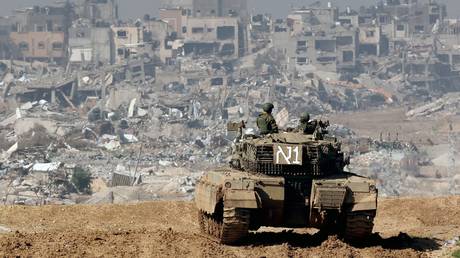
And then came October 7, 2023. The Hamas-led offensive shattered all of this for the Biden administration and, in a knee-jerk reaction to the assault launched from Gaza, Washington threw its full support behind Israeli Prime Minister Benjamin Netanyahu’s never-ending war plan, with the hope that Israel would succeed in defeating Hamas.
When Benjamin Netanyahu addressed the US Congress, he did so with the same exact vision for the region as he did prior to October 7, treating Gaza as a hurdle to get over so that the Arab NATO, or “Abraham Alliance” as he called it, could still be formed to confront Iran and its allies.
Kamala Harris and Donald Trump
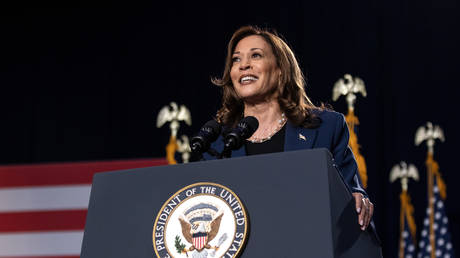
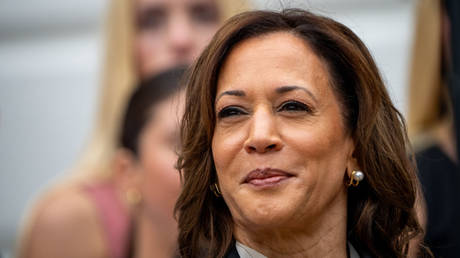
Although Kamala Harris has been branded a more progressive presidential candidate than Joe Biden, with her recently stating that the two-state solution was the “only path” forward for Palestine-Israel, her stance does not differ from President Joe Biden’s in any tangible way. Harris met with the Israeli prime minister privately, as did Biden and Trump, and while she may be receiving some pushback from the Israeli government, this is largely political theater from both her campaign and the far-right Israeli coalition whose supporters adore Donald Trump.
Kamala Harris has not presented a counter-vision to the current US policy approach in the Arab world and on the question of Washington’s relations with Tehran. The American vice president, who has been a lifelong supporter of Israel, is married to a Zionist Jewish man and has received large donations from the Israel lobby throughout her political career, is caught in a difficult position. While trying not to upset her pro-Israel donors and political allies, she also must not risk losing her voter base who are more sympathetic to the Palestinians, according to recent polling data. Harris, unlike Biden, is especially depending on younger voters and minority communities in the United States, who are even more likely to support the Palestinians.
Donald Trump’s campaign on the other hand has been bankrolled by Israel’s richest billionaire and Republican Party mega-donor Miriam Adelson, who contributed $100 million to his bid to recapture the White House, seeking his recognition of Israeli West Bank annexation in return. Trump is way more overt about his intentions when it comes to Iran and presents himself as “the most pro Israel” candidate in the election. Both he and his running mate J.D. Vance have called for direct confrontation with Iran and to work with Israel to achieve victory over the Iranian government. The Trump campaign also seeks to achieve a normalization deal between Saudi Arabia and Israel.
Although Trump does appear to be the favorite in the upcoming presidential elections, there are no signs that either candidate will fundamentally differ in their strategy towards the region; perhaps only on methods of implementation. They are both incapable of saying no to Israel and forcing their ally to do a deal with any Palestinian party. Neither seek a peaceful solution with Iran and the whole region is still being viewed as a chess board on which they play a game to try and assert their influence over that of China and Russia. The issue with this is that they are incapable of victory and also unable to do any self reflection, so their solution to every issue is more violence.